10-K
FYfalse0001130464http://www.blackhillscorp.com/20251231#FuelPurchasedPowerAndCostOfGasSoldhttp://www.blackhillscorp.com/20251231#FuelPurchasedPowerAndCostOfGasSoldhttp://www.blackhillscorp.com/20251231#FuelPurchasedPowerAndCostOfGasSoldhttp://www.blackhillscorp.com/20251231#FuelPurchasedPowerAndCostOfGasSoldhttp://www.blackhillscorp.com/20251231#FuelPurchasedPowerAndCostOfGasSoldhttp://www.blackhillscorp.com/20251231#FuelPurchasedPowerAndCostOfGasSoldhttp://fasb.org/us-gaap/2025#DerivativeLiabilitiesCurrenthttp://fasb.org/us-gaap/2025#DerivativeLiabilitiesCurrenthttp://xbrl.sec.gov/stpr/2025#CO2022 2023 2024http://fasb.org/srt/2025#ChiefExecutiveOfficerMember0001130464bkh:FlowThroughAccountingMember2025-12-310001130464us-gaap:IntersegmentEliminationMemberbkh:RetailElectricNaturalGasandCoalMember2025-01-012025-12-310001130464bkh:ExternalCustomersMemberus-gaap:OperatingSegmentsMemberbkh:GasUtilitiesMember2023-01-012023-12-310001130464bkh:WyomingElectricMemberbkh:ElectricUtilitiesMemberbkh:SeniorUnsecuredNotesDue2027Member2025-12-310001130464us-gaap:AdditionalPaidInCapitalMember2023-12-310001130464us-gaap:LongMemberbkh:FixedforFloatSwapsPurchasedMemberbkh:NaturalGasDistributionMember2024-12-310001130464us-gaap:NoncontrollingInterestMember2025-01-012025-12-310001130464bkh:WyomingElectricMember2025-12-310001130464bkh:PowerGenerationMember2023-01-012023-12-310001130464us-gaap:TreasuryStockCommonMember2022-12-310001130464us-gaap:TransferredOverTimeMemberus-gaap:IntersegmentEliminationMember2023-01-012023-12-310001130464stpr:NE2023-01-012023-12-310001130464srt:WeightedAverageMemberbkh:ElectricUtilitiesMemberbkh:IntegratedGenerationMember2025-12-310001130464bkh:ManufacturedGasPlantMemberbkh:BlackHillsEnergyIowaGasMember2025-12-310001130464us-gaap:TransferredAtPointInTimeMember2025-01-012025-12-310001130464bkh:ElectricUtilitiesMembersrt:MinimumMemberus-gaap:ElectricDistributionMember2024-12-310001130464bkh:BlackHillsCorporationMembersrt:MaximumMember2025-12-310001130464us-gaap:FairValueInputsLevel3Memberus-gaap:FairValueMeasurementsRecurringMember2025-12-310001130464us-gaap:TreasuryStockCommonMember2024-12-310001130464stpr:CO2024-01-012024-12-310001130464us-gaap:TransferredAtPointInTimeMemberus-gaap:OperatingSegmentsMemberbkh:GasUtilitiesMember2025-01-012025-12-310001130464bkh:BlackHillsCorporationMemberbkh:SeniorUnsecuredNotesDue2033Member2025-12-310001130464us-gaap:NondesignatedMemberus-gaap:CommodityContractMemberbkh:DerivativeLiabilitiesCurrentMember2025-12-310001130464us-gaap:PensionPlansDefinedBenefitMember2023-12-310001130464bkh:DeferredIncomeTaxAmortizationMember2025-12-310001130464us-gaap:OperatingSegmentsMemberbkh:WholesaleMemberbkh:GasUtilitiesMember2024-01-012024-12-310001130464us-gaap:IntersegmentEliminationMemberbkh:RetailElectricNaturalGasandCoalMember2023-01-012023-12-310001130464us-gaap:ReportableSegmentAggregationBeforeOtherOperatingSegmentMember2024-01-012024-12-310001130464us-gaap:OperatingSegmentsMemberbkh:WholesaleMemberbkh:GasUtilitiesMember2023-01-012023-12-310001130464us-gaap:PerformanceSharesMember2025-01-012025-12-310001130464bkh:BlackHillsCorporationMemberbkh:SeniorUnsecuredNotesDue2046Member2025-12-310001130464us-gaap:NondesignatedMember2024-01-012024-12-310001130464us-gaap:DesignatedAsHedgingInstrumentMemberus-gaap:CommodityContractMemberbkh:DerivativeLiabilitiesCurrentMember2024-12-310001130464srt:WeightedAverageMemberus-gaap:GasGatheringAndProcessingEquipmentMember2025-12-310001130464bkh:OtherMemberus-gaap:IntersegmentEliminationMember2025-01-012025-12-310001130464us-gaap:PensionPlansDefinedBenefitMemberus-gaap:FairValueMeasurementsRecurringMemberbkh:CommonCollectiveTrustEquityFundMember2024-12-310001130464srt:MaximumMember2025-01-012025-12-310001130464us-gaap:FairValueInputsLevel2Memberus-gaap:PensionPlansDefinedBenefitMemberus-gaap:FairValueMeasurementsRecurringMember2025-12-310001130464us-gaap:OperatingSegmentsMemberbkh:RetailElectricNaturalGasandCoalMemberbkh:GasUtilitiesMember2023-01-012023-12-310001130464bkh:WyomingElectricMemberbkh:ElectricUtilitiesMemberbkh:FirstMortgageBondsDue2037Member2024-12-310001130464srt:MinimumMember2025-12-310001130464us-gaap:IntersegmentEliminationMemberus-gaap:TransferredOverTimeMember2024-01-012024-12-310001130464us-gaap:ReclassificationOutOfAccumulatedOtherComprehensiveIncomeMemberus-gaap:AccumulatedGainLossNetCashFlowHedgeParentMember2024-01-012024-12-310001130464us-gaap:CorporateNonSegmentMemberbkh:SeniorUnsecuredNotesDue2031Member2025-10-020001130464bkh:TransmissionMember2023-01-012023-12-310001130464us-gaap:FairValueInputsLevel3Memberus-gaap:FairValueMeasurementsRecurringMember2024-12-310001130464us-gaap:FairValueInputsLevel1Memberus-gaap:FairValueMeasurementsRecurringMember2024-12-310001130464us-gaap:RestrictedStockMember2024-01-012024-12-310001130464us-gaap:InterestRateSwapMemberus-gaap:AccumulatedGainLossNetCashFlowHedgeParentMember2023-12-310001130464us-gaap:FairValueInputsLevel3Memberus-gaap:EquitySecuritiesMember2025-12-310001130464us-gaap:FairValueInputsLevel2Memberus-gaap:PensionPlansDefinedBenefitMemberus-gaap:FairValueMeasurementsRecurringMember2024-12-310001130464stpr:NE2025-01-012025-12-310001130464us-gaap:FairValueInputsLevel3Memberus-gaap:DefinedBenefitPostretirementHealthCoverageMemberus-gaap:FairValueMeasurementsRecurringMember2024-12-310001130464bkh:TransportationStorageGatheringAndCoalAgreementsMember2025-12-310001130464srt:MinimumMember2024-01-012024-12-310001130464bkh:BlackHillsCorporationMember2024-12-310001130464bkh:BlackHillsCorporationMemberbkh:SeniorUnsecuredNotesDue2027Member2024-12-310001130464bkh:PuebloAirportGenerationMemberus-gaap:SubsidiaryOfCommonParentMember2025-12-310001130464bkh:RetailElectricNaturalGasandCoalMember2023-01-012023-12-310001130464bkh:ElectricUtilitiesMembersrt:MinimumMemberbkh:PlantAcquisitionAdjustmentMember2024-12-310001130464us-gaap:PensionPlansDefinedBenefitMemberus-gaap:FairValueMeasurementsRecurringMember2025-12-310001130464bkh:IntegratedGenerationMemberbkh:ElectricUtilitiesMember2025-12-310001130464us-gaap:PerformanceSharesMemberbkh:PerformanceShareUnitsPerformanceConditionMember2024-12-310001130464bkh:BlackHillsCorporationMemberbkh:SeniorUnsecuredNotesDue2027Member2025-12-310001130464bkh:DeferredGasCostAdjustmentsMember2024-12-310001130464bkh:GTResourcesLLCMemberus-gaap:PendingLitigationMember2022-04-132022-04-130001130464bkh:InterestExpenseIncurredNetOfAmountsCapitalizedMember2024-01-012024-12-310001130464bkh:ElectricUtilitiesMemberus-gaap:OperatingSegmentsMemberbkh:TransmissionMember2024-01-012024-12-310001130464srt:WeightedAverageMemberus-gaap:NaturalGasStorageMember2025-12-310001130464us-gaap:PensionPlansDefinedBenefitMemberbkh:CommonCollectiveTrustFixedIncomeFundMemberus-gaap:FairValueInputsLevel1Memberus-gaap:FairValueMeasurementsRecurringMember2024-12-310001130464bkh:WyomingElectricMemberbkh:ElectricUtilitiesMemberbkh:FirstMortgageBondsDue2044Member2025-12-310001130464bkh:WholesaleMember2024-01-012024-12-310001130464bkh:RetailElectricNaturalGasandCoalMember2025-01-012025-12-310001130464bkh:OtherMemberus-gaap:OperatingSegmentsMemberbkh:GasUtilitiesMember2024-01-012024-12-310001130464bkh:ElectricUtilitiesMemberus-gaap:OperatingSegmentsMemberbkh:TransmissionMember2025-01-012025-12-310001130464bkh:ElectricUtilitiesMember2025-12-310001130464us-gaap:RemovalCostsMember2025-12-310001130464bkh:ElectricUtilitiesMemberus-gaap:OperatingSegmentsMemberbkh:RetailElectricNaturalGasandCoalMember2023-01-012023-12-310001130464us-gaap:IntersegmentEliminationMemberbkh:TransmissionMember2023-01-012023-12-310001130464bkh:KansasCorporationCommissionKCCMemberbkh:BlackHillsEnergyKansasGasMember2025-07-242025-07-240001130464us-gaap:GasTransmissionEquipmentMemberbkh:GasUtilitiesMember2024-12-310001130464bkh:ManufacturedGasPlantMemberbkh:BlackHillsEnergyIowaGasMember2024-12-310001130464bkh:BlackHillsCorporationMemberbkh:SeniorUnsecuredNotesDue2035Member2024-12-310001130464us-gaap:StateAndLocalJurisdictionMemberus-gaap:ValuationAllowanceOperatingLossCarryforwardsMember2025-01-012025-12-310001130464us-gaap:ElectricTransmissionMembersrt:WeightedAverageMemberbkh:ElectricUtilitiesMember2025-12-310001130464bkh:ContractSubjecttoMasterNettingArrangementMember2025-12-310001130464bkh:TransmissionMember2025-01-012025-12-310001130464bkh:SouthDakotaElectricMemberbkh:ElectricUtilitiesMemberbkh:FirstMortgageBondsDue2032Member2025-12-3100011304642025-01-012025-01-310001130464us-gaap:AdditionalPaidInCapitalMember2022-12-310001130464us-gaap:ElectricGenerationEquipmentMemberbkh:ElectricUtilitiesMembersrt:MinimumMember2024-12-310001130464us-gaap:CorporateNonSegmentMember2024-01-012024-12-310001130464us-gaap:EstimateOfFairValueFairValueDisclosureMember2024-12-310001130464bkh:ElectricUtilitiesMemberbkh:PlantAcquisitionAdjustmentMembersrt:MaximumMember2024-12-310001130464us-gaap:NaturalGasStorageMemberbkh:GasUtilitiesMember2025-12-310001130464us-gaap:StormCostsMember2024-12-310001130464bkh:ExternalCustomersMember2025-01-012025-12-310001130464bkh:KansasCorporationCommissionKCCMemberbkh:GSRSRiderRevenueMemberbkh:BlackHillsEnergyKansasGasMember2025-07-242025-07-240001130464bkh:OtherMember2023-01-012023-12-310001130464bkh:ElectricUtilitiesMember2023-12-310001130464bkh:DeferredEnergyAndFuelCostAdjustmentsMember2025-12-310001130464us-gaap:FairValueInputsLevel3Memberus-gaap:PensionPlansDefinedBenefitMemberus-gaap:FairValueMeasurementsRecurringMemberus-gaap:HedgeFundsMultistrategyMember2024-12-310001130464us-gaap:FairValueInputsLevel2Memberus-gaap:FairValueMeasurementsRecurringMember2025-12-310001130464us-gaap:InterestRateSwapMemberus-gaap:ReclassificationOutOfAccumulatedOtherComprehensiveIncomeMemberus-gaap:AccumulatedGainLossNetCashFlowHedgeParentMember2024-01-012024-12-310001130464us-gaap:TransferredAtPointInTimeMemberbkh:ElectricUtilitiesMemberus-gaap:OperatingSegmentsMember2025-01-012025-12-310001130464us-gaap:CommonStockMemberbkh:AugustFourTwentyTwentyAtmProgramMember2024-01-012024-12-310001130464us-gaap:OperatingSegmentsMemberbkh:RetailElectricNaturalGasandCoalMemberbkh:GasUtilitiesMember2024-01-012024-12-310001130464bkh:ElectricUtilitiesMemberus-gaap:OperatingSegmentsMemberbkh:InterSegmentRevenuesMember2024-01-012024-12-310001130464us-gaap:OperatingSegmentsMemberbkh:AlternativeRevenueAndOtherMemberbkh:GasUtilitiesMember2025-01-012025-12-310001130464us-gaap:ReportableSegmentAggregationBeforeOtherOperatingSegmentMemberbkh:InterSegmentRevenuesMember2025-01-012025-12-310001130464bkh:AllowanceForFundsUsedDuringConstructionMember2024-12-310001130464bkh:TransmissionMember2024-01-012024-12-310001130464us-gaap:DebtSecuritiesMemberus-gaap:FairValueInputsLevel2Member2025-12-310001130464us-gaap:GasDistributionEquipmentMemberbkh:GasUtilitiesMember2024-12-310001130464us-gaap:IntersegmentEliminationMemberbkh:TransmissionMember2024-01-012024-12-310001130464bkh:ElectricUtilitiesMemberus-gaap:OperatingSegmentsMemberbkh:MarketOffSystemSalesMember2023-01-012023-12-310001130464us-gaap:ElectricGenerationEquipmentMemberbkh:ElectricUtilitiesMember2025-12-310001130464us-gaap:NoncontrollingInterestMember2025-12-310001130464bkh:BlackHillsCorporationMemberbkh:SeniorUnsecuredNotesDue2031Member2024-12-310001130464bkh:EmployeeBenefitPlansAndRelatedDeferredTaxesLiabilitiesMember2024-12-310001130464us-gaap:OtherCapitalizedPropertyPlantAndEquipmentMemberbkh:ElectricUtilitiesMember2024-12-310001130464bkh:ElectricUtilitiesMemberus-gaap:OperatingSegmentsMemberbkh:WholesaleMember2024-01-012024-12-310001130464us-gaap:RevolvingCreditFacilityMemberus-gaap:CommercialPaperMember2024-12-310001130464stpr:CO2025-01-012025-12-310001130464bkh:MarketOffSystemSalesMember2023-01-012023-12-310001130464us-gaap:CommonStockMemberbkh:JuneSixteenTwentyTwentyThreeAtmProgramMember2025-01-012025-12-310001130464us-gaap:PensionPlansDefinedBenefitMemberbkh:CommonCollectiveTrustFixedIncomeFundMemberus-gaap:FairValueInputsLevel1Memberus-gaap:FairValueMeasurementsRecurringMember2025-12-310001130464us-gaap:IntersegmentEliminationMemberbkh:WholesaleMember2023-01-012023-12-310001130464bkh:CushionGasNotDepreciatedMemberbkh:GasUtilitiesMember2024-12-310001130464bkh:AllowanceForFundsUsedDuringConstructionMember2025-12-310001130464bkh:ElectricUtilitiesMemberus-gaap:OperatingSegmentsMemberbkh:MarketOffSystemSalesMember2024-01-012024-12-310001130464us-gaap:AccumulatedDefinedBenefitPlansAdjustmentMember2025-01-012025-12-310001130464srt:WeightedAverageMemberbkh:ElectricUtilitiesMemberbkh:PlantAcquisitionAdjustmentMember2025-12-310001130464bkh:BlackHillsCorporationMemberbkh:SeniorUnsecuredNotesDue2031Member2025-12-310001130464us-gaap:PensionPlansDefinedBenefitMemberus-gaap:RealEstateFundsMemberus-gaap:FairValueMeasurementsRecurringMember2024-12-310001130464bkh:GasUtilitiesMember2025-01-012025-12-310001130464us-gaap:OperatingSegmentsMemberbkh:TransportationMemberbkh:GasUtilitiesMember2024-01-012024-12-310001130464us-gaap:PensionPlansDefinedBenefitMemberus-gaap:RealEstateFundsMemberus-gaap:FairValueMeasurementsRecurringMember2025-12-310001130464srt:MaximumMember2024-01-012024-12-310001130464us-gaap:CommodityOptionMemberus-gaap:LongMemberbkh:NaturalGasDistributionMember2024-12-310001130464us-gaap:BaseRateMemberus-gaap:RevolvingCreditFacilityMember2025-12-310001130464us-gaap:CommonStockMember2024-01-012024-12-310001130464us-gaap:ElectricTransmissionMemberbkh:ElectricUtilitiesMember2025-12-310001130464us-gaap:FairValueInputsLevel2Memberus-gaap:EquitySecuritiesMember2025-12-3100011304642024-06-012024-06-300001130464bkh:ElectricUtilitiesMemberus-gaap:OperatingSegmentsMemberbkh:MarketOffSystemSalesMember2025-01-012025-12-310001130464us-gaap:DebtSecuritiesMember2025-12-310001130464bkh:EmployeeBenefitPlansAndRelatedDeferredTaxesAssetsMember2024-12-310001130464bkh:DefinedContributionPlan401KMember2025-01-012025-12-310001130464bkh:SettlementAgreementForAGeneralRateIncreaseMemberbkh:BlackHillsEnergyNebraskaGasMemberbkh:NebraskaPublcServiceCommissionNPSCMember2025-12-092025-12-090001130464bkh:PrincipalPaymentsOnLongTermDebtIncludingCurrentMaturitiesMember2025-12-310001130464bkh:ElectricUtilitiesMember2024-01-012024-12-310001130464us-gaap:DesignatedAsHedgingInstrumentMemberus-gaap:CashFlowHedgingMember2024-01-012024-12-310001130464us-gaap:IntersegmentEliminationMemberbkh:TransportationMember2023-01-012023-12-310001130464bkh:KansasCorporationCommissionKCCMemberbkh:BlackHillsEnergyKansasGasMemberbkh:RateReviewFiledwiththeRegulatoryAgencyMember2025-02-030001130464us-gaap:InterestRateSwapMemberus-gaap:AccumulatedGainLossNetCashFlowHedgeParentMember2025-01-012025-12-310001130464us-gaap:CorporateNonSegmentMemberbkh:InterSegmentRevenuesMember2023-01-012023-12-310001130464bkh:ExternalCustomersMemberbkh:ElectricUtilitiesMemberus-gaap:OperatingSegmentsMember2025-01-012025-12-310001130464us-gaap:ElectricGenerationEquipmentMembersrt:WeightedAverageMemberbkh:ElectricUtilitiesMember2025-12-310001130464bkh:OtherRegulatoryLiabilitiesMember2025-12-310001130464bkh:UtilitiesGroupMember2025-12-310001130464srt:MinimumMemberus-gaap:NaturalGasStorageMember2024-12-310001130464us-gaap:FairValueMeasurementsRecurringMemberus-gaap:EstimateOfFairValueFairValueDisclosureMember2025-12-310001130464bkh:TransmissionTieMember2025-12-310001130464bkh:ElectricUtilitiesMemberus-gaap:OperatingSegmentsMemberbkh:WholesaleMember2023-01-012023-12-310001130464us-gaap:FairValueInputsLevel2Memberus-gaap:PensionPlansDefinedBenefitMemberus-gaap:RealEstateFundsMemberus-gaap:FairValueMeasurementsRecurringMember2025-12-310001130464bkh:GasUtilitiesMember2024-12-310001130464bkh:ElectricUtilitiesMemberus-gaap:OperatingSegmentsMemberbkh:TransportationMember2024-01-012024-12-3100011304642025-10-012025-12-310001130464us-gaap:IntersegmentEliminationMemberbkh:TransportationMember2024-01-012024-12-310001130464us-gaap:DeferredFuelCostsMember2024-12-310001130464us-gaap:DefinedBenefitPostretirementHealthCoverageMemberus-gaap:FairValueInputsLevel1Memberus-gaap:FairValueMeasurementsRecurringMember2025-12-310001130464us-gaap:ReclassificationOutOfAccumulatedOtherComprehensiveIncomeMemberus-gaap:CommodityContractMemberus-gaap:AccumulatedGainLossNetCashFlowHedgeParentMember2025-01-012025-12-310001130464us-gaap:OtherCapitalizedPropertyPlantAndEquipmentMemberbkh:ElectricUtilitiesMembersrt:MaximumMember2024-12-310001130464us-gaap:CorporateNonSegmentMember2025-12-310001130464stpr:NE2024-01-012024-12-310001130464us-gaap:RetainedEarningsMember2022-12-310001130464us-gaap:PerformanceSharesMemberbkh:PerformanceShareUnitsMarketConditionMember2024-12-310001130464bkh:BlackHillsCorporationMemberbkh:SeniorUnsecuredNotesDue2030Member2025-12-310001130464bkh:BondIssuanceCostsMember2025-12-310001130464us-gaap:DefinedBenefitPostretirementHealthCoverageMemberus-gaap:FairValueInputsLevel2Memberus-gaap:CashAndCashEquivalentsMemberus-gaap:FairValueMeasurementsRecurringMember2025-12-310001130464us-gaap:DesignatedAsHedgingInstrumentMemberus-gaap:InterestRateSwapMemberus-gaap:CashFlowHedgingMember2023-01-012023-12-310001130464bkh:BlackHillsEnergyColoradoElectricMemberbkh:ColoradoPublicUtilitiesCommissionCPUCMember2025-05-062025-05-060001130464us-gaap:GasDistributionEquipmentMembersrt:MaximumMember2024-12-310001130464us-gaap:OperatingSegmentsMemberbkh:AlternativeRevenueAndOtherMemberbkh:GasUtilitiesMember2024-01-012024-12-310001130464us-gaap:VariableInterestEntityPrimaryBeneficiaryMember2024-12-310001130464bkh:IntegratedGenerationMemberbkh:ElectricUtilitiesMember2024-12-310001130464us-gaap:OtherCapitalizedPropertyPlantAndEquipmentMembersrt:WeightedAverageMember2025-12-310001130464bkh:OtherMemberus-gaap:OperatingSegmentsMemberbkh:GasUtilitiesMember2023-01-012023-12-310001130464us-gaap:FairValueInputsLevel2Memberus-gaap:PensionPlansDefinedBenefitMemberbkh:CommonCollectiveTrustMoneyMarketMemberus-gaap:FairValueMeasurementsRecurringMember2025-12-310001130464us-gaap:CommodityOptionMemberbkh:NaturalGasDistributionMember2025-12-310001130464bkh:ReturnSeekingAssetsMemberus-gaap:RealEstateMember2025-12-310001130464srt:WeightedAverageMemberbkh:ElectricUtilitiesMemberus-gaap:ElectricDistributionMember2024-12-310001130464bkh:DeferredEnergyAndFuelCostAdjustmentsMember2024-12-310001130464us-gaap:InterestRateSwapMember2025-01-012025-12-310001130464bkh:ReturnSeekingAssetsMemberus-gaap:HedgeFundsMultistrategyMember2025-12-310001130464srt:MinimumMemberus-gaap:GasTransmissionEquipmentMember2024-12-310001130464us-gaap:HedgeFundsMultistrategyMember2025-01-012025-12-310001130464us-gaap:ElectricTransmissionMemberbkh:ElectricUtilitiesMembersrt:MaximumMember2024-12-310001130464bkh:WyodakPlantMemberbkh:ElectricUtilitiesMember2025-01-012025-12-310001130464us-gaap:FairValueInputsLevel2Memberus-gaap:PensionPlansDefinedBenefitMemberbkh:CommonCollectiveTrustCashAndCashEquivalentsMemberus-gaap:FairValueMeasurementsRecurringMember2024-12-310001130464us-gaap:FairValueInputsLevel3Memberus-gaap:PensionPlansDefinedBenefitMemberus-gaap:FairValueMeasurementsRecurringMember2025-12-310001130464us-gaap:FairValueInputsLevel2Memberus-gaap:FairValueMeasurementsRecurringMember2024-12-310001130464bkh:ManufacturedGasPlantMember2025-12-310001130464us-gaap:FairValueInputsLevel3Memberus-gaap:PensionPlansDefinedBenefitMemberus-gaap:FairValueMeasurementsRecurringMember2024-12-310001130464us-gaap:CashFlowHedgingMemberbkh:NaturalGasDistributionMember2025-12-310001130464bkh:ReturnSeekingAssetsMember2024-12-310001130464us-gaap:PensionPlansDefinedBenefitMemberus-gaap:FairValueInputsLevel1Memberus-gaap:FairValueMeasurementsRecurringMemberus-gaap:HedgeFundsMultistrategyMember2025-12-310001130464us-gaap:IntersegmentEliminationMemberbkh:MarketOffSystemSalesMember2025-01-012025-12-310001130464us-gaap:AssetRecoverableGasCostsMember2024-12-310001130464us-gaap:CorporateNonSegmentMemberbkh:InterSegmentRevenuesMember2024-01-012024-12-310001130464us-gaap:CommonStockMember2025-01-012025-12-310001130464bkh:ExternalCustomersMemberus-gaap:ReportableSegmentAggregationBeforeOtherOperatingSegmentMember2024-01-012024-12-310001130464us-gaap:FairValueInputsLevel2Memberus-gaap:PensionPlansDefinedBenefitMemberbkh:CommonCollectiveTrustFixedIncomeFundMemberus-gaap:FairValueMeasurementsRecurringMember2024-12-310001130464us-gaap:OperatingSegmentsMemberbkh:MarketOffSystemSalesMemberbkh:GasUtilitiesMember2025-01-012025-12-310001130464bkh:ReturnSeekingAssetsMemberus-gaap:FixedIncomeFundsMember2024-12-310001130464bkh:BlackHillsCorporationMember2025-12-310001130464us-gaap:OtherCapitalizedPropertyPlantAndEquipmentMembersrt:WeightedAverageMemberbkh:ElectricUtilitiesMember2024-12-310001130464us-gaap:TransferredAtPointInTimeMemberus-gaap:IntersegmentEliminationMember2023-01-012023-12-310001130464us-gaap:GasGatheringAndProcessingEquipmentMemberbkh:GasUtilitiesMember2025-12-310001130464us-gaap:PensionPlansDefinedBenefitMembersrt:MinimumMemberbkh:ReturnSeekingAssetsMember2025-12-310001130464bkh:ColoradoRenewableEnergyMember2025-12-310001130464us-gaap:PensionPlansDefinedBenefitMemberus-gaap:FairValueInputsLevel1Memberus-gaap:FairValueMeasurementsRecurringMember2025-12-310001130464us-gaap:PensionPlansDefinedBenefitMemberus-gaap:FairValueMeasurementsRecurringMemberbkh:CommonCollectiveTrustEquityFundMember2025-12-310001130464bkh:ReturnSeekingAssetsMemberus-gaap:EquitySecuritiesMember2024-12-310001130464us-gaap:OtherCapitalizedPropertyPlantAndEquipmentMemberbkh:GasUtilitiesMember2024-12-310001130464us-gaap:LongMemberbkh:NaturalGasPhysicalPurchasesMemberbkh:NaturalGasDistributionMember2024-12-310001130464bkh:OtherMember2024-01-012024-12-310001130464bkh:GasUtilitiesMember2023-12-310001130464us-gaap:CommodityOptionMemberus-gaap:LongMemberbkh:NaturalGasDistributionMember2025-12-310001130464us-gaap:StormCostsMember2025-12-310001130464us-gaap:InterestRateSwapMemberus-gaap:CashFlowHedgingMember2025-01-012025-12-310001130464us-gaap:CommodityContractMemberus-gaap:AccumulatedGainLossNetCashFlowHedgeParentMember2025-12-310001130464bkh:DefinedContributionPlan401KMember2024-01-012024-12-310001130464us-gaap:IntersegmentEliminationMemberbkh:TransmissionMember2025-01-012025-12-310001130464bkh:PowerGenerationMember2025-01-012025-12-310001130464us-gaap:NoncontrollingInterestMember2023-01-012023-12-310001130464us-gaap:OperatingSegmentsMemberbkh:InterSegmentRevenuesMemberbkh:GasUtilitiesMember2023-01-012023-12-310001130464us-gaap:IntersegmentEliminationMemberbkh:AlternativeRevenueAndOtherMember2024-01-012024-12-310001130464bkh:SeniorUnsecuredNotesDue2026Memberus-gaap:CorporateNonSegmentMemberus-gaap:SubsequentEventMember2026-01-150001130464us-gaap:EstimateOfFairValueFairValueDisclosureMember2025-12-310001130464us-gaap:IntersegmentEliminationMemberbkh:MarketOffSystemSalesMember2023-01-012023-12-310001130464us-gaap:CorporateNonSegmentMemberbkh:InterSegmentRevenuesMember2025-01-012025-12-310001130464bkh:ReturnSeekingAssetsMemberus-gaap:HedgeFundsMultistrategyMember2024-12-310001130464us-gaap:OperatingSegmentsMemberus-gaap:TransferredOverTimeMemberbkh:GasUtilitiesMember2024-01-012024-12-310001130464srt:WeightedAverageMemberbkh:ElectricUtilitiesMemberbkh:IntegratedGenerationMember2024-12-310001130464stpr:AR2025-01-012025-12-310001130464us-gaap:PensionPlansDefinedBenefitMemberbkh:BlackHillsRetirementPlanMember2025-12-310001130464us-gaap:PensionPlansDefinedBenefitMemberbkh:CommonCollectiveTrustCashAndCashEquivalentsMemberus-gaap:FairValueMeasurementsRecurringMember2024-12-310001130464us-gaap:LongMemberbkh:NaturalGasPhysicalPurchasesMemberbkh:NaturalGasDistributionMember2025-12-310001130464us-gaap:NondesignatedMemberus-gaap:CommodityContractMemberbkh:DerivativeLiabilitiesCurrentMember2024-12-310001130464bkh:InterSegmentRevenuesMemberus-gaap:OperatingSegmentsMemberbkh:GasUtilitiesMember2024-01-012024-12-310001130464us-gaap:CorporateNonSegmentMember2025-10-022025-10-020001130464bkh:InterestExpenseIncurredNetOfAmountsCapitalizedMember2025-01-012025-12-310001130464us-gaap:ReclassificationOutOfAccumulatedOtherComprehensiveIncomeMemberus-gaap:AccumulatedDefinedBenefitPlansAdjustmentMember2024-01-012024-12-310001130464bkh:BondIssuanceCostsMember2024-12-310001130464bkh:ElectricUtilitiesMemberus-gaap:OperatingSegmentsMember2025-01-012025-12-310001130464bkh:SouthDakotaElectricMemberbkh:ElectricUtilitiesMemberbkh:FirstMortgageBondsDue2039Member2025-12-310001130464us-gaap:DesignatedAsHedgingInstrumentMember2024-12-310001130464us-gaap:AccumulatedDefinedBenefitPlansAdjustmentMember2024-12-3100011304642025-05-080001130464bkh:LiabilityHedgingAssetsMember2024-12-310001130464us-gaap:TreasuryStockCommonMember2023-12-310001130464bkh:MarketOffSystemSalesMember2024-01-012024-12-310001130464srt:WeightedAverageMemberus-gaap:GasGatheringAndProcessingEquipmentMember2024-12-310001130464us-gaap:ElectricTransmissionMemberbkh:ElectricUtilitiesMembersrt:MinimumMember2024-12-310001130464us-gaap:AccumulatedOtherComprehensiveIncomeMember2022-12-310001130464us-gaap:SubsequentEventMember2026-01-012026-01-310001130464us-gaap:PensionPlansDefinedBenefitMember2025-12-310001130464us-gaap:InterestRateSwapMemberus-gaap:AccumulatedGainLossNetCashFlowHedgeParentMember2024-12-310001130464us-gaap:CarryingReportedAmountFairValueDisclosureMember2024-12-310001130464us-gaap:FutureMemberbkh:NaturalGasDistributionMember2025-12-310001130464bkh:WholesaleMember2023-01-012023-12-310001130464bkh:SouthDakotaElectricMemberbkh:ElectricUtilitiesMemberbkh:FirstMortgageBondsDue2044Member2024-12-310001130464us-gaap:RevolvingCreditFacilityMember2025-01-012025-12-310001130464us-gaap:OperatingSegmentsMemberbkh:InterSegmentRevenuesMemberbkh:GasUtilitiesMember2025-01-012025-12-310001130464bkh:GTResourcesLLCMemberus-gaap:PendingLitigationMember2022-04-130001130464bkh:BlackHillsCorporationMemberbkh:SeniorUnsecuredNotesDue2026Member2024-12-310001130464bkh:InterestPaymentsOnLongTermDebtMember2025-12-310001130464bkh:ColoradoRenewableEnergyMemberbkh:ColoradoPublicUtilitiesCommissionCPUCMember2025-12-310001130464bkh:OtherMemberbkh:ElectricUtilitiesMemberus-gaap:OperatingSegmentsMember2023-01-012023-12-310001130464bkh:ElectricUtilitiesMemberus-gaap:OperatingSegmentsMemberbkh:InterSegmentRevenuesMember2023-01-012023-12-310001130464us-gaap:BasisSwapMemberbkh:NaturalGasDistributionMember2025-12-310001130464us-gaap:RestrictedStockMember2025-01-012025-12-310001130464bkh:WygenIIIGeneratingFacilityMember2025-12-310001130464us-gaap:NondesignatedMember2025-01-012025-12-310001130464us-gaap:OtherCapitalizedPropertyPlantAndEquipmentMembersrt:MinimumMember2024-12-310001130464us-gaap:AccumulatedOtherComprehensiveIncomeMember2025-12-310001130464stpr:KS2023-01-012023-12-310001130464bkh:BlackHillsCorporationMemberbkh:SeniorUnsecuredNotesDue2033Member2024-12-310001130464bkh:SouthDakotaElectricMemberbkh:ElectricUtilitiesMemberbkh:FirstMortgageBondsDue2044Member2025-12-310001130464bkh:ReturnSeekingAssetsMemberus-gaap:RealEstateMember2024-12-310001130464us-gaap:FairValueInputsLevel2Memberus-gaap:PensionPlansDefinedBenefitMemberus-gaap:FairValueMeasurementsRecurringMemberbkh:CommonCollectiveTrustEquityFundMember2025-12-310001130464us-gaap:ElectricTransmissionMemberbkh:ElectricUtilitiesMember2024-12-310001130464bkh:SouthDakotaElectricMemberbkh:ElectricUtilitiesMemberbkh:FirstMortgageBondsDue2032Member2024-12-310001130464us-gaap:BasisSwapMemberus-gaap:LongMemberbkh:NaturalGasDistributionMember2024-12-310001130464us-gaap:SupplementalEmployeeRetirementPlanDefinedBenefitMember2025-01-012025-12-310001130464us-gaap:RetainedEarningsMember2025-12-310001130464us-gaap:TransferredOverTimeMember2024-01-012024-12-310001130464us-gaap:FairValueInputsLevel3Memberus-gaap:PensionPlansDefinedBenefitMemberbkh:CommonCollectiveTrustCashAndCashEquivalentsMemberus-gaap:FairValueMeasurementsRecurringMember2024-12-310001130464bkh:WyomingElectricMemberbkh:ElectricUtilitiesMember2025-12-310001130464us-gaap:FairValueInputsLevel3Memberus-gaap:PensionPlansDefinedBenefitMemberus-gaap:RealEstateFundsMemberus-gaap:FairValueMeasurementsRecurringMember2024-12-310001130464us-gaap:RevolvingCreditFacilityMember2024-05-310001130464us-gaap:CommercialPaperMember2025-01-012025-12-310001130464bkh:BlackHillsCorporationMemberbkh:SeniorUnsecuredNotesDue2049Member2024-12-310001130464us-gaap:CommonStockMember2023-12-310001130464bkh:OtherMember2025-01-012025-12-310001130464bkh:ElectricUtilitiesMemberus-gaap:TransferredOverTimeMemberus-gaap:OperatingSegmentsMember2024-01-012024-12-310001130464bkh:WyomingElectricMemberbkh:ElectricUtilitiesMember2024-12-310001130464bkh:ElectricUtilitiesMemberbkh:InterSegmentRevenuesMemberus-gaap:OperatingSegmentsMember2025-01-012025-12-310001130464bkh:ElectricUtilitiesMemberus-gaap:OperatingSegmentsMemberbkh:AlternativeRevenueAndOtherMember2023-01-012023-12-310001130464bkh:OtherMemberus-gaap:IntersegmentEliminationMember2023-01-012023-12-310001130464bkh:ElectricUtilitiesMemberus-gaap:ElectricDistributionMember2025-12-310001130464us-gaap:PensionPlansDefinedBenefitMemberbkh:CommonCollectiveTrustFixedIncomeFundMemberus-gaap:FairValueMeasurementsRecurringMember2024-12-310001130464us-gaap:CorporateNonSegmentMember2023-01-012023-12-310001130464bkh:BlackHillsCorporationMembersrt:MinimumMember2024-12-310001130464us-gaap:ReclassificationOutOfAccumulatedOtherComprehensiveIncomeMemberus-gaap:AccumulatedDefinedBenefitPlansAdjustmentNetUnamortizedGainLossMember2025-01-012025-12-310001130464us-gaap:FairValueInputsLevel3Memberus-gaap:CashAndCashEquivalentsMember2025-12-310001130464bkh:GasUtilitiesMember2024-01-012024-12-310001130464us-gaap:OtherPostretirementBenefitPlansDefinedBenefitMember2024-12-310001130464us-gaap:FairValueInputsLevel3Memberus-gaap:PensionPlansDefinedBenefitMemberus-gaap:FairValueMeasurementsRecurringMemberbkh:CommonCollectiveTrustEquityFundMember2025-12-310001130464us-gaap:FairValueMeasurementsRecurringMemberus-gaap:EstimateOfFairValueFairValueDisclosureMember2024-12-310001130464us-gaap:PensionPlansDefinedBenefitMemberus-gaap:FairValueMeasurementsRecurringMemberus-gaap:HedgeFundsMultistrategyMember2024-12-310001130464us-gaap:CommodityContractMemberus-gaap:AccumulatedGainLossNetCashFlowHedgeParentMember2023-12-310001130464bkh:ElectricUtilitiesMemberus-gaap:OperatingSegmentsMemberbkh:WholesaleMember2025-01-012025-12-310001130464us-gaap:PensionPlansDefinedBenefitMemberbkh:CommonCollectiveTrustFixedIncomeFundMemberus-gaap:FairValueMeasurementsRecurringMember2025-12-310001130464us-gaap:TransferredOverTimeMember2023-01-012023-12-310001130464us-gaap:DesignatedAsHedgingInstrumentMember2025-12-3100011304642025-01-012025-12-310001130464us-gaap:CommonStockMemberbkh:JuneSixteenTwentyTwentyThreeAtmProgramMember2024-01-012024-12-310001130464bkh:LiabilityHedgingAssetsMember2025-12-310001130464us-gaap:FairValueInputsLevel3Memberus-gaap:DebtSecuritiesMember2025-12-310001130464us-gaap:GasGatheringAndProcessingEquipmentMembersrt:MinimumMember2024-12-310001130464srt:WeightedAverageMemberus-gaap:GasTransmissionEquipmentMember2024-12-310001130464us-gaap:RevolvingCreditFacilityMember2025-12-310001130464bkh:RetailElectricNaturalGasandCoalMember2024-01-012024-12-310001130464us-gaap:NoncontrollingInterestMember2024-01-012024-12-310001130464us-gaap:DesignatedAsHedgingInstrumentMemberus-gaap:CashFlowHedgingMember2025-01-012025-12-310001130464us-gaap:FairValueInputsLevel1Memberus-gaap:EquitySecuritiesMember2025-12-310001130464bkh:ElectricUtilitiesMemberbkh:SouthDakotaElectricMemberbkh:FirstMortgageBondsDue2039Member2024-12-310001130464us-gaap:OperatingSegmentsMemberus-gaap:TransferredOverTimeMemberbkh:GasUtilitiesMember2023-01-012023-12-310001130464bkh:BlackHillsEnergyNebraskaGasMemberbkh:NebraskaPublcServiceCommissionNPSCMemberbkh:RateReviewFiledwiththeRegulatoryAgencyMember2025-05-010001130464us-gaap:FairValueInputsLevel3Memberus-gaap:DefinedBenefitPostretirementHealthCoverageMemberus-gaap:CashAndCashEquivalentsMemberus-gaap:FairValueMeasurementsRecurringMember2024-12-310001130464us-gaap:CommonStockMemberbkh:AugustFourTwentyTwentyAtmProgramMember2025-01-012025-12-310001130464us-gaap:OperatingSegmentsMemberbkh:WholesaleMemberbkh:GasUtilitiesMember2025-01-012025-12-310001130464srt:MinimumMemberbkh:CommonCollectiveTrustFundsMember2025-01-012025-12-310001130464us-gaap:FairValueInputsLevel2Memberus-gaap:DefinedBenefitPostretirementHealthCoverageMemberus-gaap:CashAndCashEquivalentsMemberus-gaap:FairValueMeasurementsRecurringMember2024-12-310001130464bkh:OtherRegulatoryAssetsMember2024-12-310001130464us-gaap:RevolvingCreditFacilityMemberus-gaap:CommercialPaperMember2024-01-012024-12-310001130464bkh:ElectricUtilitiesMemberus-gaap:OperatingSegmentsMemberbkh:AlternativeRevenueAndOtherMember2024-01-012024-12-310001130464us-gaap:OtherCapitalizedPropertyPlantAndEquipmentMemberbkh:ElectricUtilitiesMember2025-12-310001130464us-gaap:OperatingSegmentsMemberbkh:TransmissionMemberbkh:GasUtilitiesMember2025-01-012025-12-310001130464us-gaap:NaturalGasStorageMemberbkh:GasUtilitiesMember2024-12-310001130464us-gaap:TransferredOverTimeMemberus-gaap:OperatingSegmentsMemberbkh:GasUtilitiesMember2025-01-012025-12-310001130464us-gaap:AccumulatedOtherComprehensiveIncomeMember2024-01-012024-12-310001130464us-gaap:PensionPlansDefinedBenefitMemberus-gaap:FairValueInputsLevel1Memberus-gaap:FairValueMeasurementsRecurringMemberus-gaap:HedgeFundsMultistrategyMember2024-12-310001130464bkh:ElectricUtilitiesMemberbkh:IntegratedGenerationMembersrt:MinimumMember2024-12-310001130464bkh:WholesaleMember2025-01-012025-12-310001130464us-gaap:PensionPlansDefinedBenefitMemberus-gaap:FairValueInputsLevel1Memberus-gaap:FairValueMeasurementsRecurringMember2024-12-310001130464us-gaap:StateAndLocalTaxJurisdictionOtherMember2024-01-012024-12-310001130464us-gaap:DesignatedAsHedgingInstrumentMemberus-gaap:InterestRateSwapMemberus-gaap:CashFlowHedgingMember2025-01-012025-12-310001130464bkh:DeferredGasCostAdjustmentsMember2025-12-310001130464us-gaap:DebtSecuritiesMemberus-gaap:FairValueInputsLevel1Member2025-12-310001130464us-gaap:FairValueInputsLevel2Memberus-gaap:PensionPlansDefinedBenefitMemberus-gaap:FairValueMeasurementsRecurringMemberbkh:CommonCollectiveTrustEquityFundMember2024-12-310001130464bkh:ElectricUtilitiesMember2025-01-012025-12-310001130464bkh:MarketOffSystemSalesMember2025-01-012025-12-3100011304642016-04-142016-04-140001130464us-gaap:InterestRateSwapMemberus-gaap:AccumulatedGainLossNetCashFlowHedgeParentMember2025-12-310001130464us-gaap:CorporateNonSegmentMember2024-12-310001130464us-gaap:CarryingReportedAmountFairValueDisclosureMember2025-12-310001130464us-gaap:IntersegmentEliminationMemberbkh:RetailElectricNaturalGasandCoalMember2024-01-012024-12-310001130464srt:WeightedAverageMemberbkh:ElectricUtilitiesMemberbkh:PlantAcquisitionAdjustmentMember2024-12-310001130464us-gaap:ElectricTransmissionMembersrt:WeightedAverageMemberbkh:ElectricUtilitiesMember2024-12-310001130464bkh:BlackHillsCorporationMemberbkh:SeniorUnsecuredNotesDue2028Member2025-12-310001130464srt:MaximumMember2025-12-310001130464bkh:BlackHillsCorporationMemberbkh:SeniorUnsecuredNotesDue2029Member2024-12-310001130464us-gaap:ReportableSegmentAggregationBeforeOtherOperatingSegmentMember2025-01-012025-12-310001130464us-gaap:PriceRiskDerivativeMember2024-12-310001130464us-gaap:RetainedEarningsMember2025-01-012025-12-310001130464bkh:ElectricUtilitiesMemberus-gaap:ElectricDistributionMember2024-12-310001130464srt:NaturalGasReservesMemberus-gaap:NondesignatedMember2025-01-012025-12-310001130464bkh:WyodakPlantMember2025-12-3100011304642022-12-310001130464us-gaap:PensionPlansDefinedBenefitMemberus-gaap:FairValueInputsLevel1Memberus-gaap:RealEstateFundsMemberus-gaap:FairValueMeasurementsRecurringMember2025-12-310001130464bkh:WyomingElectricMemberbkh:ElectricUtilitiesMemberbkh:IndustrialDevelopmentRevenueBondsDue2027Member2024-12-310001130464us-gaap:PerformanceSharesMemberbkh:OutstandingPerformanceShareUnitsMember2025-12-310001130464us-gaap:FairValueInputsLevel1Memberus-gaap:FairValueMeasurementsRecurringMember2025-12-310001130464us-gaap:CommodityContractMemberus-gaap:AccumulatedGainLossNetCashFlowHedgeParentMember2024-01-012024-12-310001130464bkh:BlackHillsCorporationMemberbkh:SeniorUnsecuredNotesDue2026Member2025-12-310001130464us-gaap:NaturalGasStorageMembersrt:MaximumMember2024-12-310001130464us-gaap:LongMemberbkh:FixedforFloatSwapsPurchasedMemberbkh:NaturalGasDistributionMember2025-12-310001130464srt:MinimumMember2025-01-012025-12-310001130464us-gaap:PensionPlansDefinedBenefitMemberus-gaap:FairValueInputsLevel1Memberus-gaap:RealEstateFundsMemberus-gaap:FairValueMeasurementsRecurringMember2024-12-310001130464bkh:ElectricUtilitiesMemberus-gaap:OperatingSegmentsMemberbkh:TransmissionMember2023-01-012023-12-310001130464bkh:ElectricUtilitiesMemberus-gaap:OperatingSegmentsMemberbkh:RetailElectricNaturalGasandCoalMember2025-01-012025-12-310001130464us-gaap:LongMemberus-gaap:FutureMemberbkh:NaturalGasDistributionMember2024-12-310001130464us-gaap:ReclassificationOutOfAccumulatedOtherComprehensiveIncomeMember2025-01-012025-12-310001130464us-gaap:AssetRecoverableGasCostsMember2025-12-310001130464srt:WeightedAverageMemberus-gaap:GasTransmissionEquipmentMember2025-12-310001130464us-gaap:FairValueInputsLevel2Memberus-gaap:DefinedBenefitPostretirementHealthCoverageMemberus-gaap:FairValueMeasurementsRecurringMember2025-12-310001130464bkh:IntegratedGenerationMemberbkh:ElectricUtilitiesMembersrt:MaximumMember2024-12-310001130464us-gaap:OperatingSegmentsMemberbkh:TransportationMemberbkh:GasUtilitiesMember2023-01-012023-12-310001130464us-gaap:CashAndCashEquivalentsMemberus-gaap:FairValueInputsLevel1Member2025-12-3100011304642023-01-012023-12-310001130464us-gaap:OperatingSegmentsMemberbkh:RetailElectricNaturalGasandCoalMemberbkh:GasUtilitiesMember2025-01-012025-12-310001130464us-gaap:OperatingSegmentsMemberbkh:TransportationMemberbkh:GasUtilitiesMember2025-01-012025-12-310001130464bkh:DirectPaymentsNetOfRefundsMember2025-01-012025-12-310001130464us-gaap:OtherNonoperatingIncomeExpenseMember2023-01-012023-12-310001130464us-gaap:FairValueInputsLevel3Memberus-gaap:DefinedBenefitPostretirementHealthCoverageMemberus-gaap:FairValueMeasurementsRecurringMember2025-12-310001130464us-gaap:NoncontrollingInterestMember2023-12-310001130464us-gaap:CommodityContractMember2023-01-012023-12-310001130464us-gaap:LongMemberus-gaap:FutureMemberbkh:NaturalGasDistributionMember2025-12-310001130464bkh:TransferredRenewableCreditsNetOfDiscountMember2025-01-012025-12-310001130464us-gaap:OperatingSegmentsMemberbkh:GasUtilitiesMember2023-01-012023-12-310001130464bkh:BlackHillsCorporationMemberbkh:SeniorUnsecuredNotesDue2030Member2024-12-310001130464bkh:ExternalCustomersMemberbkh:ElectricUtilitiesMemberus-gaap:OperatingSegmentsMember2023-01-012023-12-310001130464us-gaap:CommodityContractMember2024-01-012024-12-310001130464srt:MinimumMemberus-gaap:HedgeFundsMultistrategyMember2025-12-310001130464us-gaap:IntersegmentEliminationMemberbkh:MarketOffSystemSalesMember2024-01-012024-12-310001130464bkh:PowerGenerationMember2024-01-012024-12-310001130464bkh:BlackHillsCorporationMemberbkh:SeniorUnsecuredNotesDue2029Member2025-12-310001130464us-gaap:DefinedBenefitPostretirementHealthCoverageMemberus-gaap:CashAndCashEquivalentsMemberus-gaap:FairValueMeasurementsRecurringMember2024-12-310001130464us-gaap:BasisSwapMemberbkh:NaturalGasDistributionMember2024-12-310001130464bkh:PowerPurchaseAgreementsMember2025-12-310001130464us-gaap:CommonStockMemberbkh:AugustFourTwentyTwentyAtmProgramMember2023-01-012023-12-3100011304642026-01-310001130464us-gaap:GasGatheringAndProcessingEquipmentMemberbkh:GasUtilitiesMember2024-12-310001130464us-gaap:DesignatedAsHedgingInstrumentMemberus-gaap:CashFlowHedgingMemberus-gaap:CommodityContractMember2025-01-012025-12-310001130464bkh:BlackHillsCorporationMemberbkh:SeniorUnsecuredNotesDue2046Member2024-12-310001130464us-gaap:ElectricGenerationEquipmentMemberbkh:ElectricUtilitiesMember2024-12-310001130464us-gaap:AdditionalPaidInCapitalMember2025-01-012025-12-310001130464bkh:EmployeeBenefitPlansAndRelatedDeferredTaxesLiabilitiesMember2025-12-310001130464bkh:TransferredRenewableCreditsNetOfDiscountMember2024-01-012024-12-310001130464bkh:MayEightTwoThousandTwentyFiveAtmProgramMemberus-gaap:CommonStockMember2024-01-012024-12-310001130464us-gaap:FairValueInputsLevel2Memberus-gaap:PensionPlansDefinedBenefitMemberus-gaap:FairValueMeasurementsRecurringMemberus-gaap:HedgeFundsMultistrategyMember2024-12-310001130464bkh:NaturalGasPhysicalPurchasesMemberbkh:NaturalGasDistributionMember2025-12-310001130464us-gaap:RetainedEarningsMember2024-01-012024-12-310001130464us-gaap:ReclassificationOutOfAccumulatedOtherComprehensiveIncomeMemberus-gaap:AccumulatedDefinedBenefitPlansAdjustmentMember2025-01-012025-12-310001130464us-gaap:IntersegmentEliminationMemberbkh:WholesaleMember2024-01-012024-12-310001130464us-gaap:AdditionalPaidInCapitalMember2024-12-310001130464us-gaap:FairValueInputsLevel3Memberus-gaap:PensionPlansDefinedBenefitMemberus-gaap:FairValueMeasurementsRecurringMemberbkh:CommonCollectiveTrustEquityFundMember2024-12-310001130464us-gaap:OperatingSegmentsMemberbkh:MarketOffSystemSalesMemberbkh:GasUtilitiesMember2024-01-012024-12-310001130464us-gaap:InterestRateSwapMember2024-01-012024-12-310001130464bkh:LiabilityHedgingAssetsMemberus-gaap:FixedIncomeFundsMember2024-12-310001130464us-gaap:AdditionalPaidInCapitalMember2024-01-012024-12-310001130464bkh:BlackHillsCorporationMemberbkh:SeniorUnsecuredNotesDue2035Member2025-12-310001130464us-gaap:InterestRateSwapMemberus-gaap:AccumulatedGainLossNetCashFlowHedgeParentMember2024-01-012024-12-310001130464us-gaap:CommodityContractMemberus-gaap:AccumulatedGainLossNetCashFlowHedgeParentMember2024-12-310001130464us-gaap:ElectricGenerationEquipmentMemberbkh:ElectricUtilitiesMembersrt:MaximumMember2024-12-310001130464us-gaap:DesignatedAsHedgingInstrumentMemberus-gaap:CashFlowHedgingMember2023-01-012023-12-310001130464us-gaap:TreasuryStockCommonMember2025-01-012025-12-310001130464us-gaap:DesignatedAsHedgingInstrumentMemberus-gaap:CashFlowHedgingMemberus-gaap:CommodityContractMember2023-01-012023-12-310001130464us-gaap:DefinedBenefitPostretirementHealthCoverageMemberus-gaap:CashAndCashEquivalentsMemberus-gaap:FairValueInputsLevel1Memberus-gaap:FairValueMeasurementsRecurringMember2025-12-310001130464us-gaap:FairValueInputsLevel3Memberus-gaap:PensionPlansDefinedBenefitMemberus-gaap:FairValueMeasurementsRecurringMemberus-gaap:HedgeFundsMultistrategyMember2025-12-310001130464us-gaap:PensionPlansDefinedBenefitMemberus-gaap:FairValueMeasurementsRecurringMemberus-gaap:HedgeFundsMultistrategyMember2025-12-310001130464us-gaap:RetainedEarningsMember2023-01-012023-12-310001130464bkh:BlackHillsEnergyColoradoElectricMemberbkh:ColoradoPublicUtilitiesCommissionCPUCMember2025-05-052025-05-050001130464us-gaap:SuretyBondMember2025-12-310001130464us-gaap:AccumulatedDefinedBenefitPlansAdjustmentMember2024-01-012024-12-310001130464us-gaap:OtherPostretirementBenefitPlansDefinedBenefitMember2023-12-310001130464us-gaap:PerformanceSharesMembersrt:MinimumMember2025-12-310001130464us-gaap:PerformanceSharesMemberbkh:PerformanceShareUnitsPerformanceConditionMember2025-01-012025-12-310001130464us-gaap:IntersegmentEliminationMemberbkh:AlternativeRevenueAndOtherMember2023-01-012023-12-310001130464us-gaap:DesignatedAsHedgingInstrumentMemberus-gaap:CommodityContractMemberbkh:DerivativeLiabilitiesCurrentMember2025-12-310001130464us-gaap:AccumulatedOtherComprehensiveIncomeMember2024-12-310001130464us-gaap:TreasuryStockCommonMember2025-12-310001130464bkh:ExternalCustomersMember2024-01-012024-12-310001130464bkh:OtherRegulatoryAssetsMember2025-12-310001130464us-gaap:OperatingSegmentsMemberbkh:AlternativeRevenueAndOtherMemberbkh:GasUtilitiesMember2023-01-012023-12-310001130464bkh:OtherRegulatoryLiabilitiesMember2024-12-310001130464bkh:BlackHillsCorporationMembersrt:MinimumMember2025-12-310001130464us-gaap:BasisSwapMemberus-gaap:LongMemberbkh:NaturalGasDistributionMember2025-12-310001130464us-gaap:ReportableSegmentAggregationBeforeOtherOperatingSegmentMemberbkh:InterSegmentRevenuesMember2024-01-012024-12-310001130464us-gaap:ReclassificationOutOfAccumulatedOtherComprehensiveIncomeMemberus-gaap:AccumulatedGainLossNetCashFlowHedgeParentMember2025-01-012025-12-310001130464us-gaap:OperatingSegmentsMemberbkh:TransmissionMemberbkh:GasUtilitiesMember2024-01-012024-12-310001130464us-gaap:ReportableSegmentAggregationBeforeOtherOperatingSegmentMember2023-01-012023-12-310001130464us-gaap:FairValueInputsLevel1Member2025-12-310001130464us-gaap:NondesignatedMember2023-01-012023-12-310001130464us-gaap:TransferredAtPointInTimeMemberus-gaap:IntersegmentEliminationMember2024-01-012024-12-310001130464us-gaap:PensionPlansDefinedBenefitMember2023-01-012023-12-310001130464us-gaap:IntersegmentEliminationMember2025-01-012025-12-310001130464us-gaap:SettledLitigationMemberbkh:BlackHillsEnergyColoradoElectricMember2025-12-310001130464us-gaap:TreasuryStockCommonMember2023-01-012023-12-310001130464srt:MaximumMemberbkh:BlackHillsEnergyColoradoElectricMemberbkh:ColoradoPublicUtilitiesCommissionCPUCMember2025-03-172025-03-170001130464us-gaap:CommodityContractMemberus-gaap:AccumulatedGainLossNetCashFlowHedgeParentMember2025-01-012025-12-310001130464bkh:ManufacturedGasPlantMemberbkh:BlackHillsEnergyIowaGasMember2025-01-012025-12-310001130464bkh:ArkansasPublicServiceCommissionMemberbkh:BlackHillsEnergyArkansasGasMemberbkh:RateReviewFiledwiththeRegulatoryAgencyMember2025-12-050001130464srt:MaximumMemberus-gaap:HedgeFundsMultistrategyMember2025-12-310001130464us-gaap:FairValueInputsLevel2Memberus-gaap:PensionPlansDefinedBenefitMemberbkh:CommonCollectiveTrustFixedIncomeFundMemberus-gaap:FairValueMeasurementsRecurringMember2025-12-310001130464us-gaap:EquitySecuritiesMember2025-12-310001130464us-gaap:OtherPostretirementBenefitPlansDefinedBenefitMember2025-12-310001130464us-gaap:IntersegmentEliminationMember2024-01-012024-12-310001130464bkh:ElectricUtilitiesMemberbkh:PlantAcquisitionAdjustmentMember2025-12-310001130464bkh:BlackHillsEnergyColoradoElectricMemberbkh:RateReviewFiledwiththeRegulatoryAgencyMemberbkh:ColoradoPublicUtilitiesCommissionCPUCMember2024-06-140001130464us-gaap:AdditionalPaidInCapitalMember2025-12-310001130464us-gaap:VariableInterestEntityPrimaryBeneficiaryMember2025-12-310001130464us-gaap:OperatingSegmentsMemberbkh:MarketOffSystemSalesMemberbkh:GasUtilitiesMember2023-01-012023-12-310001130464bkh:ReturnSeekingAssetsMemberus-gaap:FixedIncomeFundsMember2025-12-3100011304642022-01-012022-12-310001130464us-gaap:NondesignatedMemberus-gaap:CommodityContractMember2025-12-310001130464us-gaap:InterestRateSwapMemberus-gaap:ReclassificationOutOfAccumulatedOtherComprehensiveIncomeMemberus-gaap:AccumulatedGainLossNetCashFlowHedgeParentMember2025-01-012025-12-310001130464us-gaap:FairValueInputsLevel2Memberus-gaap:PensionPlansDefinedBenefitMemberus-gaap:RealEstateFundsMemberus-gaap:FairValueMeasurementsRecurringMember2024-12-310001130464us-gaap:FairValueInputsLevel3Memberus-gaap:PensionPlansDefinedBenefitMemberbkh:CommonCollectiveTrustMoneyMarketMemberus-gaap:FairValueMeasurementsRecurringMember2025-12-3100011304642023-12-310001130464us-gaap:AdditionalPaidInCapitalMember2023-01-012023-12-310001130464us-gaap:NondesignatedMemberus-gaap:CommodityContractMember2024-12-310001130464us-gaap:RetainedEarningsMember2023-12-310001130464bkh:BlackHillsEnergyIowaGasMemberbkh:IowaUtilitiesCommissionIUCMemberbkh:RateReviewFiledwiththeRegulatoryAgencyMember2024-05-010001130464bkh:ElectricUtilitiesMemberus-gaap:OperatingSegmentsMemberbkh:AlternativeRevenueAndOtherMember2025-01-012025-12-310001130464bkh:TransportationMember2024-01-012024-12-310001130464bkh:DeferredIncomeTaxAmortizationMember2024-12-310001130464us-gaap:RevolvingCreditFacilityMember2024-12-310001130464bkh:GasUtilitiesMember2025-12-310001130464us-gaap:StateAndLocalJurisdictionMemberus-gaap:ValuationAllowanceOperatingLossCarryforwardsMember2025-12-310001130464bkh:EnvironmentalMember2024-12-310001130464bkh:BlackHillsCorporationMemberbkh:SeniorUnsecuredNotesDue2034Member2025-12-310001130464us-gaap:VariableInterestEntityPrimaryBeneficiaryMember2025-01-012025-12-310001130464us-gaap:DefinedBenefitPostretirementHealthCoverageMemberus-gaap:FairValueMeasurementsRecurringMember2025-12-310001130464us-gaap:SupplementalEmployeeRetirementPlanDefinedBenefitMember2024-12-310001130464bkh:ElectricUtilitiesMemberus-gaap:OperatingSegmentsMemberbkh:RetailElectricNaturalGasandCoalMember2024-01-012024-12-310001130464us-gaap:OtherNonoperatingIncomeExpenseMember2024-01-012024-12-310001130464bkh:IowaUtilitiesCommissionIUCMemberbkh:BlackHillsEnergyIowaGasMember2024-10-012024-12-310001130464us-gaap:CommonStockMember2023-01-012023-12-310001130464srt:MinimumMemberbkh:ColoradoPublicUtilitiesCommissionCPUCMemberbkh:BlackHillsEnergyColoradoElectricMember2025-03-172025-03-170001130464us-gaap:PensionPlansDefinedBenefitMemberbkh:LiabilityHedgingAssetsMembersrt:MaximumMember2025-12-310001130464us-gaap:PensionPlansDefinedBenefitMemberus-gaap:FairValueMeasurementsRecurringMember2024-12-310001130464us-gaap:StateAndLocalJurisdictionMember2025-12-310001130464bkh:WygenIGeneratingFacilityMember2025-12-310001130464us-gaap:TransferredAtPointInTimeMemberus-gaap:OperatingSegmentsMemberbkh:GasUtilitiesMember2024-01-012024-12-310001130464bkh:BlackHillsCorporationMemberbkh:SeniorUnsecuredNotesDue2028Member2024-12-310001130464bkh:BlackHillsCorporationMemberbkh:SeniorUnsecuredNotesDue2049Member2025-12-310001130464us-gaap:ReclassificationOutOfAccumulatedOtherComprehensiveIncomeMemberus-gaap:AccumulatedDefinedBenefitPlansAdjustmentNetUnamortizedGainLossMember2024-01-012024-12-310001130464us-gaap:PerformanceSharesMemberbkh:PerformanceShareUnitsMarketConditionMember2025-12-310001130464bkh:WyomingElectricMembersrt:MaximumMember2025-12-310001130464bkh:ExternalCustomersMember2023-01-012023-12-310001130464us-gaap:IntersegmentEliminationMemberbkh:TransportationMember2025-01-012025-12-310001130464bkh:BlackHillsEnergyColoradoElectricMemberbkh:ColoradoPublicUtilitiesCommissionCPUCMember2025-03-172025-03-170001130464bkh:DirectPaymentsNetOfRefundsMember2024-01-012024-12-310001130464srt:MaximumMemberus-gaap:GasTransmissionEquipmentMember2024-12-310001130464bkh:ElectricUtilitiesMembersrt:MaximumMemberus-gaap:ElectricDistributionMember2024-12-310001130464bkh:ExternalCustomersMemberus-gaap:ReportableSegmentAggregationBeforeOtherOperatingSegmentMember2023-01-012023-12-310001130464us-gaap:ReclassificationOutOfAccumulatedOtherComprehensiveIncomeMember2024-01-012024-12-310001130464us-gaap:PensionPlansDefinedBenefitMember2025-01-012025-12-310001130464us-gaap:CommonStockMemberbkh:JuneSixteenTwentyTwentyThreeAtmProgramMember2023-01-012023-12-310001130464bkh:BlackHillsCorporationMemberbkh:SeniorUnsecuredNotesDue2034Member2024-12-310001130464us-gaap:PerformanceSharesMemberbkh:PerformanceShareUnitsMarketConditionMember2025-01-012025-12-310001130464us-gaap:FairValueInputsLevel3Memberus-gaap:PensionPlansDefinedBenefitMemberus-gaap:RealEstateFundsMemberus-gaap:FairValueMeasurementsRecurringMember2025-12-310001130464us-gaap:PerformanceSharesMemberbkh:PerformanceShareUnitsPerformanceConditionMember2025-12-310001130464us-gaap:GasDistributionEquipmentMembersrt:WeightedAverageMember2025-12-310001130464bkh:SouthDakotaElectricMemberbkh:ElectricUtilitiesMember2025-12-310001130464bkh:ExternalCustomersMemberus-gaap:OperatingSegmentsMemberbkh:GasUtilitiesMember2025-01-012025-12-310001130464us-gaap:ElectricGenerationEquipmentMembersrt:WeightedAverageMemberbkh:ElectricUtilitiesMember2024-12-310001130464us-gaap:SupplementalEmployeeRetirementPlanDefinedBenefitMember2024-01-012024-12-310001130464us-gaap:CashAndCashEquivalentsMember2025-12-310001130464bkh:FixedforFloatSwapsPurchasedMemberbkh:NaturalGasDistributionMember2024-12-310001130464bkh:NorthWesternMember2025-08-180001130464us-gaap:SupplementalEmployeeRetirementPlanDefinedBenefitMember2025-12-310001130464bkh:WyomingElectricMemberbkh:ElectricUtilitiesMemberbkh:FirstMortgageBondsDue2044Member2024-12-310001130464us-gaap:DefinedBenefitPostretirementHealthCoverageMemberus-gaap:CashAndCashEquivalentsMemberus-gaap:FairValueInputsLevel1Memberus-gaap:FairValueMeasurementsRecurringMember2024-12-310001130464bkh:ArkansasPublicServiceCommissionMemberbkh:BlackHillsEnergyArkansasGasMemberbkh:RateReviewFiledwiththeRegulatoryAgencyMember2025-12-052025-12-050001130464bkh:FlowThroughAccountingMember2024-12-310001130464bkh:ContractSubjecttoMasterNettingArrangementMember2024-12-310001130464bkh:TransportationMember2023-01-012023-12-310001130464srt:MinimumMemberus-gaap:RealEstateFundsMember2025-01-012025-12-310001130464us-gaap:OtherCapitalizedPropertyPlantAndEquipmentMembersrt:MaximumMember2024-12-310001130464us-gaap:RestrictedStockMember2023-12-310001130464bkh:OtherMemberbkh:ElectricUtilitiesMemberus-gaap:OperatingSegmentsMember2025-01-012025-12-310001130464srt:WeightedAverageMemberbkh:ElectricUtilitiesMemberus-gaap:ElectricDistributionMember2025-12-310001130464bkh:AlternativeRevenueAndOtherMember2023-01-012023-12-310001130464us-gaap:FairValueInputsLevel3Memberus-gaap:PensionPlansDefinedBenefitMemberbkh:CommonCollectiveTrustFixedIncomeFundMemberus-gaap:FairValueMeasurementsRecurringMember2024-12-310001130464us-gaap:RemovalCostsMember2024-12-310001130464us-gaap:CashAndCashEquivalentsMemberbkh:LiabilityHedgingAssetsMember2024-12-310001130464bkh:MayEightTwoThousandTwentyFiveAtmProgramMemberus-gaap:CommonStockMember2023-01-012023-12-310001130464srt:NaturalGasReservesMemberus-gaap:NondesignatedMember2023-01-012023-12-310001130464bkh:ExternalCustomersMemberus-gaap:OperatingSegmentsMemberbkh:GasUtilitiesMember2024-01-012024-12-310001130464us-gaap:AccumulatedDefinedBenefitPlansAdjustmentMember2025-12-310001130464bkh:AlternativeRevenueAndOtherMember2024-01-012024-12-310001130464us-gaap:PensionPlansDefinedBenefitMemberbkh:CommonCollectiveTrustMoneyMarketMemberus-gaap:FairValueMeasurementsRecurringMember2025-12-310001130464srt:WeightedAverageMemberus-gaap:NaturalGasStorageMember2024-12-310001130464us-gaap:IntersegmentEliminationMemberbkh:AlternativeRevenueAndOtherMember2025-01-012025-12-310001130464us-gaap:DeferredFuelCostsMember2025-12-3100011304642025-12-310001130464us-gaap:TransferredOverTimeMemberus-gaap:IntersegmentEliminationMember2025-01-012025-12-310001130464us-gaap:RevolvingCreditFacilityMemberus-gaap:CommercialPaperMember2025-01-012025-12-310001130464bkh:OtherMemberus-gaap:OperatingSegmentsMemberbkh:GasUtilitiesMember2025-01-012025-12-310001130464us-gaap:RestrictedStockMember2023-01-012023-12-310001130464us-gaap:RestrictedStockMember2025-12-310001130464bkh:InterestExpenseIncurredNetOfAmountsCapitalizedMember2023-01-012023-12-310001130464us-gaap:DesignatedAsHedgingInstrumentMemberus-gaap:CashFlowHedgingMemberus-gaap:CommodityContractMember2024-01-012024-12-310001130464bkh:SeniorUnsecuredNotesDue2026Memberus-gaap:CorporateNonSegmentMemberus-gaap:SubsequentEventMember2026-01-152026-01-150001130464us-gaap:PerformanceSharesMember2024-01-012024-12-310001130464us-gaap:FairValueInputsLevel2Memberus-gaap:PensionPlansDefinedBenefitMemberus-gaap:FairValueMeasurementsRecurringMemberus-gaap:HedgeFundsMultistrategyMember2025-12-310001130464us-gaap:TreasuryStockCommonMember2024-01-012024-12-310001130464us-gaap:TransferredAtPointInTimeMember2023-01-012023-12-310001130464us-gaap:PensionPlansDefinedBenefitMember2024-12-310001130464us-gaap:OtherCapitalizedPropertyPlantAndEquipmentMemberbkh:GasUtilitiesMember2025-12-310001130464us-gaap:FairValueInputsLevel3Memberus-gaap:DefinedBenefitPostretirementHealthCoverageMemberus-gaap:CashAndCashEquivalentsMemberus-gaap:FairValueMeasurementsRecurringMember2025-12-310001130464us-gaap:GasGatheringAndProcessingEquipmentMembersrt:MaximumMember2024-12-310001130464bkh:ReturnSeekingAssetsMember2025-12-310001130464us-gaap:GasDistributionEquipmentMembersrt:MinimumMember2024-12-310001130464bkh:FixedforFloatSwapsPurchasedMemberbkh:NaturalGasDistributionMember2025-12-310001130464us-gaap:GasTransmissionEquipmentMemberbkh:GasUtilitiesMember2025-12-310001130464us-gaap:PensionPlansDefinedBenefitMember2024-01-012024-12-310001130464us-gaap:TransferredAtPointInTimeMember2024-01-012024-12-310001130464us-gaap:FairValueInputsLevel3Member2025-12-310001130464us-gaap:DefinedBenefitPostretirementHealthCoverageMemberus-gaap:FairValueInputsLevel1Memberus-gaap:FairValueMeasurementsRecurringMember2024-12-310001130464us-gaap:SupplementalEmployeeRetirementPlanDefinedBenefitMember2023-01-012023-12-310001130464us-gaap:InternalRevenueServiceIRSMember2025-12-310001130464us-gaap:SupplementalEmployeeRetirementPlanDefinedBenefitMember2023-12-310001130464bkh:ReturnSeekingAssetsMemberus-gaap:EquitySecuritiesMember2025-12-310001130464us-gaap:ReclassificationOutOfAccumulatedOtherComprehensiveIncomeMemberus-gaap:CommodityContractMemberus-gaap:AccumulatedGainLossNetCashFlowHedgeParentMember2024-01-012024-12-310001130464bkh:CushionGasNotDepreciatedMemberbkh:GasUtilitiesMember2025-12-310001130464us-gaap:RestrictedStockMember2024-12-310001130464us-gaap:RevolvingCreditFacilityMemberus-gaap:EurodollarMember2025-12-310001130464us-gaap:FairValueInputsLevel3Memberus-gaap:PensionPlansDefinedBenefitMemberbkh:CommonCollectiveTrustFixedIncomeFundMemberus-gaap:FairValueMeasurementsRecurringMember2025-12-310001130464us-gaap:FairValueMeasurementsRecurringMember2025-12-310001130464us-gaap:AccumulatedDefinedBenefitPlansAdjustmentMember2023-12-310001130464us-gaap:PerformanceSharesMembersrt:MaximumMember2025-12-310001130464bkh:EmployeeBenefitPlansAndRelatedDeferredTaxesAssetsMember2025-12-310001130464us-gaap:FairValueInputsLevel2Member2025-12-310001130464us-gaap:FairValueMeasurementsRecurringMember2024-12-310001130464us-gaap:OperatingSegmentsMemberbkh:GasUtilitiesMember2025-01-012025-12-310001130464us-gaap:CommonStockMember2025-12-310001130464bkh:EnvironmentalMember2025-12-310001130464us-gaap:PensionPlansDefinedBenefitMemberbkh:ReturnSeekingAssetsMembersrt:MaximumMember2025-12-3100011304642024-12-310001130464bkh:ElectricUtilitiesMemberbkh:SouthDakotaElectricMember2024-12-310001130464bkh:ManufacturedGasPlantMemberbkh:BlackHillsEnergyNebraskaGasMemberbkh:GasUtilitiesMember2025-12-310001130464us-gaap:LetterOfCreditMemberus-gaap:RevolvingCreditFacilityMember2025-12-310001130464bkh:TransportationMember2025-01-012025-12-310001130464us-gaap:IntersegmentEliminationMemberbkh:WholesaleMember2025-01-012025-12-310001130464us-gaap:CorporateNonSegmentMember2025-01-012025-12-310001130464bkh:ElectricUtilitiesMemberus-gaap:OperatingSegmentsMemberbkh:TransportationMember2025-01-012025-12-310001130464us-gaap:OtherPostretirementBenefitPlansDefinedBenefitMember2025-01-012025-12-310001130464bkh:TransmissionServicesAgreementsMember2025-12-310001130464bkh:ExternalCustomersMemberus-gaap:ReportableSegmentAggregationBeforeOtherOperatingSegmentMember2025-01-012025-12-310001130464us-gaap:CommonStockMember2022-12-310001130464us-gaap:DefinedBenefitPostretirementHealthCoverageMemberus-gaap:FairValueInputsLevel2Memberus-gaap:FairValueMeasurementsRecurringMember2024-12-310001130464us-gaap:GasDistributionEquipmentMemberbkh:GasUtilitiesMember2025-12-310001130464us-gaap:PensionPlansDefinedBenefitMemberus-gaap:FairValueInputsLevel1Memberus-gaap:FairValueMeasurementsRecurringMemberbkh:CommonCollectiveTrustEquityFundMember2024-12-310001130464bkh:BlackHillsCorporationMembersrt:MaximumMember2024-12-310001130464us-gaap:DefinedBenefitPostretirementHealthCoverageMemberus-gaap:CashAndCashEquivalentsMemberus-gaap:FairValueMeasurementsRecurringMember2025-12-310001130464us-gaap:CommonStockMember2024-12-310001130464srt:NaturalGasReservesMemberus-gaap:NondesignatedMember2024-01-012024-12-310001130464us-gaap:InterestRateSwapMember2023-01-012023-12-3100011304642025-06-300001130464us-gaap:GasDistributionEquipmentMembersrt:WeightedAverageMember2024-12-310001130464bkh:ElectricUtilitiesMemberus-gaap:TransferredOverTimeMemberus-gaap:OperatingSegmentsMember2025-01-012025-12-310001130464us-gaap:PensionPlansDefinedBenefitMemberus-gaap:FairValueInputsLevel1Memberus-gaap:FairValueMeasurementsRecurringMemberbkh:CommonCollectiveTrustEquityFundMember2025-12-310001130464bkh:DefinedContributionPlanCompanyRetirementMember2025-01-012025-12-310001130464bkh:ElectricUtilitiesMemberus-gaap:OperatingSegmentsMemberbkh:TransportationMember2023-01-012023-12-310001130464us-gaap:TransferredAtPointInTimeMemberbkh:ElectricUtilitiesMemberus-gaap:OperatingSegmentsMember2023-01-012023-12-310001130464bkh:ElectricUtilitiesMemberus-gaap:OperatingSegmentsMemberus-gaap:TransferredOverTimeMember2023-01-012023-12-310001130464us-gaap:FutureMemberbkh:NaturalGasDistributionMember2024-12-310001130464bkh:WyomingElectricMemberbkh:ElectricUtilitiesMemberbkh:IndustrialDevelopmentRevenueBondsDue2027Member2025-12-310001130464us-gaap:RevolvingCreditFacilityMemberus-gaap:CommercialPaperMember2025-12-310001130464us-gaap:DesignatedAsHedgingInstrumentMemberus-gaap:InterestRateSwapMemberus-gaap:CashFlowHedgingMember2024-01-012024-12-310001130464us-gaap:DefinedBenefitPostretirementHealthCoverageMemberus-gaap:FairValueMeasurementsRecurringMember2024-12-310001130464us-gaap:AccumulatedOtherComprehensiveIncomeMember2025-01-012025-12-310001130464us-gaap:CommodityContractMember2025-01-012025-12-310001130464bkh:ElectricUtilitiesMemberus-gaap:OperatingSegmentsMember2024-01-012024-12-310001130464us-gaap:AccumulatedOtherComprehensiveIncomeMember2023-12-310001130464bkh:ElectricUtilitiesMember2024-12-310001130464us-gaap:OtherPostretirementBenefitPlansDefinedBenefitMember2023-01-012023-12-310001130464us-gaap:AccumulatedOtherComprehensiveIncomeMember2023-01-012023-12-310001130464us-gaap:PerformanceSharesMember2025-12-310001130464bkh:WyomingElectricMemberbkh:ElectricUtilitiesMemberbkh:FirstMortgageBondsDue2037Member2025-12-310001130464us-gaap:RevolvingCreditFacilityMember2024-05-312024-05-310001130464bkh:OtherMemberbkh:ElectricUtilitiesMemberus-gaap:OperatingSegmentsMember2024-01-012024-12-310001130464us-gaap:ValuationAllowanceTaxCreditCarryforwardMemberus-gaap:StateAndLocalJurisdictionMember2025-12-310001130464us-gaap:OtherPostretirementBenefitPlansDefinedBenefitMember2024-01-012024-12-310001130464us-gaap:TransferredAtPointInTimeMemberus-gaap:IntersegmentEliminationMember2025-01-012025-12-310001130464us-gaap:PerformanceSharesMemberbkh:OutstandingPerformanceShareUnitsMember2025-01-012025-12-310001130464srt:GuarantorSubsidiariesMember2025-12-310001130464us-gaap:OperatingSegmentsMemberbkh:GasUtilitiesMember2024-01-012024-12-310001130464us-gaap:PensionPlansDefinedBenefitMemberbkh:CommonCollectiveTrustCashAndCashEquivalentsMemberus-gaap:FairValueInputsLevel1Memberus-gaap:FairValueMeasurementsRecurringMember2024-12-310001130464bkh:ElectricUtilitiesMemberbkh:PlantAcquisitionAdjustmentMember2024-12-310001130464bkh:DefinedContributionPlanCompanyRetirementMember2024-01-012024-12-310001130464us-gaap:OtherCapitalizedPropertyPlantAndEquipmentMemberbkh:ElectricUtilitiesMembersrt:MinimumMember2024-12-310001130464us-gaap:OtherCapitalizedPropertyPlantAndEquipmentMembersrt:WeightedAverageMember2024-12-3100011304642024-01-012024-12-310001130464bkh:ColoradoRenewableEnergyMember2024-12-310001130464bkh:OtherMemberus-gaap:IntersegmentEliminationMember2024-01-012024-12-310001130464us-gaap:PensionPlansDefinedBenefitMemberbkh:CommonCollectiveTrustMoneyMarketMemberus-gaap:FairValueInputsLevel1Memberus-gaap:FairValueMeasurementsRecurringMember2025-12-310001130464us-gaap:TransferredAtPointInTimeMemberus-gaap:OperatingSegmentsMemberbkh:GasUtilitiesMember2023-01-012023-12-310001130464bkh:LiabilityHedgingAssetsMemberus-gaap:FixedIncomeFundsMember2025-12-310001130464us-gaap:ReportableSegmentAggregationBeforeOtherOperatingSegmentMemberbkh:InterSegmentRevenuesMember2023-01-012023-12-310001130464bkh:NaturalGasPhysicalPurchasesMemberbkh:NaturalGasDistributionMember2024-12-310001130464us-gaap:PriceRiskDerivativeMember2025-12-310001130464us-gaap:NoncontrollingInterestMember2024-12-310001130464us-gaap:OtherNonoperatingIncomeExpenseMember2025-01-012025-12-310001130464bkh:ExternalCustomersMemberbkh:ElectricUtilitiesMemberus-gaap:OperatingSegmentsMember2024-01-012024-12-310001130464us-gaap:RetainedEarningsMember2024-12-310001130464bkh:AlternativeRevenueAndOtherMember2025-01-012025-12-310001130464us-gaap:OtherCapitalizedPropertyPlantAndEquipmentMembersrt:WeightedAverageMemberbkh:ElectricUtilitiesMember2025-12-310001130464us-gaap:PensionPlansDefinedBenefitMemberbkh:LiabilityHedgingAssetsMembersrt:MinimumMember2025-12-310001130464us-gaap:OperatingSegmentsMemberbkh:TransmissionMemberbkh:GasUtilitiesMember2023-01-012023-12-310001130464bkh:MayEightTwoThousandTwentyFiveAtmProgramMemberus-gaap:CommonStockMember2025-01-012025-12-310001130464us-gaap:IntersegmentEliminationMember2023-01-012023-12-310001130464us-gaap:CommodityOptionMemberbkh:NaturalGasDistributionMember2024-12-310001130464us-gaap:CashAndCashEquivalentsMemberbkh:LiabilityHedgingAssetsMember2025-12-310001130464us-gaap:NoncontrollingInterestMember2022-12-310001130464bkh:ElectricUtilitiesMemberus-gaap:OperatingSegmentsMember2023-01-012023-12-310001130464us-gaap:TransferredOverTimeMember2025-01-012025-12-310001130464us-gaap:FairValueInputsLevel2Memberus-gaap:CashAndCashEquivalentsMember2025-12-310001130464us-gaap:TransferredAtPointInTimeMemberbkh:ElectricUtilitiesMemberus-gaap:OperatingSegmentsMember2024-01-012024-12-310001130464bkh:PerformanceShareUnitsMarketConditionMember2025-01-012025-12-31utr:acreutr:MWxbrli:purexbrli:sharesutr:MMBTUbkh:PensionPlanutr:mibkh:CreditExtensionbkh:Segmentiso4217:USD
UNITED STATES
SECURITIES AND EXCHANGE COMMISSION
Washington, DC 20549
Form 10-K
☒ ANNUAL REPORT PURSUANT TO SECTION 13 OR 15(d) OF THE SECURITIES EXCHANGE ACT OF 1934
For the fiscal year ended December 31, 2025
Or
☐ TRANSITION REPORT PURSUANT TO SECTION 13 OR 15(d) OF THE SECURITIES EXCHANGE ACT OF 1934
For the transition period from _______________ to _______________
Commission File Number 001-31303
BLACK HILLS CORPORATION
Incorporated in South Dakota IRS Identification Number 46-0458824
7001 Mount Rushmore Road
Rapid City, South Dakota 57702
Registrant’s telephone number (605) 721-1700
|
|
|
Securities registered pursuant to Section 12(b) of the Act: |
Title of each class |
Trading Symbol |
Name of each exchange on which registered |
Common stock of $1.00 par value |
BKH |
New York Stock Exchange |
Indicate by check mark if the registrant is a well-known seasoned issuer, as defined in Rule 405 of the Securities Act. Yes ☒ No ☐
Indicate by check mark if the registrant is not required to file reports pursuant to Section 13 or Section 15(d) of the Act. Yes ☐ No ☒
Indicate by check mark whether the registrant (1) has filed all reports required to be filed by Section 13 or 15(d) of the Securities Exchange Act of 1934 during the preceding 12 months (or for such shorter period that the registrant was required to file such reports), and (2) has been subject to such filing requirements for the past 90 days. Yes ☒ No ☐
Indicate by check mark whether the registrant has submitted electronically every Interactive Data File required to be submitted pursuant to Rule 405 of Regulation S-T (§ 232.405 of this chapter) during the preceding 12 months (or for such shorter period that the registrant was required to submit such files). Yes ☒ No ☐
Indicate by check mark whether the registrant is a large accelerated filer, an accelerated filer, a non-accelerated filer, smaller reporting company, or an emerging growth company. See the definitions of “large accelerated filer,” “accelerated filer,” “smaller reporting company,” and “emerging growth company” in Rule 12b-2 of the Exchange Act.
|
|
|
|
|
|
|
|
Large accelerated filer |
☒ |
|
Accelerated filer |
☐ |
|
|
|
|
|
|
|
|
|
Non-accelerated filer |
☐ |
|
Smaller reporting company |
☐ |
|
|
|
|
|
|
|
|
|
|
|
|
Emerging growth company |
☐ |
|
If an emerging growth company, indicate by check mark if the Registrant has elected not to use the extended transition period for complying with any new or revised financial accounting standards provided pursuant to Section 13(a) of the Exchange Act. ☐
Indicate by check mark whether the registrant has filed a report on and attestation to its management’s assessment of the effectiveness of its internal control over financial reporting under Section 404(b) of the Sarbanes-Oxley Act (15 U.S.C.7262(b)) by the registered public accounting firm that prepared or issued its audit report. ☒
If securities are registered pursuant to Section 12(b) of the Act, indicate by check mark whether the financial statements of the registrant included in the filing reflect the correction of an error to previously issued financial statements. ☐
Indicate by check mark whether any of those error corrections are restatements that required a recovery analysis of incentive-based compensation received by any of the registrant’s executive officers during the relevant recovery period pursuant to §240.10D-1(b). ☐
Indicate by check mark whether the registrant is a shell company (as defined in Rule 12b-2 of the Exchange Act). Yes ☐ No ☒
The aggregate market value of the voting common equity held by non-affiliates of the registrant on the last business day of the registrant’s most recently completed second fiscal quarter, June 30, 2025, was $4,057,141,834
|
|
|
|
Indicate the number of shares outstanding of each of the registrant’s classes of common stock, as of the latest practicable date. |
Class |
Outstanding at January 31, 2026 |
|
Common stock, $1.00 par value |
75,474,846 |
shares |
|
Documents Incorporated by Reference
Portions of the registrant’s Definitive Proxy Statement being prepared for the solicitation of proxies in connection with the 2026 Annual Meeting of Stockholders to be held on April 29, 2026, are incorporated by reference in Part III of this Form 10-K.
GLOSSARY OF TERMS AND ABBREVIATIONS
The following terms and abbreviations appear in the text of this report and have the definitions described below:
|
|
AC |
Alternating Current |
AFUDC |
Allowance for Funds Used During Construction |
AI |
Artificial Intelligence |
AOCI |
Accumulated Other Comprehensive Income (Loss) |
APSC |
Arkansas Public Service Commission |
Arkansas Gas |
Black Hills Energy Arkansas, Inc., an indirect, wholly-owned subsidiary of Black Hills Utility Holdings, providing natural gas services to customers in Arkansas (doing business as Black Hills Energy). |
ARO |
Asset Retirement Obligation |
ASC |
Accounting Standards Codification |
ASU |
Accounting Standards Update as issued by the FASB |
ATM |
At-the-market equity offering program |
Availability |
The availability factor of a power plant is the percentage of the time that it is available to provide energy. |
BHC |
Black Hills Corporation; the Company |
BHSC |
Black Hills Service Company, LLC, a direct, wholly-owned subsidiary of Black Hills Corporation (doing business as Black Hills Energy) |
Black-box Settlement |
Settlement with a utility’s commission where the revenue requirement is agreed upon, but the specific adjustments used by each party to arrive at the amount are not specified in public rate orders. |
Black Hills Colorado IPP |
Black Hills Colorado IPP, LLC, a 50.1% owned subsidiary of Black Hills Electric Generation |
Black Hills Electric Generation |
Black Hills Electric Generation, LLC, a direct, wholly-owned subsidiary of Black Hills Non-regulated Holdings, providing wholesale electric capacity and energy primarily to our affiliate utilities. |
Black Hills Electric Parent Holdings |
Black Hills Electric Utility Holdings, LLC., a direct, wholly-owned subsidiary of Black Hills Corporation |
Black Hills Energy |
The name used to conduct the business of our Utilities |
Black Hills Energy Renewable Resources (BHERR) |
Black Hills Energy Renewable Resources, LLC, a direct, wholly-owned subsidiary of Black Hills Non-regulated Holdings |
Black Hills Energy Services |
Black Hills Energy Services Company, an indirect, wholly-owned subsidiary of Black Hills Utility Holdings, providing natural gas commodity supply for the Choice Gas Programs (doing business as Black Hills Energy). |
Black Hills Non-regulated Holdings |
Black Hills Non-regulated Holdings, LLC, a direct, wholly-owned subsidiary of Black Hills Corporation |
Black Hills Power |
Black Hills Power, Inc., a direct, wholly-owned subsidiary of Black Hills Corporation (doing business as Black Hills Energy). Also known as South Dakota Electric. |
Black Hills Utility Holdings |
Black Hills Utility Holdings, Inc., a direct, wholly-owned subsidiary of Black Hills Corporation (doing business as Black Hills Energy) |
Black Hills Wyoming |
Black Hills Wyoming, LLC, a direct, wholly-owned subsidiary of Black Hills Electric Generation |
Blockchain Interruptible Service (BCIS) Tariff |
A WPSC-approved tariff applicable to prospective new Wyoming Electric blockchain customers. The tariff allows customers to negotiate rates and terms and conditions for interruptible electric utility service of 10 MW or greater that would be interconnected with Wyoming Electric’s system. Agreements under the BCIS tariff must be filed with the WPSC prior to the first customer billing, be at least 2 years in duration and include specific pricing for all electricity purchased (with pricing terms subject to renegotiation every three years). BCIS customers shall not participate in the PCA to the extent of service received under the tariff. |
|
|
Busch Ranch I |
The 29 MW wind farm near Pueblo, Colorado, jointly owned by Colorado Electric and Black Hills Electric Generation. Colorado Electric and Black Hills Electric Generation each have a 50% ownership interest in the wind farm. Black Hills Electric Generation provides its share of energy from the wind farm to Colorado Electric through a PPA, which expires in October 2037. |
Busch Ranch II |
The 59.4 MW wind farm near Pueblo, Colorado owned by Black Hills Electric Generation to provide wind energy to Colorado Electric through a PPA expiring in November 2044. |
Captive |
A protected separate cell captive insurance company sponsored by EIS. |
CEPR |
Clean Energy Plan Rider, which is a 1.5% surcharge to fund Colorado Electric's recovery of renewable energy projects under the Clean Energy Plan. In conjunction with the implementation of the CEPR in January 2025, the RESA surcharge was reduced from 2.0% to 1.5%. |
CFTC |
United States Commodity Futures Trading Commission |
Cheyenne Light |
Cheyenne Light, Fuel and Power Company, a direct, wholly-owned subsidiary of Black Hills Corporation, providing electric service in the Cheyenne, Wyoming area (doing business as Black Hills Energy). Also known as Wyoming Electric. |
Cheyenne Prairie |
Cheyenne Prairie Generating Station located in Cheyenne, Wyoming serves the utility customers of South Dakota Electric and Wyoming Electric. The facility includes one simple-cycle, 40 MW combustion turbine that is wholly-owned by Wyoming Electric and one combined-cycle, 100 MW unit that is jointly-owned by Wyoming Electric (42 MW) and South Dakota Electric (58 MW). |
Chief Operating Decision Maker (CODM) |
Chief Executive Officer |
Choice Gas Program |
Regulator-approved programs in Wyoming and Nebraska that allow certain utility customers to select their natural gas commodity supplier, providing the unbundling of the commodity service from the distribution delivery service. |
CIAC |
Contribution in aid of construction |
City of Gillette |
Gillette, Wyoming |
Clean Energy Plan |
2030 Ready Plan that establishes a roadmap and preferred resource portfolio for Colorado Electric to achieve the State of Colorado’s requirement calling upon electric utilities to reduce greenhouse gas emissions by a minimum of 80% from 2005 levels by 2030. |
CO2 |
Carbon dioxide |
Colorado Electric |
Black Hills Colorado Electric, LLC, a direct, wholly-owned subsidiary of Black Hills Electric Parent Holdings, providing electric service to customers in Colorado (doing business as Black Hills Energy). |
Colorado Gas |
Black Hills Colorado Gas, Inc., an indirect, wholly-owned subsidiary of Black Hills Utility Holdings, providing natural gas services to customers in Colorado (doing business as Black Hills Energy). |
Common Use System |
The Common Use System is a jointly operated transmission system we participate in with Basin Electric Power Cooperative and Powder River Energy Corporation. The Common Use System provides transmission service over these utilities' combined 230-kilovolt (kV) and limited 69-kV transmission facilities within areas of southwestern South Dakota and northeastern Wyoming. |
Consolidated Indebtedness to Capitalization Ratio |
Any Indebtedness outstanding at such time, divided by capital at such time. Capital being consolidated net-worth (excluding non-controlling interest) plus consolidated indebtedness (including letters of credit and certain guarantees issued) as defined within the current Revolving Credit Facility. |
Cooling Degree Day |
A cooling degree day is equivalent to each degree that the average of the high and low temperature for a day is above 65 degrees. The warmer the climate, the greater the number of cooling degree days. Cooling degree days are used in the utility industry to measure the relative warmth of weather and to compare relative temperatures between one geographic area and another. Normal degree days are based on the National Weather Service data for selected locations. |
|
|
Corriedale |
The 52.5 MW wind farm near Cheyenne, Wyoming, jointly owned by South Dakota Electric (32.5 MW) and Wyoming Electric (20 MW), serving as the dedicated wind energy supply to the Renewable Ready program, which is a voluntary renewable energy subscription program for large commercial, industrial, and governmental customers in South Dakota and Wyoming. |
CP Program |
Commercial Paper Program |
CPCN |
Certificate of Public Convenience and Necessity |
CPUC |
Colorado Public Utilities Commission |
CSO |
Chief Security Officer |
CT |
Combustion Turbine |
Cushion Gas |
The portion of natural gas necessary to force saleable gas from a storage field into the transmission system and for system balancing, representing a permanent investment necessary to use storage facilities and maintain reliability. |
Cybersecurity incident |
An unauthorized occurrence, or a series of related unauthorized occurrences, on or conducted through a registrant’s information systems that jeopardizes the confidentiality, integrity, or availability of a registrant’s information systems or any information residing therein. |
Cybersecurity threat |
Any potential unauthorized occurrence on or conducted through a registrant’s information systems that may result in adverse effects on the confidentiality, integrity, or availability of a registrant’s information systems or any information residing therein. |
DC |
Direct Current |
Dividend Payout Ratio |
Annual dividends paid on common stock divided by net income from continuing operations available for common stock |
DSM |
Demand Side Management |
Dth |
Dekatherm. A unit of energy equal to 10 therms or one million British thermal units (MMBtu). |
EBITDA |
Earnings before interest, taxes, depreciation and amortization, a non-GAAP measure. |
ECA |
Energy Cost Adjustment is an adjustment that allows us to pass the prudently-incurred cost of fuel and purchased energy through to customers. |
EECR |
Energy Efficiency Cost Recovery is an adjustment mechanism that allows us to recover from customers the costs associated with providing energy efficiency programs. |
EIA |
Environmental Improvement Adjustment is an annual adjustment mechanism that allows South Dakota Electric to recover from customers eligible investments in, and expense related to, new environmental measures. |
EIS |
Energy Insurance Services, Inc., a nonaffiliated captive insurance company and consolidated VIE of BHC. EIS is owned by Energy Insurance Mutual Limited Company and allows participating member sponsoring organizations, such as BHC, to insure risks using captive entities. |
Emergency PSPS |
Emergency Public Safety Power Shutoff is a safety measure to prevent the electric system from becoming a potential source of ignition during extreme weather conditions/events. It entails selectively and intentionally turning off power to a portion of a service area when high-fire-risk weather and fuel conditions occur. |
Energy Assistance Benefit Charge |
Energy Assistance Benefit Charge is a Colorado statutory-created surcharge to provide additional funding for bill assistance and weatherization for income-qualified customers. We collect these funds and remit them to a Colorado non-profit organization that assists low-income residents with utility bills, repairs, and energy efficiency upgrades. |
Energy Transition |
The global energy sector’s shift from fossil-based systems of energy production and consumption, including oil, natural gas and coal to renewable energy sources like wind and solar, as well as battery storage solutions. |
EPA |
United States Environmental Protection Agency |
EV |
Electric Vehicle |
EWG |
Exempt Wholesale Generator |
FASB |
Financial Accounting Standards Board |
FCC |
Federal Communications Commission |
|
|
FERC |
United States Department of Energy's Federal Energy Regulatory Commission |
Fitch |
Fitch Ratings Inc. |
GAAP |
Accounting principles generally accepted in the United States of America |
Gas Price Risk Management Rider |
Gas Price Risk Management Rider is a Colorado Gas mechanism that is similar to GCA but designed to also provide a price floor and price ceiling. |
GCA |
Gas Cost Adjustment is a mechanism that allows us to pass the prudently-incurred cost of gas and certain services through to customers. |
GHG |
Greenhouse gases |
Gillette Energy Complex |
The Gillette Energy Complex located in Gillette, Wyoming includes 793 MW of coal-fired generating facilities (Neil Simpson II, Wygen I, Wygen II, Wygen III, Wyodak Plant) which are supplied by WRDC and a 40 MW gas-fired generation facility (Neil Simpson CT). We operate and own majority interests in five of the six facilities and own 20% of Wyodak Plant. |
GSRS |
Gas System Reliability Surcharge is a monthly charge that recovers Kansas Gas's costs associated with pipeline safety and government-mandated projects. |
GWh |
Gigawatt Hours |
Heating Degree Day |
A heating degree day is equivalent to each degree that the average of the high and the low temperatures for a day is below 65 degrees. The colder the climate, the greater the number of heating degree days. Heating degree days are used in the utility industry to measure the relative coldness of weather and to compare relative temperatures between one geographic area and another. Normal degree days are based on the National Weather Service data for selected locations. |
HomeServe |
Products offered to our natural gas residential customers interested in purchasing additional home repair service plans. |
HSR Act |
Hart-Scott-Rodino Antitrust Improvements Act of 1976 |
IBNR |
Incurred but not reported |
Information systems |
Electronic information resources, owned or used by the registrant, including physical or virtual infrastructure controlled by such information resources, or components thereof, organized for the collection, processing, maintenance, use, sharing, dissemination, or disposition of the registrant’s information to maintain or support the registrant’s operations. |
Integrated Generation |
Non-regulated power generation and mining businesses (Black Hills Electric Generation and WRDC) that are vertically integrated within our Electric Utilities segment. |
Iowa Gas |
Black Hills Iowa Gas Utility Company, LLC, a direct, wholly-owned subsidiary of Black Hills Utility Holdings, providing natural gas services to customers in Iowa (doing business as Black Hills Energy). |
IPP |
Independent Power Producer |
IRA |
Inflation Reduction Act of 2022 |
IRC |
Internal Revenue Code |
IRP |
Integrated Resource Plan |
IRS |
United States Internal Revenue Service |
ITC |
Investment Tax Credit |
IUC |
Iowa Utilities Commission |
Kansas Gas |
Black Hills Kansas Gas Utility Company, LLC, a direct, wholly-owned subsidiary of Black Hills Utility Holdings, providing natural gas services to customers in Kansas (doing business as Black Hills Energy). |
KCC |
Kansas Corporation Commission |
kV |
Kilovolt |
|
|
Lange II |
A dual fuel (natural gas and diesel oil) electric generation project in Rapid City, South Dakota with an estimated total capacity of 99 MW. This facility will be owned and operated by South Dakota Electric and will be located adjacent to the Lange CT generation facility. This project is expected to be in service by the second half of 2026. The addition of these resources will replace generation facilities planned for retirement and support updated planning reserve margin requirements. |
Large Power Contract Service (LPCS) Tariff |
Wyoming Electric offers service under the LPCS tariff approved by the Wyoming Public Service Commission. The LPCS Tariff provides a cost-based rate structure for customers with very large electric loads, typically data centers or other high-demand facilities.This Tariff is designed to ensure that service to LPCS customers is fully self-supporting and does not shift costs to other customer classes. |
Mcf |
Thousand cubic feet |
Mcfd |
Thousand cubic feet per day |
MDU |
Montana-Dakota Utilities Co., a subsidiary of MDU Resources Group, Inc. |
Merger |
Merger Sub merging with and into NorthWestern |
Merger Agreement |
The Agreement and Plan of Merger, dated as of August 18, 2025, by and among BHC, Merger Sub, and NorthWestern |
Merger Sub |
River Merger Sub Inc., a Delaware corporation and direct, wholly owned subsidiary of BHC |
MMBtu |
Million British thermal units |
Moody’s |
Moody’s Investors Service, Inc. |
MPSC |
Montana Public Service Commission |
MSHA |
United States Department of Labor’s Mine Safety and Health Administration |
MW |
Megawatt |
MWh |
Megawatt-hour |
N/A |
Not Applicable |
NAV |
Net Asset Value |
Nebraska Gas |
Black Hills Nebraska Gas, LLC, an indirect, wholly-owned subsidiary of Black Hills Utility Holdings, providing natural gas services to customers in Nebraska (doing business as Black Hills Energy). |
Neil Simpson II |
A mine-mouth, coal-fired power plant owned and operated by South Dakota Electric with a total capacity of 90 MW located at our Gillette Energy Complex. |
NERC |
North American Electric Reliability Corporation |
NOX |
Nitrogen oxide |
NOL |
Net Operating Loss |
NorthWestern |
NorthWestern Energy Group, Inc., a Delaware corporation |
NPSC |
Nebraska Public Service Commission |
NYSE |
New York Stock Exchange |
OBBBA |
One Big Beautiful Bill Act enacted on July 4, 2025, which is a legislative package designed to permanently extend certain expiring provisions of the TCJA and deliver additional tax relief for individuals and businesses. The OBBBA introduced changes to federal energy policies by rolling back several clean energy provisions and codified restrictions related to prohibited foreign entities, termination, and restrictions on clean energy PTCs, extension and modification of clean fuel production The OBBBA does not repeal tax credit transferability provisions enacted under the IRA, but restricts credit transfers to prohibited foreign entities. |
OCI |
Other Comprehensive Income |
OSHA |
United States Department of Labor’s Occupational Safety & Health Administration |
PacifiCorp |
PacifiCorp, a wholly owned subsidiary of MidAmerican Energy Holdings Company, itself an affiliate of Berkshire Hathaway. |
PCA |
Power Cost Adjustment is an annual adjustment mechanism that allows Wyoming Electric to pass a portion of prudently-incurred delivered power costs, including fuel, purchased capacity and energy, and transmission costs, through to customers. |
|
|
PCCA |
Power Capacity Cost Adjustment is an annual adjustment that allows Colorado Electric to pass the prudently-incurred purchased capacity costs, incremental to costs included in base rates, through to customers. |
Peak View |
The 60.8 MW wind farm owned by Colorado Electric. |
PHMSA |
United States Department of Transportation's Pipeline and Hazardous Materials Safety Administration |
PPA |
Power Purchase Agreement |
PTC |
Production Tax Credit |
Pueblo Airport Generation |
Pueblo Airport Generating Station located in Pueblo, Colorado includes 440 MW of combined cycle gas-fired power generation plants jointly owned by Colorado Electric (240 MW) and Black Hills Colorado IPP (200 MW). Black Hills Colorado IPP owns and operates this facility. The plants commenced operation on January 1, 2012. |
PUHCA 2005 |
Public Utility Holding Company Act of 2005 |
Ready Wyoming |
A 260-mile, multi-phase transmission expansion project in Wyoming which was fully completed and placed in service in 2025. The project provides customers long-term price stability and greater flexibility as power markets develop in the western United States. This project is also expected to enable economic growth in Wyoming, expand access to renewable resources and facilitate additional renewable development across wind- and sun-rich resource areas. |
RESA |
Renewable Energy Standard Adjustment is an incremental retail rate limited to 1.5% for Colorado Electric customers that provides funding for renewable energy projects and programs to comply with Colorado’s Renewable Energy Standard. |
Revolving Credit Facility |
Our $750 million credit facility used to fund working capital needs, letters of credit and other corporate purposes, which was amended on May 31, 2024, and will terminate on May 31, 2030. This facility includes an accordion feature that allows us to increase total commitments up to $1.0 billion with the consent of the administrative agent, the issuing agents, and each bank increasing or providing a new commitment. |
RMNG |
Rocky Mountain Natural Gas LLC, an indirect, wholly-owned subsidiary of Black Hills Utility Holdings, is an intrastate transmission pipeline that provides natural gas transmission and wholesale services in western Colorado (doing business as Black Hills Energy). |
SDPUC |
South Dakota Public Utilities Commission |
SEC |
United States Securities and Exchange Commission |
Service Guard Comfort Plan |
Appliance protection plan that provides home appliance repair services through on-going monthly service agreements to residential utility customers. |
Scope 1 |
Direct GHG emissions that occur from sources that are controlled or owned by an organization. |
Scope 3 |
Emissions which are the result of activities from assets not owned or controlled by the reporting organization, but that the organization indirectly affects in its value chain. |
SO2 |
Sulfur dioxide |
SOFR |
Secured Overnight Financing Rate |
S&P |
S&P Global Ratings, a division of S&P Global Inc. |
South Dakota Electric |
Black Hills Power, Inc., a direct, wholly-owned subsidiary of Black Hills Corporation, providing electric service to customers in Montana, South Dakota, and Wyoming (doing business as Black Hills Energy). |
SSIR |
System Safety and Integrity Rider is a mechanism that allows us to recover the costs associated with certain pipeline safety and integrity investments, including the replacement of higher risk pipe, the improvement of the data management system, and the mitigation of other safety issues identified on our natural gas system. |
System Peak Demand |
Represents the highest point of retail customer usage for a single hour. |
TCA |
Transmission Cost Adjustment is an annual adjustment mechanism that allows us to recover from customers eligible transmission investments prior to the next rate review. |
TCAM |
Transmission Cost Adjustment Mechanism is a WPSC-approved tariff based on a formulaic approach that determines the recovery of Wyoming Electric's transmission costs. |
|
|
TCJA |
Tax Cuts and Jobs Act enacted on December 22, 2017, which reduced the U.S. federal corporate tax rate from 35% to 21%. |
Tech Services |
Non-regulated product lines delivered by our Utilities that 1) provide electrical system construction services to large industrial customers of our electric utilities, and 2) serve gas transportation customers throughout its service territory by constructing and maintaining customer-owned gas infrastructure facilities, typically through one-time contracts. |
TEPR |
Transportation Electrification Program Rider is a CPUC-approved mechanism associated with Colorado Electric's EV program. |
TFA |
Transmission Facility Adjustment is an annual adjustment mechanism that allows South Dakota Electric to recover charges for qualifying new and modified transmission facilities from customers. |
Transmission Tie |
South Dakota Electric owns 35% of a AC-DC-AC transmission tie that interconnects the Western and Eastern transmission grids, which are independently-operated transmission grids serving the western and eastern United States, respectively. Basin Electric Power Cooperative owns the remaining ownership percentage. This transmission tie allows us to buy and sell energy in the Eastern grid without having to isolate and physically reconnect load or generation between the two transmission grids, thus enhancing the reliability of our system. It accommodates scheduling transactions in both directions simultaneously, provides additional opportunities to sell excess generation or to make economic purchases to serve our native load and contract obligations, and enables us to take advantage of power price differentials between the two grids. The total transfer capacity of the tie is 400 MW, including 200 MW from West to East and 200 MW from East to West. |
TSA |
United States Department of Homeland Security's Transportation Security Administration |
Utilities |
Black Hills’ Electric and Gas Utilities |
VEBA |
Voluntary Employee Benefit Association |
VIE |
Variable Interest Entity |
Wildfire Mitigation Plan (WMP) |
Our three-layered approach to manage wildfire risks driven by asset-based risk assessments that include asset programs, integrity programs and operational response. |
Wind Capacity Factor |
Measures the amount of electricity a wind turbine produces in a given time period relative to its maximum potential |
Winter Storm Uri |
February 2021 winter weather event that caused extreme cold temperatures in the central United States and led to unprecedented fluctuations in customer demand and market pricing for natural gas and energy. |
Working Capacity |
Total gas storage capacity minus cushion gas |
WPSC |
Wyoming Public Service Commission |
WRDC |
Wyodak Resources Development Corp., a coal mine which is a direct, wholly-owned subsidiary of Black Hills Non-regulated Holdings, providing coal supply primarily to five on-site, mine-mouth generating facilities at our Gillette Energy Complex (doing business as Black Hills Energy). |
Wygen I |
A mine-mouth, coal-fired generating facility with a total capacity of 90 MW located at our Gillette Energy Complex. Black Hills Wyoming owns 76.5% of the facility and Municipal Energy Agency of Nebraska (MEAN) owns the remaining 23.5%. |
Wygen II |
A mine-mouth, coal-fired power plant owned by Wyoming Electric with a total capacity of 95 MW located at our Gillette Energy Complex. |
Wygen III |
A mine-mouth, coal-fired power plant operated by South Dakota Electric with a total capacity of 116 MW located at our Gillette Energy Complex. South Dakota Electric owns 52% of the power plant, MDU owns 25%, and the City of Gillette owns the remaining 23%. |
Wyodak Plant |
The 402.3 MW mine-mouth, coal-fired generating facility located at our Gillette Energy Complex, jointly owned by PacifiCorp (80%) and South Dakota Electric (20%). WRDC supplies all of the fuel for the facility. |
Wyoming Electric |
Cheyenne Light, Fuel and Power Company, a direct, wholly-owned subsidiary of Black Hills Corporation, providing electric service to customers in the Cheyenne, Wyoming area (doing business as Black Hills Energy). |
|
|
Wyoming Gas |
Black Hills Wyoming Gas, LLC, an indirect, wholly-owned subsidiary of Black Hills Utility Holdings, providing natural gas services to customers in Wyoming (doing business as Black Hills Energy). |
Wyoming Integrity Rider |
The Wyoming Integrity Rider (WIR) is a WPSC-approved tariff that allows Wyoming Gas to recover costs from customers associated with ongoing infrastructure replacement, gas meter and yard line replacement projects driven by federal regulation. |
WEBSITE ACCESS TO REPORTS
The reports we file with the SEC, including our annual reports on Form 10-K, quarterly reports on Form 10-Q, current reports on Form 8-K, and amendments to those reports, are available free of charge at our website www.blackhillscorp.com as soon as reasonably practicable after they are filed. The SEC also maintains an internet site that contains reports, proxy and information statements, and other information we file electronically with the SEC which can be accessed at http://www.sec.gov. In addition, the charters of our Audit, Governance, and Compensation Committees are located on our website along with our Code of Business Conduct, Code of Ethics for our Chief Executive Officer and Senior Finance Officer, Corporate Governance Guidelines of the Board of Directors and Policy for Director Independence. The information contained on our website is not part of this document.
FORWARD-LOOKING INFORMATION
This Form 10-K contains forward-looking statements as defined by the SEC. Forward-looking statements are all statements other than statements of historical fact, including, without limitation, those statements that are identified by the words “anticipates,” “estimates,” “expects,” “intends,” “plans,” “predicts”, and similar expressions and include statements concerning plans, objectives, goals, strategies, future events or performance, and underlying assumptions and other statements that are other than statements of historical facts. From time to time, the Company may publish or otherwise make available forward-looking statements of this nature, including statements contained within Item 7 - Management’s Discussion & Analysis of Financial Condition and Results of Operations.
Forward-looking statements involve risks and uncertainties, which could cause actual results or outcomes to differ materially from those expressed. The Company’s expectations, beliefs and projections are expressed in good faith and are believed by the Company to have a reasonable basis, including, without limitation, management’s examination of historical operating trends, data contained in the Company’s records and other data available from third parties. Nonetheless, the Company’s expectations, beliefs or projections may not be achieved or accomplished.
Any forward-looking statement contained in this document speaks only as of the date on which the statement is made and the Company undertakes no obligation to update any forward-looking statement or statements to reflect events or circumstances that occur after the date on which the statement is made or to reflect the occurrence of unanticipated events. New factors emerge from time to time, such as adverse macroeconomic conditions, global pandemics or severe weather events, and it is not possible for management to predict all of the factors, nor can it assess the effect of each factor on the Company’s business or the extent to which any factor, or combination of factors, may cause actual results to differ materially from those contained in any forward-looking statement. All forward-looking statements, whether written or oral and whether made by or on behalf of the Company, are expressly qualified by the risk factors and cautionary statements in this Annual Report on Form 10-K, including statements contained within Item 1A - Risk Factors.
PART I
ITEM 1. BUSINESS
History and Organization
Black Hills Corporation, a South Dakota corporation (together with its subsidiaries, referred to herein as the “Company,” "BHC," “we,” “us”, or “our”), is a customer-focused, growth-oriented utility company headquartered in Rapid City, South Dakota (incorporated in South Dakota in 1941).
We operate our business in the United States, reporting our operating results through our Electric Utilities and Gas Utilities segments. Certain unallocated corporate expenses that support our operating segments are presented as Corporate and Other.
Our Electric Utilities segment generates, transmits and distributes electricity to approximately 227,000 electric utility customers in Colorado, Montana, South Dakota, and Wyoming. Our Electric Utilities own 1,386 MW of generation and 9,478 miles of electric transmission and distribution lines.
Our Gas Utilities segment serves approximately 1,138,000 natural gas utility customers in Arkansas, Colorado, Iowa, Kansas, Nebraska, and Wyoming. Our Gas Utilities own and operate 4,581 miles of intrastate gas transmission pipelines and 44,840 miles of gas distribution mains and service lines, seven natural gas storage sites, more than 50,000 horsepower of compression, and 494 miles of gathering lines.
Proposed Merger with NorthWestern
BHC and NorthWestern entered into an all-stock business combination on August 18, 2025. The transaction is intended to be tax-free and expected to close in the second half of 2026, subject to the satisfaction or waiver of certain closing conditions, including approvals from the FERC, MPSC, NPSC and SDPUC, clearance under the HSR Act, consent of the FCC, and approval from each company's shareholders. The combined company will serve approximately 0.7 million electric utility customers and 1.5 million gas utility customers across eight states. See additional information in Item 1A - Risk Factors and Note 17 of the Notes to Consolidated Financial Statements in this Annual Report on Form 10-K.
Electric Utilities
We conduct electric utility operations through our Colorado, South Dakota, and Wyoming subsidiaries. Our Electric Utilities generate, transmit, and distribute electricity to our retail customers. Our electric generating facilities and power purchase agreements provide for the supply of electricity principally to our retail customers. We also sell excess power to other utilities and marketing companies, including our affiliates. Additionally, we provide non-regulated services to our retail customers under the Service Guard Comfort Plan and Tech Services.
We also own and operate non-regulated power generation and mining assets that are vertically integrated into and primarily support our Electric Utilities. All of these operations are located at our electric generating complexes and are physically integrated into our Electric Utilities’ operations.
|
|
|
|
|
|
|
|
|
|
|
As of December 31, |
|
Retail Customers by Customer Class |
2025 |
|
2024 |
|
2023 |
|
Residential |
|
194,735 |
|
|
192,716 |
|
|
190,776 |
|
Commercial |
|
31,240 |
|
|
31,210 |
|
|
30,491 |
|
Industrial |
|
86 |
|
|
83 |
|
|
84 |
|
Municipal |
|
1,039 |
|
|
1,079 |
|
|
989 |
|
Total Electric Retail Customers at End of Year |
|
227,100 |
|
|
225,088 |
|
|
222,340 |
|
|
|
|
|
|
|
|
|
|
|
|
As of December 31, |
|
Retail Customers by Business Unit |
2025 |
|
2024 |
|
2023 |
|
Colorado Electric |
|
102,152 |
|
|
101,455 |
|
|
100,907 |
|
South Dakota Electric |
|
78,976 |
|
|
77,941 |
|
|
76,479 |
|
Wyoming Electric |
|
45,972 |
|
|
45,692 |
|
|
44,954 |
|
Total Electric Retail Customers at End of Year |
|
227,100 |
|
|
225,088 |
|
|
222,340 |
|
Capacity and Demand. System Peak Demand for the Electric Utilities’ retail customers for each of the last three years are listed below:
|
|
|
|
|
|
|
|
System Peak Demand (in MWs) |
|
2025 |
2024 |
2023 |
|
Summer |
Winter |
Summer |
Winter |
Summer |
Winter |
Colorado Electric |
396 |
299 |
394 |
311 |
411 |
297 |
South Dakota Electric |
379 |
343 |
388 |
346 |
378 |
289 |
Wyoming Electric (a) |
379 |
375 |
309 |
314 |
312 |
301 |
____________________
(a)See Recent Developments section of Management’s Discussion and Analysis of Financial Condition and Results of Operations in Item 7 in this Annual Report on Form 10-K for discussion on recent Wyoming Electric peaks.
As of December 31, 2025, our Electric Utilities’ ownership interests in electric generating plants were as follows:
|
|
|
|
|
|
|
|
Unit |
Fuel
Type |
Location |
Ownership
Interest % (c) |
Owned
Nameplate
Capacity (MWs) |
|
In Service
Date |
Colorado Electric: |
|
|
|
|
|
|
Busch Ranch I |
Wind |
Pueblo, Colorado |
50% |
|
14.5 |
|
2012 |
Peak View (a) (b) |
Wind |
Pueblo, Colorado |
100% |
|
60.8 |
|
2016 |
Pueblo Airport Generation #1-2 |
Natural Gas |
Pueblo, Colorado |
100% |
|
200.0 |
|
2011 |
Pueblo Airport Generation CT #6 |
Natural Gas |
Pueblo, Colorado |
100% |
|
40.0 |
|
2016 |
AIP Diesel |
Diesel Oil |
Pueblo, Colorado |
100% |
|
10.0 |
|
2001 |
Diesel #1-5 |
Diesel Oil |
Rocky Ford, Colorado |
100% |
|
10.0 |
|
1964 |
South Dakota Electric: |
|
|
|
|
|
|
Cheyenne Prairie |
Natural Gas |
Cheyenne, Wyoming |
58% |
|
58.0 |
|
2014 |
Corriedale (b) |
Wind |
Cheyenne, Wyoming |
62% |
|
32.5 |
|
2020 |
Wygen III |
Coal |
Gillette, Wyoming |
52% |
|
60.3 |
|
2010 |
Neil Simpson II |
Coal |
Gillette, Wyoming |
100% |
|
90.0 |
|
1995 |
Wyodak Plant |
Coal |
Gillette, Wyoming |
20% |
|
80.5 |
|
1978 |
Neil Simpson CT |
Natural Gas |
Gillette, Wyoming |
100% |
|
40.0 |
|
2000 |
Lange CT |
Natural Gas |
Rapid City, South Dakota |
100% |
|
40.0 |
|
2002 |
Ben French Diesel #1-5 |
Diesel Oil |
Rapid City, South Dakota |
100% |
|
10.0 |
|
1965 |
Ben French CTs #1-4 |
Natural Gas/Diesel Oil |
Rapid City, South Dakota |
100% |
|
100.0 |
|
1977-1979 |
Wyoming Electric: |
|
|
|
|
|
|
Cheyenne Prairie |
Natural Gas |
Cheyenne, Wyoming |
42% |
|
42.0 |
|
2014 |
Cheyenne Prairie CT |
Natural Gas |
Cheyenne, Wyoming |
100% |
|
40.0 |
|
2014 |
Corriedale (b) |
Wind |
Cheyenne, Wyoming |
38% |
|
20.0 |
|
2020 |
Wygen II |
Coal |
Gillette, Wyoming |
100% |
|
95.0 |
|
2008 |
Integrated Generation: |
|
|
|
|
|
|
Wygen I |
Coal |
Gillette, Wyoming |
76.5% |
|
68.9 |
|
2003 |
Pueblo Airport Generation #4-5 |
Natural Gas |
Pueblo, Colorado |
50.1% (d) |
|
200.0 |
|
2012 |
Busch Ranch I |
Wind |
Pueblo, Colorado |
50% |
|
14.5 |
|
2012 |
Busch Ranch II (b) |
Wind |
Pueblo, Colorado |
100% |
|
59.4 |
|
2019 |
Total MW Capacity |
|
|
|
|
1,386.4 |
|
|
____________________
(a)The PTCs for Peak View flow back to customers through the RESA and ECA mechanisms as a reduction to Colorado Electric’s margins.
(b)This facility qualifies for PTCs at $30/MWh under IRC 45 during the 10-year period beginning on the date the facility was originally placed in service.
(c)Jointly owned facilities are discussed in Note 6 of the Notes to Consolidated Financial Statements in this Annual Report on Form 10-K. (d)Non-controlling interest is discussed in Note 12 of the Notes to Consolidated Financial Statements in this Annual Report on Form 10-K.
Our Electric Utilities’ power supply by resource as a percent of the total power supply for our energy needs for the years ended December 31 was as follows:
|
|
|
|
|
|
|
|
|
|
Power Supply |
2025 |
|
2024 |
|
2023 |
|
Coal |
|
25.5 |
% |
|
32.5 |
% |
|
35.0 |
% |
Natural Gas |
|
29.3 |
% |
|
29.4 |
% |
|
26.4 |
% |
Wind |
|
7.4 |
% |
|
8.6 |
% |
|
8.9 |
% |
Total Generated (a) |
|
62.2 |
% |
|
70.5 |
% |
|
70.3 |
% |
Coal, Natural Gas, Diesel Oil and Other Market Purchases |
|
22.9 |
% |
|
14.7 |
% |
|
24.1 |
% |
Wind and Solar Purchases |
|
14.9 |
% |
|
14.8 |
% |
|
5.6 |
% |
Total Purchased |
|
37.8 |
% |
|
29.5 |
% |
|
29.7 |
% |
Total |
|
100.0 |
% |
|
100.0 |
% |
|
100.0 |
% |
____________________
(a)The diesel oil-fueled generating units are generally used as supplemental peaking units. Power generated from these units, as a percentage of total power supply, was 0.0% for each of the years presented.
Our Electric Utilities’ weighted average cost of fuel utilized to generate electricity and the average price paid for purchased power (excluding contracted capacity) per MWh for the years ended December 31 were as follows:
|
|
|
|
|
|
|
|
|
|
Fuel and Purchased Power (dollars per MWh) |
2025 |
|
2024 |
|
2023 |
|
Coal |
$ |
16.59 |
|
$ |
13.87 |
|
$ |
13.40 |
|
Natural Gas |
|
18.00 |
|
|
15.64 |
|
|
20.20 |
|
Wind |
|
— |
|
|
— |
|
|
— |
|
Total Generated Weighted Average Fuel Cost |
|
15.28 |
|
|
12.90 |
|
|
14.27 |
|
Coal, Natural Gas, Diesel Oil and Other Market Purchases |
|
51.13 |
|
|
67.04 |
|
|
55.61 |
|
Wind and Solar Purchases |
|
38.74 |
|
|
38.70 |
|
|
34.99 |
|
Total Purchased Power Weighted Average Cost |
|
46.24 |
|
|
52.79 |
|
|
51.68 |
|
Total Weighted Average Fuel and Purchased Power Cost |
$ |
26.98 |
|
$ |
24.66 |
|
$ |
25.39 |
|
Purchased Power. We have executed various PPAs to support our Electric Utilities’ capacity and energy needs beyond our regulated power plants’ generation, which include long-term related party agreements with our non-regulated power generation businesses. See additional information in Note 3 of the Notes to Consolidated Financial Statements in this Annual Report on Form 10-K.
Coal Mining. We own and operate a single coal mine through our WRDC subsidiary which is reported within our Electric Utilities segment. We surface mine, process and sell low-sulfur sub-bituminous coal at our mine located immediately adjacent to our Gillette Energy Complex in the Powder River Basin in northeastern Wyoming, where our five coal-fired power plants are located. We produced approximately 3.3 million tons of coal in 2025.
The mine provides low-sulfur coal directly to these five power plants via a conveyor belt system, minimizing transportation costs. The fuel can be delivered to our adjacent power plants at very cost competitive prices (i.e., $1.26 per MMBtu for year ended December 31, 2025) when compared to alternatives. Nearly all of the mine’s production is sold to our on-site generation facilities under long-term supply contracts. Approximately one-half of the mine's production is sold under cost-plus contracts with affiliates.
As of December 31, 2025, we estimated our recoverable reserves to be approximately 172 million tons, based on a life-of-mine engineering study utilizing currently available drilling data and geological information prepared by internal engineering analyses. The recoverable reserve life is equal to approximately 51 years at the current production levels.
Transmission and Distribution. Through our Electric Utilities, we own electric transmission and distribution systems composed of high voltage lines (greater than 69 kV) and low voltage lines (69 kV or less). We also jointly operate an electric transmission system, referred to as the Common Use System, with Basin Electric Power Cooperative and Powder River Energy Corporation. Each participant in the Common Use System individually owns assets that are operated together for a single system. The Common Use System also provides transmission service to our Transmission Tie. South Dakota Electric owns 35% of the Transmission Tie. The Transmission Tie is further discussed in Note 6 of the Notes to Consolidated Financial Statements in this Annual Report on Form 10-K.
At December 31, 2025, our Electric Utilities owned the electric transmission and distribution lines shown below:
|
|
|
|
|
|
|
|
Utility |
State |
Transmission (a) |
|
Distribution |
|
|
|
(in Line Miles) |
|
Colorado Electric |
Colorado |
|
655 |
|
|
3,229 |
|
South Dakota Electric (b) |
South Dakota, Wyoming |
|
1,193 |
|
|
2,662 |
|
Wyoming Electric |
Wyoming |
|
366 |
|
|
1,373 |
|
|
|
|
2,214 |
|
|
7,264 |
|
____________________
(a)Electric transmission line miles include voltages of 69 kV and above.
(b)South Dakota Electric transmission line miles include 131 miles within the Common Use System.
Material transmission services agreements are included in our disclosures in Note 3 of the Notes to Consolidated Financial Statements in this Annual Report on Form 10-K.
Seasonal Variations of Business. Our Electric Utilities are seasonal businesses and weather patterns may impact their operating results. Demand for electricity is sensitive to seasonal cooling, heating and industrial load requirements, as well as market price. In particular, cooling demand is often greater in the summer and heating demand is often greater in the winter.
Competition. We generally have limited competition for the retail generation and distribution of electricity in our service areas. Various legislative or regulatory restructuring and competitive initiatives have been discussed in several of the states in which our utilities operate. These initiatives would be aimed at increasing competition or providing for distributed generation. To date, these initiatives have not had a material impact on our utilities. In Colorado and Wyoming, our electric utilities are subject to rules which may require competitive bidding for generation supply. Because of these rules, our Electric Utilities face competition from other utilities and non-affiliated IPPs for the right to supply electric energy and capacity when resource plans require additional resources. Additionally, electrification initiatives in our service territories could increase demand for electricity and increase customer growth.
The independent power industry consists of many strong and capable competitors, some of which may have more extensive operations or greater financial resources than we possess. With respect to the merchant power sector, FERC has taken steps to increase access to the national transmission grid by utility and non-utility purchasers and sellers of electricity to foster competition within the wholesale electricity markets. Our non-regulated power generation businesses could face greater competition if utilities are permitted to robustly invest in power generation assets. Conversely, state regulations requiring utilities to competitively bid generation resources may provide opportunity for IPPs in some regions. To date, these initiatives have not had a material impact on our non-regulated power generation businesses.
Our mining business strategy is to sell nearly all of our production to on-site generation facilities under long-term supply contracts. Historically, any off-site sales have been to consumers within close proximity to WRDC. Coal competes with other energy sources, such as natural gas, nuclear, wind, solar, and hydropower. Costs and other factors relating to these alternative fuels, such as safety, environmental, and availability considerations affect the overall demand for coal as a fuel.
Operating Statistics. See a summary of key operating statistics in the Electric Utilities segment operating results within Management’s Discussion and Analysis of Financial Condition and Results of Operations in Item 7 of this Annual Report on Form 10-K.
Gas Utilities
We conduct natural gas utility operations through our Arkansas, Colorado, Iowa, Kansas, Nebraska, and Wyoming subsidiaries. Our Gas Utilities transport and distribute natural gas through our distribution network to our retail customers. Additionally, we sell contractual pipeline capacity and gas commodities to other utilities and marketing companies, including our affiliates, on an as-available basis.
We also provide non-regulated services to our regulated customers. Black Hills Energy Services provides natural gas supply to approximately 48,000 retail distribution customers under the Choice Gas Program in Nebraska and Wyoming. Additionally, we provide non-regulated services under the Service Guard Comfort Plan, Tech Services, and HomeServe.
|
|
|
|
|
|
|
|
|
|
|
As of December 31, |
|
Retail Customers by Customer Class |
2025 |
|
2024 |
|
2023 |
|
Residential |
|
891,484 |
|
|
882,232 |
|
|
871,930 |
|
Commercial |
|
86,299 |
|
|
85,594 |
|
|
84,917 |
|
Industrial |
|
2,219 |
|
|
2,174 |
|
|
2,179 |
|
Transportation |
|
158,150 |
|
|
158,355 |
|
|
157,367 |
|
Total Natural Gas Retail Customers at End of Year |
|
1,138,152 |
|
|
1,128,355 |
|
|
1,116,393 |
|
|
|
|
|
|
|
|
|
|
|
|
As of December 31, |
|
Retail Customers by Business Unit |
2025 |
|
2024 |
|
2023 |
|
Arkansas Gas |
|
191,538 |
|
|
189,240 |
|
|
186,216 |
|
Colorado Gas |
|
218,140 |
|
|
215,190 |
|
|
211,155 |
|
Iowa Gas |
|
165,049 |
|
|
164,134 |
|
|
163,281 |
|
Kansas Gas |
|
120,987 |
|
|
120,225 |
|
|
119,407 |
|
Nebraska Gas |
|
306,452 |
|
|
304,429 |
|
|
302,167 |
|
Wyoming Gas |
|
135,986 |
|
|
135,137 |
|
|
134,167 |
|
Total Natural Gas Retail Customers at End of Year |
|
1,138,152 |
|
|
1,128,355 |
|
|
1,116,393 |
|
We procure natural gas for our distribution customers from a diverse mix of producers, processors, and marketers and generally use financial hedges, physical fixed-price purchases, and market-based price purchases to achieve dollar-cost averaging within our natural gas portfolio. The majority of our procured natural gas is transported in interstate pipelines under firm transportation service agreements.
In addition to company-owned regulated underground natural gas storage assets in Arkansas, Colorado, and Wyoming, we also contract with third-party transportation providers for natural gas storage service to provide gas supply during the winter heating season and to meet peak day customer demand for natural gas.
The following table summarizes certain information regarding our company-owned regulated underground gas storage facilities as of December 31, 2025:
|
|
|
|
|
|
|
|
|
|
|
|
|
|
Working Capacity
(Mcf) |
|
Cushion Gas
(Mcf) |
|
Total Capacity
(Mcf) |
|
Maximum Daily
Withdrawal Capability
(Mcfd) |
|
Arkansas Gas |
|
8,442,700 |
|
|
13,149,040 |
|
|
21,591,740 |
|
|
196,000 |
|
Colorado Gas |
|
2,361,495 |
|
|
6,164,715 |
|
|
8,526,210 |
|
|
30,000 |
|
Wyoming Gas |
|
5,733,900 |
|
|
17,545,600 |
|
|
23,279,500 |
|
|
36,000 |
|
Total |
|
16,538,095 |
|
|
36,859,355 |
|
|
53,397,450 |
|
|
262,000 |
|
The following table summarizes certain information regarding our system infrastructure as of December 31, 2025:
|
|
|
|
|
|
|
|
|
|
|
Intrastate Gas
Transmission Pipelines |
|
Gas Distribution
Mains |
|
Gas Distribution
Service Lines |
|
|
(in Line Miles) |
|
Arkansas Gas |
|
875 |
|
|
5,221 |
|
|
1,441 |
|
Colorado Gas |
|
667 |
|
|
7,238 |
|
|
1,881 |
|
Iowa Gas |
|
177 |
|
|
2,952 |
|
|
2,900 |
|
Kansas Gas |
|
304 |
|
|
3,107 |
|
|
1,524 |
|
Nebraska Gas |
|
1,313 |
|
|
8,712 |
|
|
3,091 |
|
Wyoming Gas |
|
1,245 |
|
|
3,631 |
|
|
3,142 |
|
Total |
|
4,581 |
|
|
30,861 |
|
|
13,979 |
|
Seasonal Variations of Business. Our Gas Utilities are seasonal businesses and weather patterns may impact their operating results. Demand for natural gas is sensitive to seasonal heating and industrial load requirements, as well as market price. In particular, demand is often greater in the winter months for heating. Natural gas is used primarily for residential and commercial heating, and demand for this product can depend heavily upon weather throughout our service territories. As a result, a significant amount of natural gas revenue is normally recognized in the heating season consisting of the first and fourth quarters. Demand for natural gas can also be impacted by summer temperatures and precipitation, which can affect demand from agricultural customers.
Competition. We generally have limited competition for the retail distribution of natural gas in our service areas. Various restructuring and competitive initiatives have been discussed in several of the states in which our utilities operate. These initiatives are aimed at increasing competition. Additionally, electrification initiatives in our service territories could negatively impact demand for natural gas and decrease future growth. To date, these initiatives have not had a material impact on our utilities. Although we face competition from independent marketers for the sale of natural gas to our industrial and commercial customers, in instances where independent marketers displace us as the seller of natural gas, we still collect fees for transporting the gas through our distribution network.
Operating statistics. See a summary of key operating statistics in the Gas Utilities segment operating results within Management’s Discussion and Analysis of Financial Condition and Results of Operations in Item 7 of this Annual Report on Form 10-K.
Utility Regulation Characteristics
Our Utilities are subject to regulation by a number of federal, state and other organizations, including, but not limited to, the following:
•state public utility commissions, which have jurisdiction over services and facilities, rates and charges, accounting, valuation of property, depreciation rates, and various other matters;
•the FERC, which oversees the acquisition and disposition of generation, transmission and other facilities, transmission of electricity and natural gas in interstate commerce, proposals to build and operate interstate natural gas pipelines and storage facilities, and wholesale purchases and sales of electric energy, among other things;
•the NERC, which, through its regional entities, establishes and enforces mandatory reliability standards, subject to approval by the FERC, to ensure the reliability of the U.S. electric transmission and generation system, and to prevent major system blackouts;
•the EPA, which has the responsibility to maintain and enforce national standards under a variety of environmental laws, in some cases delegating authority to state agencies. The EPA also works with industries and all levels of government, including federal and state governments, in a wide variety of voluntary pollution prevention programs and energy conservation efforts;
•the PHMSA, which is responsible for administering the federal regulatory program to help ensure the safe transportation of natural gas, petroleum, and other hazardous materials by pipelines, including pipelines associated with natural gas storage, and develops regulations and other approaches to risk management to help ensure safety in design, construction, testing, operation, maintenance, and emergency response of pipeline facilities.
Rates and Regulation
Our Utilities are subject to the jurisdiction of the public utility commissions in the states where they operate and the FERC for certain assets and transactions. These commissions oversee services and facilities, rates and charges, accounting, valuation of property, depreciation rates, and various other matters. Rate decisions are influenced by many factors, including the cost of providing service, capital expenditures, the prudence of costs we incur, views concerning appropriate rates of return, general economic conditions, and the political environment. Certain commissions also have jurisdiction over the issuance of debt or securities and the creation of liens on property located in their states to secure bonds or other securities.
The regulatory provisions for recovering the costs of service vary by jurisdiction. Our Utilities have cost recovery mechanisms that allow us to pass the prudently-incurred cost of natural gas, fuel, and purchased power to customers. These mechanisms allow the utility operating in that state to collect or refund the difference between the cost of commodities and certain services embedded in our base rates and the actual cost of the commodities and certain services without filing a general rate review. In addition, some jurisdictions allow us to recover certain costs or earn a return on capital investments placed in service between base rate reviews through approved rider tariffs, such as energy efficiency plan costs and system safety and integrity investments.
Electric Utilities
The following table provides regulatory information for each of our Electric Utilities:
|
|
|
|
|
|
|
|
|
Subsidiary |
Jurisdiction |
Authorized
Rate of
Return on
Equity |
Authorized
Return on
Rate Base |
Authorized
Capital
Structure
Debt/Equity |
Authorized Rate Base (in millions) |
Effective Date |
Additional Regulatory
Mechanisms |
Percentage of Power Marketing Profit Shared with Customers |
|
|
|
|
|
|
|
|
|
Colorado Electric (a) |
CO |
9.30%-9.50% |
6.9% |
51%-53%/ 47%-49% |
$663.8 (b) |
3/2025 |
ECA, TCA, PCCA,
EECR/DSM, RESA, TEPR, Energy Assistance Benefit Charge, CEPR |
90% |
|
FERC |
9.80% |
6.45% |
53%/47% |
(b) |
9/2022 |
FERC Transmission Tariff |
N/A |
South Dakota Electric |
WY |
9.90% |
8.13% |
47%/53% |
$46.8 |
10/2014 |
ECA, EECR/DSM |
65% |
|
SD |
Black-box Settlement |
7.76% |
Black-box Settlement |
$543.9 |
10/2014 |
ECA, TFA, EIA |
70% |
|
FERC |
10.80% |
8.76% |
43%/57% |
$207.3 (c) |
2/2009 |
FERC Transmission Tariff |
N/A |
Wyoming Electric |
WY |
9.75% |
7.48% |
48%/52% |
$551.2 (a) |
3/2023 |
PCA, EECR/DSM, Rate Base Recovery on Acquisition Adjustment, TCAM |
N/A |
|
FERC |
9.90% |
8.77% |
44%/56% |
(b) |
1/2019 |
FERC Transmission Tariff |
N/A |
____________________
(a)For additional information regarding recent rate review updates, see Note 2 of the Notes to Consolidated Financial Statements in this Annual Report on Form 10-K. (b)For both Wyoming Electric and Colorado Electric retail customers, transmission investments are recovered through retail rates rather than FERC Transmission Tariffs. Transmission investments are recovered from wholesale transmission customers under the FERC Formula Transmission rate. The rate base associated with FERC assets is not displayed separate from that collected through the state recovery mechanisms, to avoid double counting. Authorized totals for Colorado Electric and Wyoming Electric include amounts recovered through base rates and the authorized regulatory mechanisms.
(c)Includes $190.2 million in 2025 rate base for the 2025 Projected Common Use System formula rate that is updated annually and $17.1 million in rate base for the Transmission Tie that is based on the approved stated rate from 2005.
The following table summarizes the mechanisms we have in place for each of our Electric Utilities:
|
|
|
|
|
|
|
|
Cost Recovery Mechanisms |
Electric Utility Jurisdiction |
EECR/DSM |
Transmission
Expense |
Fuel
Cost |
Transmission
Capital |
Purchased
Power |
RESA/CEPR |
Colorado Electric (a) |
☑ |
☑ |
☑ |
☑ |
☑ |
☑ |
Colorado Electric (FERC) (a) |
|
|
|
☑ |
|
|
South Dakota Electric (SD) (b) |
|
☑ |
☑ |
|
☑ |
|
South Dakota Electric (WY) (c) |
☑ |
☑ |
☑ |
|
☑ |
|
South Dakota Electric (FERC) |
|
|
|
☑ |
|
|
Wyoming Electric (a) |
☑ |
☑ |
☑ |
☑ |
☑ |
|
Wyoming Electric (FERC) (a) |
|
|
|
☑ |
|
|
____________________
(a)For both Wyoming Electric and Colorado Electric retail customers, transmission investments are recovered through retail rates rather than FERC Transmission Tariffs. Transmission investments are recovered from wholesale transmission customers under the FERC Formula Transmission rate.
(b)South Dakota Electric’s EIA and TFA tariffs were suspended for a six-year moratorium period effective July 1, 2017. On January 7, 2020, South Dakota Electric received approval from the SDPUC to extend the 6-year moratorium period by an additional 3 years whereby these recovery mechanisms will not be effective prior to July 1, 2026.
(c)South Dakota Electric has WPSC authorization to accumulate certain energy efficiency costs in a regulatory asset with determination of recovery to be made in the next rate review.
Gas Utilities
The following table provides regulatory information for each of our Gas Utilities:
|
|
|
|
|
|
|
|
Subsidiary |
Jurisdiction |
Authorized Rate of Return on Equity |
Authorized Return on Rate Base |
Authorized Capital Structure Debt/Equity |
Authorized Rate Base (in millions) |
Effective Date |
Additional Regulatory Mechanisms |
Arkansas Gas (a) |
AR |
9.85% |
7.07% (b) |
54%/46% |
$823.4 (c) |
10/2024 |
GCA, Safety and Integrity Rider, EECR, Weather Normalization Adjustment, Billing Determinant Adjustment, Tax Adjustment Rider |
Colorado Gas |
CO |
9.30% |
6.90% |
49%/51% |
$378.4 |
5/2024 |
GCA, DSM, Gas Price Risk Management Rider, Energy Assistance Benefit Charge |
RMNG |
CO |
9.50%-9.70% |
6.93% |
48%-50%/ 50%-52% |
$209.3 |
7/2023 |
Liquids/Off-system/Market Center Services Revenue Sharing |
Iowa Gas (a) |
IA |
Black-box Settlement |
7.21% |
Black-box Settlement |
$393.8 |
1/2025 |
GCA, EECR, System Safety and Maintenance Adjustment Rider, Gas Supply Optimization revenue sharing |
Kansas Gas (a) |
KS |
Black-box Settlement |
Black-box Settlement |
Black-box Settlement |
Black-box Settlement |
8/2025 |
GCA, Weather Normalization Tariff, Gas System Reliability Surcharge, Ad Valorem Tax Surcharge, Cost of Bad Debt Collected through GCA, Gas Supply Optimization revenue sharing |
Nebraska Gas (a)(d) |
NE |
9.85% |
7.29% |
49%/51% |
$781.3 (e) |
1/2026 |
GCA, Cost of Bad Debt Collected through GCA, Choice Gas Program, SSIR, Bad Debt expense recovered through Choice Supplier Fee, HEAT Program, Weather Normalization Adjustment |
Wyoming Gas (d) |
WY |
9.85% |
7.33% |
49%/51% |
$450.8 |
2/2024 |
GCA, EECR, Rate Base Recovery on Acquisition Adjustment, Wyoming Integrity Rider, Choice Gas Program |
____________________
(a)For additional information regarding recent rate review updates, see Note 2 of the Notes to Consolidated Financial Statements in this Annual Report on Form 10-K. (b)Arkansas Gas return on rate base is adjusted to remove certain liabilities from rate review capital structure for comparison with other subsidiaries.
(c)Arkansas Gas rate base is adjusted to include certain liabilities for comparison with other subsidiaries.
(d)The Choice Gas Program mechanisms are applicable to only a portion of Nebraska Gas and Wyoming Gas customers.
(e)Excludes amounts to serve non-jurisdictional and agriculture customers.
The following table summarizes the mechanisms we have in place for each of our Gas Utilities:
|
|
|
|
|
|
|
Gas Utility Jurisdiction |
Cost Recovery Mechanisms |
EECR/DSM |
Integrity Additions |
Bad Debt |
Weather Normal |
Gas Cost (a) |
Revenue Decoupling |
Arkansas Gas |
☑ |
☑ |
|
☑ |
☑ |
☑ |
Colorado Gas |
☑ |
|
|
|
☑ |
|
RMNG (b) |
|
|
|
|
|
|
Iowa Gas |
☑ |
☑ |
|
|
☑ |
|
Kansas Gas |
|
☑ |
☑ |
☑ |
☑ |
|
Nebraska Gas |
|
☑ |
☑ |
☑ |
☑ |
|
Wyoming Gas |
☑ |
☑ |
|
|
☑ |
|
____________________
(a)All of our Gas Utilities, except where the Choice Gas Program is the only option, have GCAs that allow us to pass the prudently-incurred cost of gas and certain services through to the customer between rate reviews.
(b)RMNG does not have retail customers and, therefore, does not have typical cost recovery mechanisms.
Recent Tariff Filings
See Note 2 of the Notes to Consolidated Financial Statements in this Annual Report on Form 10-K for information regarding current regulatory activity.
FERC
The Federal Power Act gives FERC exclusive rate-making jurisdiction over wholesale sales of electricity and the transmission of electricity in interstate commerce. Pursuant to the Federal Power Act, all public utilities subject to FERC’s jurisdiction must maintain tariffs and rate schedules on file with FERC that govern the rates, and terms, and conditions for the provision of FERC-jurisdictional wholesale power and transmission services. Public utilities are also subject to accounting, record-keeping, and reporting requirements administered by FERC. FERC also places certain limitations on transactions between public utilities and their affiliates. Our electric utility subsidiaries provide FERC-jurisdictional services subject to FERC’s oversight.
Our Electric Utilities entities are authorized by FERC to make wholesale sales of electric capacity and energy at market-based rates under tariffs on file with FERC. As a condition of their market-based rate authority, Electric Quarterly Reports are filed with FERC. Our Electric Utilities own and operate FERC-jurisdictional interstate transmission facilities and provide open access transmission service under tariffs on file with FERC. Our Electric Utilities are subject to routine audit by FERC with respect to their compliance with FERC’s regulations.
PUHCA 2005 provides FERC authority with respect to the books and records of a utility holding company. As a utility holding company whose assets consist primarily of investments in our subsidiaries, including subsidiaries that are public utilities and also a centralized service company subsidiary, BHSC, we are subject to FERC’s authority under PUHCA 2005.
PUHCA 2005 reiterated the definition and benefits of EWG status. Under PUHCA 2005, an EWG is an entity or generator engaged, directly or indirectly through one or more affiliates, exclusively in the business of owning, operating or both owning and operating all or part of one or more eligible facilities and selling electric energy at wholesale. Though EWGs are public utilities within the definition set forth in the Federal Power Act and are subject to FERC regulation of rates and charges, they are exempt from other FERC requirements. Through its subsidiaries, Black Hills Corporation is affiliated with two EWGs, Wygen I and Pueblo Airport Generation (facilities #4-5). Both of these EWGs have been granted market-based rate authority.
NERC
The Energy Policy Act of 2005 included provisions to create an Electric Reliability Organization, which is required to promulgate mandatory reliability standards governing the operation of the bulk power system in the U.S. FERC certified NERC as the Electric Reliability Organization and also issued an initial order approving many reliability standards that went into effect in 2007. Entities that violate standards can be subject to fines and can also be assessed non-monetary penalties, depending upon the nature and severity of the violation.
Gas Pipeline and Storage Integrity and Safety
We are subject to regulation by PHMSA, which requires the following for certain gas distribution and transmission pipelines and underground storage facilities: inspection and maintenance plans; integrity management programs, including the determination of pipeline integrity risks and periodic assessments on certain pipeline segments; an operator qualification program, which includes certain trainings; a public awareness program that provides certain information; and a control room management plan. If we fail to comply with applicable statutes and the PHMSA Office of Pipeline Safety’s rules and related regulations and orders, we could be subject to significant penalties and fines.
Environmental Matters
We are subject to significant state and federal environmental regulations that encourage the use of clean energy technologies and regulate emissions of GHGs. We have undertaken initiatives to meet current requirements and to prepare for anticipated future regulations, reduce GHG emissions, and respond to state renewable and energy efficiency goals. Compliance with future environmental regulations could result in substantial cost.
On June 11, 2025, the EPA proposed to repeal the GHG reduction requirements commonly referred to as the Clean Power Plan 2.0 which were finalized by the prior administration on May 9, 2024. Clean Power Plan 2.0 requirements, which established GHG control requirements for existing coal and natural gas fired generation beginning January 1, 2030, are currently in effect as the U.S. Supreme Court denied a motion to stay them. The EPA is anticipated to finalize their proposal in the first half of 2026. We will evaluate the impacts of the final rule at that time.
Environmental risk changes frequently with the implementation of new or modified regulations, changing stakeholder interests and needs, and through the introduction of innovative work practices and technologies. We continually assess risk and develop mitigation strategies to manage and ensure compliance across the enterprise successfully and responsibly. For additional information on environmental matters, see Item 1A - Risk Factors and Note 3 of the Notes to Consolidated Financial Statements in this Annual Report on Form 10-K.
Clean Energy Goals
In November 2020, we announced clean energy goals to reduce GHG emissions intensity for our Electric Utilities by 40% by 2030 and 70% by 2040 and achieve GHG reductions of 50% by 2035 for our Gas Utilities. Our goals are compared to a 2005 baseline. Electric Utility goals include Scope 1 emissions from electric utility generating units and Scope 3 emissions from purchased power for sales. Our Gas Utilities goal initially included only Scope 1 emissions from distribution system main and service lines. In August 2022, we announced a new "Net Zero by 2035" target for our Gas Utilities, which doubled the previous target of a 50% reduction by 2035 and expanded the scope of the goal to all Scope 1 sources of methane emissions on our distribution system. Net Zero will be achieved through pipeline material and main replacements, advanced leak detection, third-party damage reduction, expanding the use of renewable natural gas and hydrogen, and utilizing carbon credit offsets.
During the second quarter of 2025, we published our 2024 Corporate Sustainability Report, highlighting our environmental, social and governance impacts and our progress on major projects and climate goals. We reported a 38% reduction
in electric utility emissions since 2005 and are on track to reduce emissions 40% by 2030 and 70% by 2040. We
also continue to advance toward our goal of net zero natural gas utility emissions by 2035.
Human Capital Resources
Overview
We are committed to building a diverse workforce that reflects the strength and character of the communities we serve, united by our shared commitment to improving life with energy. We appreciate that every team member brings distinct skills, talents, experiences and perspectives that strengthen our organization. Guided by our core values, we strive to build a culture of belonging. This means every team member can be authentic and is empowered to reach their full potential while contributing to business outcomes that positively impact our stakeholders.
|
|
|
Our Team |
As of December 31, 2025 |
As of December 31, 2024 |
Total employees |
2,795 |
2,841 |
Women in executive leadership positions (a) |
30% |
32% |
Gender diversity (women as a % of total employees) |
24% |
24% |
Represented by a union |
25% |
25% |
Military veterans |
10% |
9% |
Ethnic diversity (non-white employees as a % of total) |
15% |
15% |
|
|
|
|
For the year ended December 31, 2025 |
For the year ended December 31, 2024 |
Number of external hires |
306 |
303 |
External hires gender diversity (as a % of total external hires) |
25% |
29% |
External hires ethnic diversity (as a % of total external hires) |
20% |
25% |
Turnover rate (b) |
12% |
11% |
Retirement rate |
3% |
3% |
____________________
(a)Executive leadership positions are defined as positions with Vice President, Senior Vice President, or Chief in their title.
(b)Includes voluntary and involuntary separations but excludes internships.
Total Employees
|
|
|
|
|
Number of Employees |
|
|
As of December 31, 2025 |
|
Electric Utilities |
|
421 |
|
Gas Utilities |
|
1,184 |
|
Corporate and Other |
|
1,190 |
|
Total |
|
2,795 |
|
At December 31, 2025, approximately 18% of our total employees and 19% of our Electric and Gas Utilities employees were eligible for retirement (age 55 with at least 5 years of service).
Collective Bargaining Agreements
At December 31, 2025, certain employees of our Electric Utilities and Gas Utilities were covered by the collective bargaining agreements as shown in the table below. We have not experienced any labor stoppages in decades.
|
|
|
|
|
|
Utility |
Number of Employees |
|
Union Affiliation |
Expiration Date of Collective Bargaining Agreement |
Colorado Electric |
|
101 |
|
IBEW Local 667 |
April 15, 2027 |
South Dakota Electric |
|
119 |
|
IBEW Local 1250 |
March 31, 2027 |
South Dakota Electric |
|
7 |
|
IBEW Local 1250 |
September 29, 2028 |
Wyoming Electric |
|
30 |
|
IBEW Local 111 |
June 30, 2029 |
Total Electric Utilities |
|
257 |
|
|
|
|
|
|
|
|
Iowa Gas |
|
124 |
|
IBEW Local 204 |
May 1, 2026 |
Kansas Gas |
|
15 |
|
CWA Local 6423 |
December 31, 2029 |
Nebraska Gas |
|
92 |
|
IBEW Local 244 |
March 12, 2030 |
Nebraska Gas |
|
124 |
|
CWA Local 7476 |
October 30, 2026 |
Wyoming Gas |
|
14 |
|
IBEW Local 111 |
June 30, 2029 |
Wyoming Gas |
|
76 |
|
CWA Local 7476 |
October 30, 2026 |
Total Gas Utilities |
|
445 |
|
|
|
|
|
|
|
|
Total |
|
702 |
|
|
|
Development and Retention
Developing, engaging, and retaining talent is critical to our continued success. Our development and retention efforts include skills training, development programs, and competitive compensation. Our compensation programs are designed to be strategically aligned, externally competitive, internally equitable, personally motivating, cost effective, and legally compliant. We monitor employee engagement through engagement surveys to gather valuable insights and feedback. Every leader creates and implements action plans based on their team’s engagement survey results, and the company develops broader action plans to address organization-wide opportunities. Our development programs include management onboarding, leadership development, mentoring, stretch opportunities, and more. Internal development opportunities include corporate-wide and specialized learning for different job functions. Our Field Career Path Program promotes career growth for our frontline customer-facing employees through established standards of knowledge, skills, abilities, and performance.
Employee Safety and Wellness
Safety is one of our company values, a top priority in all we do and deeply embedded in our culture. Meetings of three or more employees begin with a safety share, a practice which contributes to keeping safety top of mind. We focus our safety efforts on fostering a learning culture with proactive safety engagement with the goal of building capacity and reducing the potential for serious injuries and fatalities.
|
|
|
For the year ended December 31, 2025 |
Days Away, Restricted, or Transferred (incidents per 200,000 hours worked) |
0.6 |
Proactive Safety Activities per Employee |
9 |
% of injuries reported within 1 day |
96.3% |
ITEM 1A. RISK FACTORS
The nature of our business subjects us to a number of uncertainties and risks. Risks that may adversely affect our business operations, financial condition, results of operations or cash flows are described below. These risk factors, along with other risk factors that we discuss in our periodic reports filed with the SEC should be considered for a better understanding of our Company.
STRATEGIC RISK
Our continued success is dependent on execution of our business plan and growth strategy, including our capital investment program.
Our strategy is centered on four priorities: People & Culture—build a team that wins together, Operational Excellence—relentlessly deliver on our commitment to serve our customers, Transformation—be a simple and connected company and Growth—grow to be a dominant long-term energy provider. Our current plans and strategy may be negatively impacted by disruptive forces and innovations in the marketplace, workforce capabilities, changing political, business or regulatory conditions, and technology advancements.
In addition, we have significant capital investment programs planned for the next five years that are key to our strategic business plan, such as: our Lange II project; the acquisition of a battery storage facility as part of our Colorado Clean Energy Plan; large-scale investments to upgrade existing utility infrastructure; support of customer and community growth needs; and compliance with safety requirements. The successful execution of our capital investment program depends on, or could be affected by, a variety of factors that include, but are not limited to: access to capital markets on reasonable terms to fund projects, weather conditions, effective management of projects, availability of qualified construction personnel including contractors, changes in commodity prices, impacts of supply chain disruptions on availability and cost of materials, governmental approvals and permitting, regulatory cost recovery, and return on invested capital. Our capacity requirements and applicable reserve margins are a critical component to serving our customers. Delays in construction, increasing reserve margins, and growing demand put additional pressures on meeting resource adequacy requirements. An inability to successfully adapt to changing conditions and execute our strategic plan, including our capital investment program, could materially affect our financial operating results including earnings, cash flow, and liquidity.
REGULATORY, LEGISLATIVE, AND LEGAL RISKS
We may be subject to unfavorable or untimely federal and state regulatory outcomes.
Our regulated Utilities are subject to cost-of-service/rate-of-return regulation and earnings oversight from federal and eight state utility commissions. This regulatory treatment does not provide any assurance as to achievement of desired earnings levels. Our customer rates are regulated based on an analysis of our costs and investments, as reviewed and approved in regulatory proceedings. While rate regulation is premised on the full recovery of prudently incurred costs and a reasonable rate of return on invested capital, there can be no assurance that our various regulatory authorities will judge all of our costs to have been prudently incurred or that the regulatory process in which rates are determined will result in full or timely recovery of our costs with a reasonable return on invested capital. In addition, adverse rate decisions, including rate moratoriums, rate refunds, limits on rate increases, lower allowed returns on investments or rate reductions, could be influenced by competitive, economic, political, legislative, public perception, affordability concerns and regulatory pressures and adversely impact earnings, cash flow, and liquidity.
Each of our Utilities are permitted to recover certain costs (such as increased fuel and purchased power costs, including costs from certain severe weather events, or integrity capital investments) outside of a base rate review in order to stabilize customer rates and reduce regulatory lag. If regulators decide to discontinue these tariff-based recovery mechanisms, it could negatively impact earnings, cash flow and liquidity.
Municipal governments may seek to limit or deny our franchise privileges.
Municipal governments within our utility service territories possess the power of condemnation and could establish a municipal utility within a portion of our current service territories by limiting or denying franchise privileges for our operations and exercising powers of condemnation over all or part of our utility assets within municipal boundaries. We regularly engage in negotiations on renewals of franchise agreements with our municipal governments. We have from time to time faced challenges or ballot initiatives on franchise renewals. Although condemnation is a process that is subject to constitutional protections requiring just and fair compensation, as with any judicial procedure, the outcome is uncertain. If a municipality sought to pursue this course of action, we cannot assure that we would secure adequate recovery of any litigation costs or our investment in assets subject to condemnation. We also cannot quantify the impact that such action would have on the remainder of our business operations.
Costs could significantly increase to achieve or maintain compliance with existing or future environmental laws, regulations or requirements including those associated with climate change.
Our business segments are subject to numerous environmental laws and regulations affecting many aspects of present and future operations, including air emissions (i.e., SO2, NOx, volatile organic compounds, particulate matter, and GHG), water quality, wastewater discharges, solid waste, and hazardous waste.
These laws and regulations may result in increased capital, operating, and other costs. These laws and regulations generally require the business segments to obtain and comply with a wide variety of environmental licenses, permits, inspections, and other government approvals. Compliance with environmental laws and regulations may require significant expenditures, including expenditures for cleanup costs and damages arising from contaminated properties. Failure or inability to comply with evolving environmental regulations may result in the imposition of fines, penalties, and injunctive measures affecting operating assets.
Our business segments may not be successful in recovering increased capital and operating costs incurred to comply with new environmental regulations through existing regulatory rate structures and contracts with customers. More stringent environmental laws or regulations could result in additional capital investments and costs of operation for existing facilities or impede the development of new facilities.
Substantial changes in federal climate and emissions policies may create long-term uncertainty in our resource planning and capital investment decisions. At the local or state level, such as in Colorado, new or more stringent regulations could require us to incur significant additional costs relating to the acceleration of capital expenditures, the purchase of additional emissions allowances or offsets, the acquisition or development of additional energy supply from renewable resources and potential decreased production from our combined cycle natural gas-fired generating units. Additional rules and regulations associated with electrification initiatives could negatively impact demand for natural gas and limit our capital investments in natural gas assets. These actions could also result in increased operating costs which could adversely impact customers and our financial operating results including earnings, cash flow and liquidity. We cannot definitively estimate the effect of climate and emissions legislation or regulation on our earnings, cash flow and liquidity.
Legislative and regulatory requirements may result in compliance penalties.
Business activities in the energy sector are heavily regulated, primarily by agencies of the federal government. Many agencies employ mandatory civil penalty structures for regulatory violations. The FERC, NERC, PHMSA, CFTC, EPA, OSHA, SEC, TSA, and MSHA may impose significant civil and criminal penalties to enforce compliance requirements relative to our business, which could have a material adverse effect on our financial operating results including earnings, cash flow, and liquidity.
Changes in Federal income tax policy or our inability to use or generate tax credits may adversely affect our financial condition, results of operations, and cash flows, as well as our credit ratings.
We are subject to taxation by the various taxing authorities at the federal, state and local levels where we operate. Sweeping legislation or regulation could be enacted by any of these governmental authorities which may affect our tax burden. Changes may include numerous provisions that affect businesses, including changes to corporate tax rates, business-related exclusions, transferability of tax credits, and deductions and credits. The outcome of regulatory proceedings regarding the extent to which a change in corporate tax rate will affect our utility customers and the time period over which that change will occur could significantly impact future earnings and cash flows. Separately, a challenge by a taxing authority, changes in taxing authorities’ administrative interpretations, decisions, policies, and positions, our ability to utilize tax benefits such as carryforwards or tax credits, or a deviation from other tax-related assumptions may cause actual financial results to deviate from previous estimates.
We have reduced our consolidated federal and state income tax liabilities in prior years through tax credits, net operating losses, and charitable contribution deductions. A reduction in or disallowance of these tax benefits could adversely affect our earnings and cash flows. We have not fully used these allowed tax benefits in our previous tax filings and have carried them forward to use against future taxable income. Our inability to generate sufficient taxable income in the future to fully use these tax carryforwards before they expire, or to transfer future tax credits as discussed below, could significantly affect our tax obligations and financial results.
Our Electric Utilities and non-regulated power generation entities own and operate renewable energy generating facilities. These facilities produce PTCs and ITCs used to reduce our federal tax obligations. The amount of tax credits we earn depends on the date the qualifying generating facilities are placed in service and various operating and economic factors, including facility generation, transmission constraints, unfavorable trends in pricing for wind or solar energy, adverse weather conditions, the breakdown or failure of equipment, and the applicable tax credit rate. These factors could significantly reduce the PTCs produced by our wind farms, resulting in increased federal income tax expense. The IRA of 2022 allows for the sale or transfer of renewable tax credits to other taxpayers. The OBBBA, enacted in July 2025, does not repeal tax credit transferability provisions enacted under the IRA and continues to permit the execution of our transferability agreements as originally agreed upon, but restricts credit transfers to prohibited foreign entities. We have sold and plan to continue to sell tax credits if market conditions are favorable. Our inability to generate, transfer, or sell these credits could have a material impact on our financial condition, results of operations and cash flows.
OPERATING RISKS
Cybersecurity incidents, terrorism, or other malicious acts targeting our key technology systems could disrupt our operations, lead to a loss or misuse of confidential and proprietary information, or cause reputational or other harm.
To effectively operate our business, we rely upon a sophisticated electronic control system, information and operation technology systems and network infrastructure to generate, distribute and deliver energy, and collect and retain sensitive information including personal information about our customers and employees. Cybersecurity incidents, terrorism, or other malicious acts targeting electronic control systems could result in a full or partial disruption of our electric and/or natural gas operations. Attacks targeting other key technology systems, including our third-party vendors’ information systems, could further add to a full or partial disruption of our operations. The utility industry has been the target of several cyberattacks on operational systems and has seen an increased volume and sophistication of cybersecurity incidents from international activist organizations, other nation state actors and individuals. Additionally, artificial intelligence, including generative artificial intelligence, may be used to facilitate or perpetrate these cybersecurity threats, and our use of generative artificial intelligence (and use by our vendors and agents) may subject us to data privacy, legal, and security risks. Any disruption of our electric and/or natural gas operations could result in a loss of service to customers and associated revenues, as well as significant expense to repair damages and remedy security breaches. In addition, any theft, loss, and/or fraudulent use of customer, shareowner, employee, or proprietary data could subject us to significant litigation, liability, and costs, as well as adversely impact our reputation with customers and regulators, among others. We maintain cyber risk insurance to mitigate a portion, but not all, of these risks and losses.
As discussed in Item 1C in this Annual Report on Form 10-K, we have instituted security measures and safeguards to protect our operational systems and information technology assets against cybersecurity threats, including certain safeguards required by NERC. Despite our implementation of security measures and safeguards, all of our technology systems may still be vulnerable to disability, failures, or unauthorized access.
In recent years, the TSA issued security directives that included several new cybersecurity requirements for critical pipeline owners and operators. Such directives or other requirements may require expenditure of significant additional resources to respond to cybersecurity incidents, to continue to modify or enhance protective measures, or to assess, investigate and remediate any critical infrastructure security vulnerabilities. Increased costs and the operational impacts of compliance and changes in cybersecurity requirements, including any failure to comply with government regulations or any failure in our cybersecurity protective measures may result in enforcement actions, all of which may have a material adverse effect on our business and our financial operating results including earnings, cash flow, and liquidity. In addition, there is no certainty that costs incurred related to securing against threats will be recovered through rates.
Liability from fires could have a negative impact on our operations or financial performance, and our protocols may not prevent such liability.
Environmental factors including precipitation, temperature, humidity and wind speeds have the potential to increase the likelihood and impact of a wildfire event. We invest resources on initiatives designed to mitigate wildfire risks and also established our Emergency PSPS program in 2025. Recent legislation by the states of Wyoming and Montana provide material liability protections for a utility that complies with its commission-approved wildfire mitigation plan. However, the potential for a wildfire event exists even when effective mitigation procedures are followed. Despite our wildfire mitigation initiatives, we could ignite a wildfire, which could spread and cause damages and would subject us to significant liability. Other potential risks associated with wildfires include the inability to secure sufficient insurance coverage, uninsured losses or losses in excess of current insurance coverage, increased costs of insurance, damage to our reputation, regulatory recovery risk, litigation risk, the potential for a credit downgrade or the inability to access capital markets on reasonable terms.
Failure to attract and retain an appropriately qualified and engaged workforce could have a negative impact on our operations and long-term business strategy.
Recent trends, such as a competitive and tight labor market and declines in employee engagement may lead to higher costs and increased risk of negative outcomes for safety, compliance, customer service, and operations. If we are unable to successfully attract and retain an appropriately qualified workforce and maintain high levels of employee engagement, and maintain satisfactory collective bargaining agreements, safety, service reliability, customer satisfaction, and our results of operations could be adversely affected. As part of our strategic business plans, we will need to attract and retain personnel who are qualified and engaged to implement our strategy and may need to retrain or re-skill certain employees to support our long-term objectives.
Our businesses have collective bargaining agreements with labor unions and approximately 25% of our employees are represented by unions. Failure to renew or renegotiate these contracts could lead to labor disruptions, including strikes or boycotts.
Supply chain challenges could negatively impact our operations.
We rely on various suppliers in our supply chain for the materials necessary to execute on our capital investment program that is key to our strategic business plans and to respond to a significant unplanned event such as a natural disaster. Our largest customers also rely on our supply chain and delays in critical materials could impact their ability to operate and grow as planned. Our supply chain, material costs, and capital investment program may be negatively impacted by:
•Unanticipated price increases due to recent macroeconomic factors, such as imposition of tariffs, inflation, including wage inflation, or rising demand for key materials such as transformers, generation units and equipment to meet the rapid pace of expansion with prospective and existing data center customers; and
•Supply restrictions beyond our control or the control of our suppliers such as disruption of the freight system (e.g. labor union strikes, disruptions of trade routes), new or increased tariffs or quotas, increased environmental threats from weather-related disasters, rising demand for key materials, and/or geopolitical unrest.
An inability to successfully manage challenges in our supply chain network could materially affect our ability to execute our business plan and growth strategy and our financial operating results including earnings, cash flow, and liquidity.
Our financial performance depends on the successful operation of electric generating facilities, electric and natural gas transmission and distribution systems, natural gas storage facilities and a coal mine.
The risks associated with managing these operations include the following:
•Operating hazards. Operating hazards such as leaks, mechanical problems and accidents, including fires or explosions, could impact employee and public safety, reliability, and customer confidence;
•Inherent dangers. Electricity and natural gas can be dangerous to employees and the general public. Failures of or contact with power lines, natural gas pipelines, or service facilities and equipment may result in fires (discussed above), explosions, property damage, and personal injuries, including death. While we maintain liability and property insurance coverage, such policies are subject to certain limits and deductibles. The occurrence of any of these events may not be fully covered by our insurance;
•Weather, natural conditions, and disasters including impacts from climate change (discussed below);
•Acts of sabotage, terrorism, or other malicious physical attacks. Damage to our facilities due to deliberate acts could lead to outages or other adverse effects;
•Equipment and processes. Breakdown or failure of equipment or processes, unavailability, or increased cost of equipment, and performance below expected levels of output or efficiency;
•Disrupted transmission and distribution. We depend on transmission and distribution facilities, including those operated by unaffiliated parties, to deliver the electricity and natural gas that we sell to our retail and wholesale customers. If transmission is interrupted physically, mechanically or with cyber means, our ability to sell or deliver utility services and satisfy our contractual obligations may be hindered;
•Natural gas supply for generation and distribution. Our regulated Utilities and non-regulated entities purchase natural gas from a number of suppliers for our generating facilities and for distribution to our customers. Our operations could be negatively impacted by the lack of availability and cost of natural gas, and disruptions in the delivery of natural gas due to various factors, including but not limited to, transportation delays, labor relations, weather, sabotage, cyber-attacks, and environmental regulations;
•Replacement power. We may incur increased cost of supplying or securing replacement power during scheduled and unscheduled outages of generation facilities;
•Governmental permits. The inability to obtain required governmental permits and approvals along with the cost of complying with or satisfying conditions imposed upon such approvals could negatively impact our ability to operate;
•Operational limitations. Operational limitations imposed by environmental and other regulatory requirements and contractual agreements, including those that restrict the timing of generation plant scheduled outages;
•Increased costs. Increased capital and operating costs to comply with increasingly stringent laws and regulations, unexpected engineering, environmental and geological problems, and unanticipated cost overruns;
•Supply chain challenges (discussed above);
•Workforce capabilities and labor relations (discussed above); and
•Public opposition. Opposition by members of public or special-interest groups could negatively impact our ability to operate our businesses.
Any of these risks described above could damage our reputation and public confidence. These risks could also cause us to be unable to deliver energy and/or operate below expected capacity levels, which in turn could reduce revenues or cause us to incur higher operating and maintenance costs and penalties. While we maintain insurance, obtain warranties from vendors and obligate contractors to meet certain performance levels, the proceeds of such insurance and our rights under contracts, warranties or performance guarantees may not be timely or adequate to cover lost revenues, increased expenses, liability, or liquidated damage payments.
The nature of our business subjects us to climate-related risk, stemming from both physical risk and transition risk of climate change, over varying time horizons.
Physical risks of climate change refer to risks to our facilities or operations that may result from changes in the physical climate, such as changes to temperature and weather patterns. Our utility businesses are seasonal businesses and weather conditions and patterns can have a material impact on our operating results. To the extent weather conditions are affected by climate change, fluctuations in commodity prices and customers’ energy usage could be magnified. Climate change may lead to increased intensity and frequency of storms, resulting in increased likelihood of wildfires, wind, and extreme temperature events. Severe weather events, such as snow and ice storms (e.g., Winter Storm Uri), wildfires, and strong winds could impact our operations, including our ability to provide energy safely, reliably, and profitably and our ability to complete construction, expansion, or refurbishment of facilities as planned. Climate change may intensify these events or increase the frequency of their occurrence. Over time, we may need to make additional investments to protect our facilities from physical risks of climate change.
Transition risks of climate change include changes to the energy systems as a result of new technologies, changing customer demand, and/or expectations and voluntary GHG reduction goals, as well as local, state, or federal regulatory requirements (discussed above). Policies such as a carbon or methane tax could increase costs associated with fossil fuel usage, resulting in higher operating costs including costs of energy generation, construction, and transportation. Risks of the transition to a low-carbon economy could result in shrinking customer demand for fossil fuel-based energy sources. This could come from increased use of behind the meter technology, such as residential solar and storage. Risk of investor pressure over climate risk and/or sustainability standards, activist campaigns against coal producers, employee preferences to work for companies with certain sustainability goals, and consumers preference for renewable energy could impact our reputation, ability to attract and retain an appropriately trained workforce, and overall access to capital and/or adequate insurance policies.
Our operations are subject to various conditions that can result in fluctuations in customer usage, including customer growth and general economic conditions in our service territories, weather conditions, and responses to price increases and technological improvements.
Demand for electricity and natural gas can vary greatly based upon the following:
•Fluctuations in customer growth and general economic conditions in our service territories. Customer growth and energy use can be negatively impacted by population declines or the loss of large-load industrial customers (including data center facilities) as well as adverse economic factors in our service territories, including recession, inflation, workforce reductions, stagnant wage growth, changing levels of support from state and local government for economic development, business closings, and reductions in the level of business investment. These risks could directly influence the demand for electricity and natural gas as well as the need for additional power generation and generating facilities. We could also be exposed to greater risks of accounts receivable write-offs if customers are unable to pay their bills;
•Weather conditions. Our Utilities are seasonal businesses and weather conditions and patterns can have a material impact on our operating performance. Demand for electricity is typically greater in the summer and winter months associated with cooling and heating, respectively. Demand for natural gas depends heavily upon winter-weather patterns throughout our service territory and a significant amount of natural gas revenues are recognized in the first and fourth quarters related to the heating season. Accordingly, our Utilities have historically generated lower revenues, income and cash flows when weather conditions are cooler than normal in the summer and warmer than normal in the winter. Demand for natural gas is also impacted by summer weather patterns that are cooler than normal and provide higher than normal precipitation; both of which can reduce natural gas demand for irrigation; and
•Our customers' focus on energy conservation which may be assisted by emerging technologies. Customer growth and usage may be impacted by the voluntary reduction in consumption of electricity and natural gas by our customers in response to increases in prices and affordability concerns, energy efficiency programs, electrification initiatives that could negatively impact the demand for natural gas, economic conditions (i.e., inflation, recession) impacting customers’ disposable income and the use of distributed generation resources or other emerging technologies. Continued technological improvements may make customer and third-party distributed generation and energy storage systems, including fuel cells, micro-turbines, wind turbines, solar cells, and batteries, more cost effective and feasible for our customers. If more customers utilize their own generation, demand for energy from us could decline. Such developments could affect the price and/or delivery of energy, require further improvements to our distribution systems to address changing load demands and could make portions of our electric system's power supply and transmission and/or distribution facilities obsolete prior to the end of their useful lives.
As part of our planning process, we estimate the fluctuations in customer growth and general economic conditions, weather, and customer energy conservation efforts, but risks still remain. The rapid growth of data centers may make it more difficult to accurately forecast load demand or to recover additional costs. Any of these matters, as well as any regulatory delay in adjusting rates as a result of reduced customer usage from effective conservation measures or the adoption of new technologies, could adversely impact our results of operations and financial condition. In addition, elimination or reduced financial support of programs that provide energy assistance to our customers, could impact the demand for energy.
Each of these factors described above could materially affect demand for electricity and natural gas which would impact our financial operating results including earnings, cash flow and liquidity.
If macroeconomic or other conditions adversely affect operations or require us to make changes to our strategic business plan, we may be forced to record a non-cash goodwill impairment charge.
We had approximately $1.3 billion of goodwill on our consolidated balance sheets as of December 31, 2025. If we make changes in our strategic business plan and growth strategy, or if macroeconomic or other conditions adversely affect operations in any of our businesses, we may be required to record a non-cash impairment charge. Goodwill is tested for impairment annually or whenever events or changes in circumstances indicate impairment may have occurred. If the testing performed indicates that impairment has occurred, we are required to record an impairment charge for the difference between the carrying value of the goodwill and the implied fair value of the goodwill in the period the determination is made. The testing of goodwill for impairment requires us to make significant estimates about our future performance and cash flows, as well as other assumptions. These estimates can be affected by numerous factors, including: future business operating performance, changes in macroeconomic conditions including recession, inflation, and interest rates, changes in our regulatory environment, industry-specific market conditions, changes in business operations, changes in competition, or changes in technologies. Any changes in key assumptions, or actual performance compared with key assumptions, about our business and its future prospects could affect the fair value of either or both of our operating segments, which may result in an impairment charge. See additional information in “Critical Accounting Estimates” under Item 7, Management’s Discussion and Analysis of Financial Condition and Results of Operations and Note 1 of the Notes to Consolidated Financial Statements in this Annual Report on Form 10-K.
FINANCIAL RISKS
A sub-investment grade credit rating could impact our ability to access capital markets.
Our senior unsecured debt rating is Baa2 (Stable outlook) by Moody’s and BBB+ (Stable outlook) by S&P. Reduction of our investment grade credit ratings could impair our ability to refinance or repay our existing debt and complete new financings on reasonable terms. A credit rating downgrade, particularly to sub-investment grade, could also result in counterparties requiring us to post additional collateral under existing or new contracts. In addition, a ratings downgrade would increase our interest expense under some of our existing debt obligations, including borrowings under our credit facilities, potentially significantly increasing our cost of capital and other associated operating costs which may not be recoverable through existing regulatory rate structures and contracts with customers.
We may be unable to obtain financing on reasonable terms needed to refinance debt, fund planned capital expenditures or otherwise execute our operating strategy.
Our ability to execute our operating strategy is highly dependent upon our access to capital. Historically, we have addressed our liquidity needs (including funds required to make scheduled principal and interest payments, refinance debt, pay dividends and fund working capital and planned capital expenditures) with operating cash flow, borrowings under credit facilities, proceeds of debt and equity offerings, and proceeds from asset sales. Our ability to access capital markets and the costs and terms of available financing depend on many factors, including changes in our credit ratings, general macroeconomic conditions which may drive changes in interest rates and cause volatility in our stock price, changes in the federal or state regulatory environment affecting energy companies, and volatility in commodity prices.
In addition, because we are a holding company and our utility assets are owned by our subsidiaries, if we are unable to adequately access the credit markets, we could be required to take additional measures designed to ensure that our utility subsidiaries are adequately capitalized to provide safe and reliable service. Possible additional measures would be evaluated in the context of then-prevailing market conditions, prudent financial management, and any applicable regulatory requirements.
We may be unable to obtain insurance coverage, and the coverage we currently have may not apply or may be insufficient to cover a significant loss.
In recent years, securing adequate insurance coverage has become more difficult and the cost of insurance has increased substantially. Our ability to obtain insurance, as well as the cost of such insurance, could be impacted by developments affecting the insurance industry and the financial condition of insurers. Additionally, insurance providers could deny coverage or decline to extend coverage under the same or similar terms that are presently available to us. Through our captive insurance cell, we take certain insurance risk on our businesses including certain transmission and employment practice liabilities. A loss for which we are not adequately insured could materially affect our financial results. The coverage we currently have in place may not apply to
a particular loss, or it may not be sufficient to cover all liabilities to which we may be subject, including liability and losses associated with wildfires, natural gas and storage field explosions, cyber-security breaches, environmental hazards, and natural disasters. Further, the proceeds of any such insurance may not be received in a timely manner.
Costs associated with our healthcare plans and other benefits could increase significantly.
The costs of providing healthcare benefits to our employees and retirees have increased significantly in recent years. We believe that our employee benefit costs, including costs related to healthcare plans for our employees and former employees, will continue to rise. Significant regulatory developments have required, and likely will continue to require, changes to our current employee benefit plans and supporting administrative processes. Our electric and natural gas utility rates are regulated on a state-by-state basis by the relevant state regulatory authorities based on an analysis of our costs, as reviewed and approved in a regulatory proceeding. Within our utility rates, we have generally recovered the cost of providing employee benefits. As employee benefit costs continue to rise, however, there is no assurance that the utility commissions will allow recovery of these increased costs. Rising employee benefit costs, or inadequate recovery of such costs, may adversely affect our financial operating results including earnings, cash flow, and liquidity.
We have a holding company corporate structure with multiple subsidiaries. Corporate dividends and debt payments are dependent upon cash distributions to the holding company from the subsidiaries.
As a holding company, our investments in our subsidiaries are our primary assets. Our operating cash flow and ability to service our indebtedness depend on the operating cash flow of our subsidiaries and the payment of funds by them to us in the form of dividends or advances. Our subsidiaries are separate legal entities that have no obligation to make any funds available for that purpose, whether by dividends or otherwise. In addition, each subsidiary’s ability to pay dividends to us depends on any applicable contractual or regulatory restrictions that may include requirements to maintain minimum levels of cash, working capital, equity, or debt service funds.
There is no assurance as to the amount, if any, of future dividends to the holding company because these subsidiaries depend on future earnings, capital requirements, and financial conditions to fund such dividends. See “Liquidity and Capital Resources” within Management’s Discussion and Analysis of Financial Condition and Results of Operations in Item 7 and Note 8 of the Notes to Consolidated Financial Statements of this Annual Report on Form 10-K for further information regarding these restrictions and their impact on our liquidity.
Market performance or changes in key valuation assumptions could require us to make significant unplanned contributions to our pension plan and other retiree benefit plans.
Assumptions related to interest rates, expected return on investments, mortality, and other key actuarial assumptions have a significant impact on our funding requirements and the expense recognized related to our pension and other retiree benefit plans. An adverse change to key assumptions associated with our defined benefit retirement plans may require significant, unplanned contributions to the plans which could adversely affect our financial operating results including earnings, cash flow, and liquidity. See Note 13 of the Notes to Consolidated Financial Statements of this Annual Report on Form 10-K for further information
Our use of derivative financial instruments as hedges against commodity prices and financial market risks could result in material financial losses.
We use various financial and physical derivatives, including futures, forwards, options, and swaps to manage commodity price and interest rate risks. The timing of the recognition of gains or losses on these economic hedges in accordance with GAAP may not consistently match up with the gains or losses on the commodities being hedged. For Black Hills Energy Services under the Choice Gas Program, and in certain instances within our regulated Utilities where unrealized and realized gains and losses from derivative instruments are not approved for regulatory accounting treatment, fluctuating commodity prices may cause fluctuations in reported financial results due to mark-to-market accounting treatment.
To the extent that we hedge our commodity price and interest rate exposures, we forgo the benefits we would otherwise experience if commodity prices or interest rates were to change in our favor. In addition, even though they are closely monitored by management, our hedging activities can result in losses. Such losses could occur under various circumstances, including if a counterparty does not perform its obligations under the hedge arrangement, the hedge is economically imperfect, commodity prices, or interest rates move unfavorably related to our physical or financial positions, or hedging policies and procedures are not followed.
Additionally, our exchange-traded futures contracts are subject to futures margin posting requirements. To the extent we are unable to meet these requirements, this could have a significant impact on our business by reducing our ability to execute derivative transactions to reduce commodity price uncertainty and to protect cash flows. Requirements to post collateral may cause significant liquidity issues by reducing our ability to use cash for investment or other corporate purposes or may require us to increase our level of debt. Further, a requirement for our counterparties to post collateral could result in additional costs being passed on to us, thereby decreasing our profitability.
RISKS RELATED TO MERGER WITH NORTHWESTERN
The ability of BHC and NorthWestern to complete the Merger is subject to various closing conditions, including the receipt of approval of BHC and NorthWestern shareholders and the receipt of consents and approvals from various governmental authorities, which may impose conditions that could adversely affect BHC or NorthWestern or cause the Merger to be abandoned. Failure to complete the Merger, or significant delays in completing the Merger, could negatively affect the trading price of BHC common stock or other securities and the future business and financial results of BHC.
To complete the Merger, BHC and NorthWestern shareholders must vote to approve a number of proposals related to the Merger and the Merger Agreement. Further, the Merger is subject to the satisfaction or waiver of certain closing conditions, including, (1) the effectiveness of the registration statement on Form S-4 relating to the Merger (which registration statement was filed on January 30, 2026, and was declared effective on February 6, 2026); (2) subject to certain conditions, the receipt of certain regulatory approvals, including expiration or termination of the applicable waiting period under the HSR Act, and approval from the FERC and certain state regulatory commissions, in each case on such terms and conditions that would not result in a material adverse effect on the combined company; (3) the absence of any court order or regulatory injunction prohibiting completion of the Merger; (4) the authorization for listing of shares of BHC Common Stock to be issued in connection with the Merger on the NYSE or other mutually-agreed stock exchange; (5) subject to specified materiality standards, the accuracy of the representations and warranties of each party; (6) compliance by each party in all material respects with its covenants under the Merger Agreement; (7) the absence of a material adverse effect on each party; and (8) receipt by each party of an opinion relating to the anticipated tax-free treatment of the Merger. If the foregoing conditions are not satisfied or waived, one or both of BHC or NorthWestern would not be required to complete the Merger.
BHC and NorthWestern have not yet obtained shareholder approval or all of the regulatory consents and approvals required to complete the Merger. Governmental or regulatory agencies could seek to block or challenge the Merger or could impose restrictions they deem necessary or desirable in the public interest as a condition to approving the Merger. BHC and NorthWestern will be unable to complete the Merger until the waiting period under the HSR Act has expired or been terminated and the required governmental approvals have been received. Regulatory authorities may impose certain requirements or obligations as conditions for their approval. The Merger Agreement may require BHC and/or NorthWestern to accept conditions from these regulators that could adversely impact the combined company. If the required governmental approvals are not received, or they are not received on terms that satisfy the conditions set forth in the Merger Agreement, then neither BHC nor NorthWestern will be obligated to complete the Merger.
There can be no assurance that a challenge to the Merger on antitrust grounds will not be made or, if such a challenge is made, of the result of such challenge.
Additionally, even after the statutory waiting period under the antitrust laws and even after completion of the Merger, governmental authorities could seek to block or challenge the Merger as they deem necessary or desirable in the public interest. In addition, in some jurisdictions, a private party could initiate an action under the antitrust laws challenging or seeking to enjoin the Merger, before or after they are completed. BHC or NorthWestern may not prevail and may incur significant costs in defending or settling any action under the antitrust laws.
The special meetings at which the BHC shareholders and the NorthWestern shareholders will vote on the transactions contemplated by the Merger Agreement may take place before all regulatory approvals have been obtained and, in cases where they have not been obtained, before the terms of any conditions to obtain such regulatory approvals that may be imposed are known. As a result, if shareholder approval of the transactions contemplated by the Merger Agreement is obtained at such meetings, BHC and NorthWestern may make decisions after the meetings to waive a condition or approve certain actions required to obtain the necessary approvals without seeking further shareholder approval. Such actions could have an adverse effect on the combined company.
If BHC and NorthWestern are unable to complete the Merger, or there is a significant delay in completing the Merger, BHC would be subject to a number of risks, including the following:
•BHC would not realize the anticipated benefits of the Merger, including, among other things, increased operating efficiencies and future cost savings;
•the attention of management of BHC may have been diverted to the Merger rather than to its own operations and the pursuit of other opportunities that could have been beneficial to BHC;
•the potential loss of key personnel during the pendency of the Merger as employees may experience uncertainty about their future roles with the combined company;
•BHC will have been subject to certain restrictions on the conduct of its business, which may prevent BHC from making certain acquisitions or dispositions or pursuing certain business opportunities while the Merger is pending;
•the trading price of BHC common stock or other securities may decline to the extent that the current market prices reflect a market assumption that the Merger will be completed; and
•the parties may be liable for damages to one another, or have to pay a termination fee, under the Merger Agreement.
BHC can provide no assurance that the various closing conditions will be satisfied and that the required governmental approvals and other approvals will be obtained, or that any required conditions will not materially adversely affect the combined company following the Merger. In addition, BHC can provide no assurance that these conditions will not result in the abandonment or delay of the Merger. The occurrence of these events individually or in combination could have a material adverse effect on BHC's results of operations and the trading price of BHC common stock or other securities.
The Merger Agreement contains provisions that limit BHC's ability to pursue alternatives to the Merger, could discourage a potential acquirer of BHC from making a favorable alternative transaction proposal and, in certain circumstances, could require BHC to pay a termination fee to NorthWestern.
Under the Merger Agreement, BHC and NorthWestern have agreed, subject to certain exceptions with respect to unsolicited proposals, not to directly or indirectly solicit competing acquisition proposals or to enter into discussions concerning, or provide confidential information in connection with, any unsolicited alternative acquisition proposals. Additionally, the BHC board of directors and the NorthWestern board of directors are each required to recommend the approval of the applicable transaction-related proposals to its respective shareholders, subject to certain exceptions. Prior to the approval of the transaction-related proposals by their respective shareholders, the BHC board of directors or the NorthWestern board of directors may change its recommendation in response to an unsolicited proposal for an alternative transaction, if such board of directors determines in good faith after consultation with its outside legal counsel and financial advisor that the proposal constitutes or would reasonably be expected to lead to a “Superior NorthWestern Proposal” or “Superior BHC Proposal”, as applicable (as such terms are defined in the Merger Agreement), and that failure to take such action would be inconsistent with their fiduciary duties under applicable law to the applicable company and its shareholders under applicable law, subject to complying with certain procedures set forth in the Merger Agreement. Prior to the approval of the transaction-related proposals by their respective shareholders, the BHC board of directors and the NorthWestern board of directors may also change its recommendation upon the occurrence of a “NorthWestern Intervening Event” or “BHC Intervening Event”, as applicable (as such terms are defined in the Merger Agreement), and such board of directors determines in good faith after consultation with its outside legal counsel and financial advisor that failing to change its recommendation would be inconsistent with its fiduciary duties under applicable law, subject to complying with certain procedures set forth in the Merger Agreement. The Merger Agreement is subject to a “force-the-vote” provision, which means neither BHC nor NorthWestern would have an independent right to terminate the Merger Agreement to accept a superior proposal. These provisions could discourage a third party that may have an interest in acquiring all or a significant part of BHC from considering or proposing that acquisition, even if such third party were prepared to pay consideration with a higher market value than the market value proposed to be received or realized in the merger, or might result in a potential acquirer proposing to pay a lower price than it would otherwise have proposed to pay. As a result of these restrictions, BHC may not be able to enter into an agreement with respect to a more favorable alternative transaction, or may be able to do so only by incurring potentially significant liability to NorthWestern.
The Merger Agreement contains certain customary termination rights for each of BHC and NorthWestern; provided, that, either party would be required to pay to the other a termination fee equal to $100 million upon termination of the Merger Agreement in certain circumstances involving (i) a change in recommendation by such party’s board of directors (including, in certain circumstances, the failure of such party to publicly reaffirm its recommendation upon request) or (ii) a party entering into a definitive agreement in respect of a competing transaction within twelve months of termination of the Merger Agreement in certain circumstances involving a potential competing acquisition proposal.
Members of the management and the boards of directors of BHC and NorthWestern have interests in the Merger that are different from, or in addition to, those of other shareholders and that could have influenced their decisions to support or approve the Merger.
In considering whether to approve the transactions contemplated by the Merger Agreement, BHC shareholders and NorthWestern shareholders should recognize that some of the members of management and the boards of directors of BHC and NorthWestern have interests in the Merger that differ from, or are in addition to, their interests as shareholders of BHC and shareholders of NorthWestern. These interests include (1) their designation as directors or executive officers of the combined company, (2) the fact that completion of the Merger will result in the acceleration of vesting of equity-based awards held by certain members of management and directors and (3) the fact that certain members of management have entered into change of control agreements with NorthWestern or BHC, as applicable, that will entitle them to cash payments and other benefits if the Merger is completed and their employment is terminated or if the executive terminates his or her employment with good reason as defined in the agreements.
Uncertainties associated with the Merger may cause a loss of management personnel and other key employees of BHC and NorthWestern, which could adversely affect the future business and operations of the combined company following the Merger.
Each of BHC and NorthWestern depends on the experience and industry knowledge of its officers and other key employees to execute its business plans. The success of the combined company after the Merger will depend in part on its ability to retain key management personnel and other key employees. Current and prospective employees of BHC and NorthWestern may experience uncertainty about their roles within the combined company following the Merger or other concerns regarding the timing and completion of the Merger or the operations of the combined company following the Merger, any of which may have an adverse effect on the ability of BHC and NorthWestern to retain or attract key management and other key personnel. If BHC or NorthWestern is unable to retain personnel, including BHC's or NorthWestern’s key management, who are critical to the future operations of the companies, BHC and NorthWestern could face disruptions in their operations, loss of existing customers, loss of key information, expertise or know-how and unanticipated additional recruitment and training costs. In addition, the loss of key BHC and NorthWestern personnel could diminish the anticipated benefits of the Merger. No assurance can be given that the combined company, following the Merger, will be able to retain or attract key management personnel and other key employees of BHC and NorthWestern to the same extent that BHC and NorthWestern have previously been able to retain or attract their own employees.
The business relationships of BHC and NorthWestern may be subject to disruption due to uncertainty associated with the Merger, which could have a material effect on the business, financial condition, cash flows and results of operations of BHC or NorthWestern pending the combined company and following the Merger.
Parties with which BHC or NorthWestern do business may experience uncertainty associated with the Merger, including with respect to current or future business relationships with BHC or NorthWestern following the Merger. BHC's and NorthWestern’s business relationships may be subject to disruption as customers, distributors, suppliers, vendors, landlords, joint venture participants and other third parties with whom they do business may attempt to delay or defer entering into new business relationships, negotiate changes in existing business relationships or consider entering into business relationships with parties other than BHC or NorthWestern following the Merger. These disruptions could have a material and adverse effect on the business, financial condition, cash flows and results of operations, of BHC or NorthWestern, regardless of whether the Merger is completed, as well as a material and adverse effect on the combined company’s ability to realize the expected cost savings and other benefits of the Merger. The risk, and adverse effects, of any disruption could be exacerbated by a delay in completion of the Merger or termination of the Merger Agreement.
BHC is subject to risk of the Merger having an adverse impact on its credit rating, both while the Merger is pending and following completion of the Merger.
BHC cannot be assured that its credit ratings will not be lowered as a result of the Merger or for any other reason, including the failure to consummate the Merger. Any reduction in BHC's credit ratings, or the criteria used by rating agencies to determine such ratings, could adversely affect its ability to complete the Merger, its access to capital, its cost of capital and its other operating costs, and its ability to refinance or repay BHC's existing debt and complete new financings, which could have a material adverse effect on BHC's business, financial condition, results of operations or the trading price of its common stock or other securities.
The market prices of BHC common stock and other securities may be subject to fluctuation while the Merger is pending and after the Merger is completed.
The market price of BHC common stock and other securities may fluctuate significantly while the Merger is pending, or after it is completed, and any adverse developments related to the Merger or otherwise could result in holders of BHC common stock or other securities losing some or all of the value of their investment. In addition, if the stock market experiences significant price and volume fluctuations, such fluctuations could be exacerbated by the pendency of the Merger, which could adversely affect the market for, or liquidity of, BHC common stock or other securities, regardless of BHC's or the combined company’s actual operating performance.
Because the Merger Agreement contemplates that BHC will issue shares of BHC common stock to NorthWestern’s shareholders based upon a fixed exchange ratio, developments with respect to NorthWestern and its shares of common stock may affect BHC common stock irrespective of their relevance to standalone BHC and even though BHC may have no control over, or knowledge of, such developments. As a result, the market price of BHC common stock during the pendency of the Merger may not accurately reflect the value of BHC absent the Merger.
BHC is subject to contractual restrictions in the Merger Agreement that may hinder its operations while the Merger is pending. The corollary restrictions applicable to NorthWestern may not prevent NorthWestern from taking actions that are adverse to BHC or its shareholders.
The Merger Agreement includes certain customary restrictions with respect to the operation of BHC's and NorthWestern’s respective businesses between the date of the Merger Agreement and the consummation of the Merger. These restrictions may prevent BHC from pursuing otherwise attractive business opportunities and making other changes to its business prior to completion of the Merger or termination of the Merger Agreement.
Despite these mutual restrictions, BHC and NorthWestern will continue to operate their businesses independently of one another during the pendency of the Merger. The restrictions in the Merger Agreement, which are subject to numerous exceptions, may not be adequate to prevent NorthWestern from taking actions that are adverse to BHC or its shareholders.
BHC will incur significant transaction and other costs in connection with the Merger.
BHC has incurred and expects to incur additional significant costs associated with the Merger, including transaction fees and costs of combining the operations of the two companies. Additional unanticipated costs also may be incurred in the integration of the businesses of BHC and NorthWestern. Any net benefit from any anticipated elimination of duplicative costs, as well as the realization of other efficiencies related to the integration of the businesses, may not be achieved in the near term or at all. Transaction costs could have a material adverse impact on the results of operations of BHC, and the failure to achieve the anticipated benefits and efficiencies from the Merger, or the incurrence of additional expenses, could have a material adverse impact on the results of operations of the combined company and its ability to pay dividends after closing. In turn, the current or future market value of BHC common stock or other securities could be adversely impacted.
The Merger may not be accretive to BHC's or NorthWestern’s earnings and may cause dilution to BHC's or NorthWestern’s earnings per share, which may negatively affect the current or future market price of BHC common stock or other securities.
Expectations that the Merger will be accretive to earnings per share on a standalone basis are based on preliminary estimates any of which may prove to be incorrect or may change materially. BHC and NorthWestern may encounter additional transaction and integration-related costs other than those they currently anticipate, may fail to realize all of the benefits anticipated in the Merger or may be subject to other factors that affect preliminary estimates or the ability of either company to realize operational efficiencies. Any of these factors could cause a decrease in BHC's and NorthWestern’s earnings per share, or negatively affect the current or future market price of BHC common stock or other securities.
BHC and/or NorthWestern may be subject to litigation challenging the Merger while it is pending, and an unfavorable judgment or ruling in any such lawsuits could prevent or delay the consummation of the Merger and/or result in substantial costs.
Lawsuits in connection with the Merger while it is pending may be filed against BHC, NorthWestern, any parties to the Merger Agreement and/or their respective directors and officers, which could prevent or delay the consummation of the Merger and/or result in additional costs to us. The ultimate resolution of any such lawsuit cannot be predicted with certainty, and an adverse ruling in any such lawsuit may cause the Merger to be delayed or not to be completed and/or result in additional costs to BHC and NorthWestern, which could cause BHC and NorthWestern not to realize some or all of the anticipated benefits of the Merger. The defense or settlement of any lawsuit that remains unresolved at the time the Merger is consummated may adversely affect the combined company’s business, financial condition, results of operations and cash flows. BHC cannot currently predict the outcome of or reasonably estimate the possible loss or range of loss from any such lawsuit.
RISKS RELATING TO THE COMBINED COMPANY FOLLOWING COMPLETION OF THE MERGER
Failure to successfully combine the businesses of BHC and NorthWestern in the expected time frame or at all may adversely affect the future results of the combined company, and, consequently, the value of the BHC common stock after the Merger.
The success of the Merger will depend, in part, on the ability of the combined company to realize in a timely fashion the anticipated benefits and efficiencies from combining the businesses of BHC and NorthWestern. The process of integration may reveal that benefits and efficiencies are less than anticipated and may result in additional expenses, all of which could reduce the anticipated benefits of the Merger.
Achieving the anticipated benefits of the Merger is subject to a number of uncertainties, including:
•whether U.S. federal and state public utility, antitrust and other regulatory authorities whose approval is required to complete the Merger impose conditions on the Merger, which may have an adverse effect on the combined company, including its ability to achieve the anticipated benefits of the Merger;
•the ability of the two companies to combine certain of their operations or take advantage of expected growth opportunities;
•general market and economic conditions;
•general competitive factors in the marketplace; and
•higher than expected costs required to achieve the anticipated benefits of the Merger.
Failure to achieve the anticipated benefits and efficiencies from the Merger, or the occurrence of additional expenses, could have a material adverse impact on the results of operations of the combined company and its ability to pay dividends after closing. In turn, the market value of the combined company’s common stock could be adversely impacted.
BHC shareholders will have a reduced ownership and voting interest after the Merger and will exercise less influence over management.
It is currently anticipated that BHC shareholders and NorthWestern shareholders will hold approximately 56 percent and 44 percent, respectively, of the combined company’s common stock then-issued and outstanding after the completion of the Merger. Consequently, BHC shareholders, as a group, will have reduced ownership and voting power in the combined company compared to their current ownership and voting power in BHC. As a result of the reduced ownership percentages, current BHC shareholders will have less influence on the management and policies of the combined company than they had with BHC. Further, provisions of the Merger Agreement will result in individuals designated by NorthWestern, and not previously subject to a vote of BHC shareholders, holding five out of eleven positions on the BHC board of directors and there will be changes to the BHC Management.
The market price of BHC common stock after the completion of the Merger may be affected by factors different from those that historically have affected or currently affect BHC common stock.
Upon completion of the Merger, NorthWestern shareholders who receive Merger consideration will become holders of BHC common stock, which will trade on the NYSE or other mutually-agreeable exchange under a new name and ticker to be announced. BHC's business differs from that of NorthWestern and certain adjustments may be made to the combined company as a result of the Merger. The financial position of the combined company after completion of the Merger may differ from BHC's financial position before the completion of the Merger, and the results of operations and/or cash flows of BHC after the completion of the Merger may be affected by factors different from those currently affecting the financial position or results of operations and/or cash flows of BHC and NorthWestern, respectively. Accordingly, the market price of BHC common stock after the completion of the Merger may be affected by factors different from those currently affecting the market prices of BHC common stock and NorthWestern common stock, respectively, in the absence of the Merger. In addition, general fluctuations in stock markets could adversely affect the market for, or liquidity of, BHC common stock, regardless of the combined company’s actual operating performance.
The failure to integrate the businesses and operations of BHC and NorthWestern successfully in the expected time frame may adversely affect the combined company’s future results.
BHC and NorthWestern have operated and, until the completion of the Merger, will continue to operate independently. Following the completion of the Merger, their respective businesses may not be integrated successfully. It is possible that the integration process could result in the loss of key BHC employees or key NorthWestern employees; the loss of customers, service providers, vendors or other business counterparties, the disruption of either company’s or both companies’ ongoing businesses, inconsistencies in standards, controls, procedures and policies, potential unknown liabilities and unforeseen expenses, delays, or regulatory conditions associated with and following completion of the Merger; or higher-than-expected integration costs and an overall post-completion integration process that takes longer than originally anticipated. Specifically, the following challenges, among others, must be addressed in integrating the operations of BHC and NorthWestern in order to realize the anticipated benefits of the Merger:
•combining the companies’ operations and corporate functions and the resulting difficulties associated with managing a larger, more complex, diversified business;
•combining the businesses of BHC and NorthWestern in a manner that permits the combined company to achieve the cost savings and operating synergies anticipated to result from the Merger;
•avoiding delays in connection with the completion of the Merger or the integration process;
•integrating personnel from the two companies and minimizing the loss of key employees;
•identifying and eliminating redundant functions and assets;
•harmonizing the companies’ operating practices, employee development and compensation programs, internal controls and other policies, procedures and processes;
•maintaining existing agreements with customers, service providers, vendors and other business counterparties and avoiding delays in entering into new agreements with prospective customers, service providers, vendors and other business counterparties;
•addressing possible differences in business backgrounds, corporate cultures and management philosophies;
•consolidating the companies’ operating, administrative and information technology infrastructure and financial systems; and
•establishing the combined company’s headquarters in Rapid City, South Dakota.
In addition, at times the attention of certain members of either company’s or both companies’ management and resources may be focused on completion of the Merger and the integration of the businesses of the two companies and diverted from day-to-day business operations or other opportunities that may be beneficial, which may disrupt each company’s ongoing operations and the operations of the combined company. Furthermore, following the Merger, the board of directors and executive leadership of the combined company will consist of former directors from each of BHC and NorthWestern and former executive officers from each of BHC and NorthWestern, respectively. Combining the boards of directors and management teams of each company into a single board and a single management team could require the reconciliation of differing priorities and philosophies.
Each of BHC and NorthWestern may have liabilities that are not known to the other party.
Both BHC and NorthWestern may have liabilities that the other party failed, or was unable, to discover in the course of performing its respective due diligence investigations. BHC and NorthWestern may learn additional information about the other party that materially adversely affects it, such as unknown or contingent liabilities and liabilities related to compliance with applicable laws. As a result of these factors, the combined company may incur additional costs and expenses and may be forced to later write-down or write-off assets, restructure operations or incur impairment or other charges that could result in the combined company reporting losses. Even if BHC's and NorthWestern’s respective due diligence has identified certain risks, unexpected risks may arise and previously known risks may materialize in a manner not consistent with its expectations. If any of these risks materialize, this could adversely affect the combined company’s financial condition and results of operations and could contribute to negative market perceptions about, or price movements of, the combined company’s common stock following the Merger.
Each of NorthWestern and BHC and their respective subsidiaries has substantial amounts of indebtedness. Consequently, the combined company will have substantial indebtedness following the Merger. As a result, the rating of the combined company’s indebtedness could be downgraded, and it may be difficult for the combined company to pay or refinance its debts or take other actions, and the combined company may need to divert its cash flow from operations to debt service payments.
The combined company’s debt service obligations could have an adverse impact on its earnings and cash flows for as long as the indebtedness is outstanding.
The combined company’s indebtedness could also have important consequences for holders of BHC common stock. For example, it could:
•make it more difficult for the combined company to pay or refinance its debts as they become due during adverse economic and industry conditions because any decrease in revenues could cause the combined company to not have sufficient cash flows from operations to make its scheduled debt payments;
•require a substantial portion of the combined company’s cash flows from operations to be used for debt service payments, thereby reducing the availability of its cash flow to fund working capital, capital expenditures, acquisitions, dividend payments and other general corporate purposes;
•result in a downgrade in the rating of the combined company’s indebtedness, which could limit its ability to borrow additional funds or increase the interest rates applicable to its indebtedness;
•increase the risk of default on debt obligations of the combined company;
•limit the flexibility of the combined company in planning for or reacting to changes in its business and the industry in which it operates;
•increase the exposure of the combined company to a rise in interest rates, which would generate greater interest expense or the costs of obtaining applicable interest rate fluctuation hedges; or
•require that additional or more stringent terms, conditions or covenants be placed on BHC.
There can be no assurance that the combined company will be able to repay or refinance such borrowings and obligations. In addition, the Merger will result in NorthWestern becoming a wholly owned subsidiary of BHC. The combined company may decide to incur additional indebtedness at subsidiaries of BHC, which could have an effect on outstanding securities, including because such subsidiary indebtedness is “structurally senior” to the indebtedness of its parent company with respect to the assets of such subsidiary.
The combined company may fail to realize all of the anticipated benefits of the Merger.
The success of the Merger will depend, in part, on BHC’s ability to realize the anticipated benefits and cost savings from combining BHC’s and NorthWestern’s businesses and operational synergies. The anticipated benefits and cost savings of the Merger may not be realized fully or at all, may take longer to realize than expected, may not be realized or could have other adverse effects that BHC does not currently foresee. Some of the assumptions that BHC and NorthWestern have made, such as the achievement of the anticipated benefits related to the geographic, commodity and asset diversification and the expected
size, scale, inventory and financial strength of the combined company, may not be realized. The integration process may, for each of BHC and NorthWestern, result in the loss of key employees, the disruption of ongoing businesses or inconsistencies in standards, controls, procedures and policies. In addition, there could be potential unknown liabilities and unforeseen expenses associated with the Merger that could adversely impact the combined company.
The future results of the combined company following the Merger will suffer if the combined company does not effectively manage its expanded operations.
Following the Merger, the size, geographic footprint and complexity of the combined company will increase significantly compared to the business of each of BHC and NorthWestern. The combined company’s future success will depend, in part, upon its ability to manage this expanded business, which will pose substantial challenges for management, including challenges related to the management and monitoring of new operations and geographies and associated increased costs and complexity. The combined company may also face increased scrutiny from, and/or additional regulatory requirements of, governmental authorities as a result of the significant increase in the size, geographic footprint and complexity of its business. There can be no assurances that the combined company will be successful or that it will realize the expected operating efficiencies, cost savings or other benefits currently anticipated from the Merger.
There is no guarantee regarding dividends following the Merger.
Although each of BHC and NorthWestern has returned capital to its respective shareholders in the past, including through cash dividends on their respective shares of common stock, the board of directors of the combined company may determine not to declare dividends or use other means to return capital to its shareholders in the future or may reduce the amount, proportion or rate of capital returned to its shareholders through dividends or other means in the future. Decisions on whether, when, by what means and in what amounts to return capital to its shareholders will remain in the discretion of the board of directors of the combined company (as reconstituted following the Merger). Any dividend payment or share repurchase amounts will be determined by the board of directors of the combined company from time to time, and it is possible that the board of directors of the combined company may increase or decrease the amount of dividends paid or shares repurchased in the future, or determine not to declare dividends and/or repurchase shares in the future, at any time and for any reason. BHC expects that any such decisions will depend on the combined company’s financial condition, results of operations, cash balances, cash requirements, future prospects, the outlook for commodity prices and other considerations that the board of directors of the combined company deems relevant, including, but not limited to:
•whether the combined company has enough discretionary cash flow to return capital to its shareholders due to its cash requirements, capital spending plans, cash flows or financial position;
•the combined company’s desire to maintain or improve the credit ratings on its debt; and
•applicable restrictions under South Dakota law.
Shareholders should be aware that they have no contractual or other legal right to dividends that have not been declared.
The combined company is expected to record a significant amount of goodwill as a result of the Merger, and such goodwill could become impaired in the future.
Accounting standards in the United States require that one party to the Merger be identified as the acquirer. In accordance with these standards, the Merger will be accounted for as an acquisition of NorthWestern’s common stock by BHC and will follow the acquisition method of accounting for business combinations. NorthWestern assets and liabilities will be consolidated with those of BHC on the combined company’s financial statements. The excess of the consideration transferred over the fair values of NorthWestern’s assets and liabilities will be recorded as goodwill.
BHC will be required to assess goodwill for impairment at least annually. To the extent goodwill becomes impaired, BHC may be required to incur material charges relating to such impairment. Such a potential impairment charge could have a material impact on BHC's future operating results and statements of financial position which may, in turn, have a material adverse effect on the trading price or liquidity of BHC securities.
BHC's ability to utilize its and/or NorthWestern’s historic net operating loss carryforwards and certain other tax attributes may be limited.
As of December 31, 2025, NorthWestern had U.S. federal net operating loss carryforwards (“NOLs”) of approximately $452.2 million, which do not expire. As of December 31, 2025, BHC had NOLs of approximately $380.1 million, which also do not expire. However, the NOLs of each of NorthWestern and BHC can only be used to offset 80% of U.S. federal taxable income. BHC's ability to utilize these NOLs and other tax attributes to reduce future taxable income following the closing of the Merger depends on many factors, including its future income, which cannot be assured, and which will be determined after the Merger on a consolidated basis with that of NorthWestern. It is possible that the amount of NOLs and other tax attributes that BHC is able to utilize in any tax period ending after the closing of the Merger may be less than the amount that BHC and NorthWestern together (or either of them separately) would have been able to use had the Merger not taken place.
Additionally, Section 382 of the Code (“Section 382”) and Section 383 of the Code generally impose an annual limitation on the amount of NOLs and certain other tax attributes that may be used to offset taxable income when a corporation has undergone an “ownership change” (as determined under Section 382). An ownership change generally occurs if one or more shareholders (or groups of shareholders) who are each deemed to own at least 5% of such corporation’s stock increase their ownership by more than 50 percentage points over their lowest ownership percentage within a rolling three-year period. In the event that an ownership change occurs with respect to BHC and/or NorthWestern, utilization of BHC and/or NorthWestern’s NOLs would be subject to an annual limitation under Section 382, generally determined by multiplying (1) the fair market value of its stock at the time of the ownership change by (2) the long-term tax-exempt rate published by the IRS for the month in which the ownership change occurs, subject to certain adjustments. Any unused annual limitation may be carried over to later years.
The completion of the Merger may cause BHC and/or NorthWestern to undergo an ownership change under Section 382, which would trigger a limitation (calculated as described above) on BHC's ability to utilize its and/or NorthWestern’s historic NOLs and other tax attributes.
Future sales or issuances of BHC common stock could have a negative impact on the BHC common stock price.
Under the terms of the Merger Agreement, NorthWestern shareholders will receive a fixed exchange ratio of 0.98 shares of BHC common stock for each share of NorthWestern common stock they own at the close of the Merger. Based on the 61,422,945 shares of NorthWestern common stock outstanding as of January 26, 2026, Northwestern shareholders would receive approximately 60,194,486 shares of BHC common stock upon the closing of the Merger. The treatment of outstanding equity awards of each of BHC and NorthWestern will vary depending on the type of award, its terms and conditions, and determinations made or to be made by each company or its board of directors, but additional shares, or cash in respect of share equivalents, would be issued to settle equity awards, and such shares are not reflected in the share totals included in the preceding sentence. The BHC common stock that NorthWestern shareholders will receive upon the exchange of NorthWestern common stock for the Merger consideration or in settlement of outstanding equity awards generally may be sold immediately in the public market. It is possible that some former NorthWestern shareholders may seek to sell some or all of the shares of BHC common stock they receive as Merger consideration, and the Merger Agreement contains no restriction on the ability of former NorthWestern shareholders to sell such shares of BHC common stock following completion of the Merger. Other BHC shareholders may also seek to sell shares of BHC common stock held by them following completion of the Merger. These sales or other dispositions of a significant number of shares of BHC common stock (or the perception that such sales or other dispositions may occur), coupled with the increase in the outstanding number of shares of BHC common stock as a result of the Merger (as well as any increase resulting from future issuances of BHC common stock), may affect the market for BHC common stock in an adverse manner and may cause the price of BHC common stock to fall.
None.
ITEM 1C. CYBERSECURITY
As a provider of essential utility services, our operations rely on complex information and operational technology systems that are increasingly targeted by sophisticated cyber adversaries, including nation-state actors, cyber-criminals, hacktivist organizations, and insiders. Recent incidents in the utility sector underscore the disruptive potential of cyberattacks on critical infrastructure, with adversaries leveraging emerging technologies such as artificial intelligence to exploit vulnerabilities and evade detection. To date, we have not experienced a cybersecurity incident that has had a material impact on our business or results of operations.
Risk Management and Strategy
Our enterprise risk management program, which incorporates cybersecurity risks that are identified through our dedicated cybersecurity risk management program, is designed to identify, report, and manage material risks and improvement opportunities, embedding risk management into business processes and decision-making at all levels. The enterprise risk management team works closely with our CSO and security governance and risk management team to evaluate and address material cybersecurity risks in alignment with our business strategy and operational needs.
Our cybersecurity risk management program is staffed by full-time cybersecurity professionals that utilizes a variety of tools and leverages industry-standard frameworks and assessments, including threat analysis and control self-assessments. Recognizing the risks associated with third-party providers, we conduct rigorous security assessments and benchmarking prior to engagement and maintain ongoing monitoring to ensure compliance with our cybersecurity standards. These assessments include vendor risk questionnaires, review of System and Organization Controls reports and continuous monitoring by our security governance and risk team.
We regularly engage assessors and auditors to validate the effectiveness of our controls and identify areas for improvement. Additionally, we utilize government and industry intelligence sources, and actively participate in peer groups and public-private partnerships to stay ahead of emerging threats. To strengthen our human defenses, we conduct ongoing cybersecurity training and monthly phishing simulations for all employees and contractors.
Our cybersecurity incident response plan includes procedures for identification, classification, communication, containment, eradication, recovery and communication of incidents. Escalation protocols ensure timely notification to senior management and our Board of Directors when materiality thresholds are met.
Governance
Our Board of Directors is responsible for the oversight of risks from cybersecurity threats. Our Chief Information and Transformation Officer provides our Board of Directors quarterly reports that summarize material cybersecurity threats and the countermeasures taken to mitigate the associated risks. These reports address a variety of topics including updates on strategic cyber initiatives, industry trends, threat vulnerability assessments, and efforts to prevent, detect, and respond to internal and external critical threats. From time to time, our Board of Directors also engages third-party consultants to provide further education about cybersecurity risks.
Our cybersecurity risk management program is led by our CSO, who has 35 years of experience in various roles involving managing information security of large-scale global security operations, including developing cybersecurity strategies and implementing effective information and cybersecurity programs. Our CSO maintains industry certifications, including an ISC2 Certified Information Systems Security Professional certification.
Through oversight of the cybersecurity risk management program, our CSO is continually informed about the status of the program, including the effectiveness of the process and controls to monitor, prevent, detect, mitigate, and remediate cybersecurity incidents. The CSO is also made aware of the latest developments in cybersecurity, including potential threats and innovative risk management techniques. The CSO, provides regular updates to the Chief Information and Transformation Officer and other members of our senior management team regarding all aspects related to cybersecurity risks and incidents.
ITEM 2. PROPERTIES
See Item 1 for a description of our principal business properties.
In addition to the properties disclosed in the Item 1, we own or lease several facilities throughout our service territories including a corporate headquarters building and various office, service center, storage, shop, and warehouse space. Substantially all of the tangible utility properties of South Dakota Electric and Wyoming Electric are subject to liens securing first mortgage bonds issued by South Dakota Electric and Wyoming Electric, respectively.
ITEM 3. LEGAL PROCEEDINGS
Information regarding our legal proceedings is incorporated herein by reference to the “Legal Proceedings” sub-caption within Item 8, Note 3, “Commitments, Contingencies and Guarantees”, of the Notes to Consolidated Financial Statements in this Annual Report on Form 10-K.
ITEM 4. MINE SAFETY DISCLOSURES
Information concerning mine safety violations or other regulatory matters required by Sections 1503(a) of the Dodd-Frank Wall Street Reform and Consumer Protection Act is included in Exhibit 95 of this Annual Report.
INFORMATION ABOUT OUR EXECUTIVE OFFICERS
Linden R. Evans, age 63, has been President and Chief Executive Officer since 2019. He served as - President and Chief Operating Officer from 2016 to 2018, and President and Chief Operating Officer - Utilities from 2004 to 2015. Mr. Evans served as the Vice President and General Manager of our former communication subsidiary in 2003 and 2004, and Associate Counsel from 2001 to 2003. Mr. Evans has 24 years of experience with the Company. As previously disclosed, Mr. Evans will retire following consummation of the Merger.
Marne M. Jones, age 52, has been Senior Vice President Chief Utility Officer since 2025. She served as Senior Vice President Utilities from 2023 to 2025, Vice President Electric Utilities from 2021 to 2023, Vice President Regulatory and Finance from 2018 to 2021, and Vice President Regulatory from 2016 to 2018. Ms. Jones has a total of 24 years of experience with the Company and has advanced through roles of increasing responsibility in finance, accounting, corporate services, regulatory, and utility operations.
Darren Nakata, age 52, joined the Company as Senior Vice President and Chief Legal Officer, Corporate Secretary and Chief Compliance Officer in October 2025. For the prior two decades Mr. Nakata held various leadership roles at companies and law firms, including NW Natural, a publicly traded natural gas, water, wastewater and renewable energy company, Vestas, a publicly traded global wind energy company, and Cravath, Swaine & Moore, a global law firm. Prior to becoming an attorney, he was an engineering consultant for several years.
Kimberly F. Nooney, age 55, has been Senior Vice President and Chief Financial Officer since 2023. She served as Vice President – Treasurer from 2015 to 2023, and also served as the Corporate Controller from 2018 to 2022. Ms. Nooney has a total of 29 years of experience with the Company across numerous roles within accounting, internal audit, corporate development, accounting systems, treasury, and financial planning and analysis.
Don Redden, age 54, joined the Company as Senior Vice Present and Chief Information and Transformation Officer in July 2025. Prior to joining the Company, Mr. Redden had over 25 years of IT leadership experience, including Vice President of Information Technology at Otter Tail Corporation, a publicly traded utility and diversified operations company, and leadership roles at Crary Industries, Microsoft, and the City of Moorhead.
Sarah A. Wiltse, age 47, has been Senior Vice President and Chief Human Resources Officer since October 2024. Prior to joining the Company, she was Vice President of Human Resources for ACCO Brands, a publicly traded global consumer goods company, from 2021 to October 2024, Director and Vice President Human Resources for Compass Minerals from 2018 to 2021, and held various leadership roles at Union Pacific from 2004 to 2018.
PART II
ITEM 5. MARKET FOR REGISTRANT’S COMMON EQUITY, RELATED STOCKHOLDER MATTERS AND ISSUER PURCHASES OF EQUITY SECURITIES
Our common stock is traded on the New York Stock Exchange under the symbol BKH. As of January 31, 2026, we had 2,975 common shareholders of record and approximately 95,000 beneficial owners.
COMPARATIVE STOCK PERFORMANCE
The following performance graph compares the cumulative total stockholder return from BHC common stock, as compared with the S&P 500 Index, S&P 500 Utilities index, and our Performance Peer Group for the past five years. The graph assumes an initial investment of $100 on December 31, 2020, and assumes all dividends were reinvested. The stockholder return shown below for the five-year historical period may not be indicative of future performance. The information in this "Comparative Stock Performance" section shall not be deemed to be "soliciting material" or to be "filed" with the Securities and Exchange Commission or subject to Regulation 14A or 14C, or to the liabilities of Section 18 of the Securities Exchange Act of 1934.
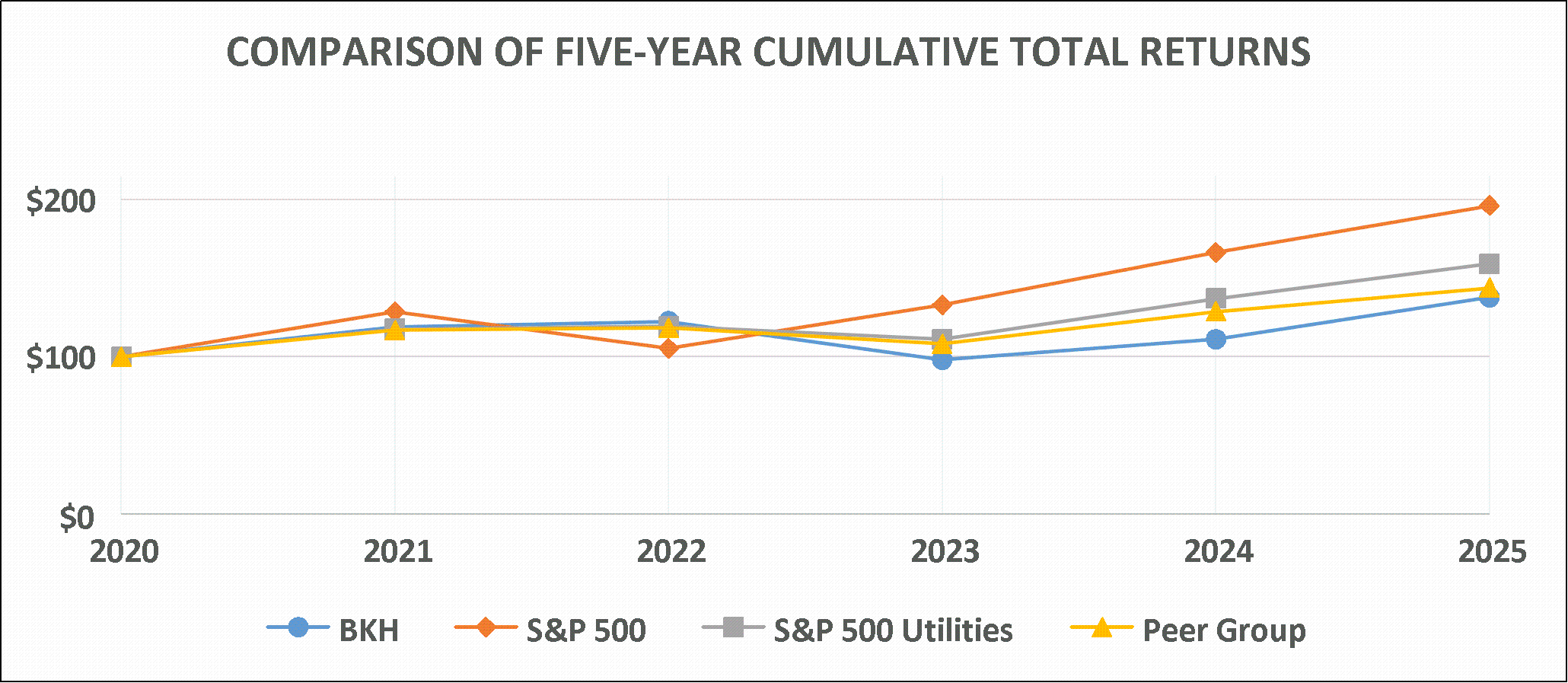
|
|
|
|
|
|
|
|
|
|
|
|
|
|
|
|
|
|
|
|
As of December 31, |
|
|
2020 |
|
2021 |
|
2022 |
|
2023 |
|
2024 |
|
2025 |
|
Black Hills Corporation |
$ |
100.00 |
|
$ |
118.88 |
|
$ |
122.53 |
|
$ |
98.10 |
|
$ |
111.34 |
|
$ |
137.97 |
|
S&P 500 |
|
100.00 |
|
|
128.71 |
|
|
105.40 |
|
|
133.10 |
|
|
166.40 |
|
|
196.16 |
|
S&P 500 Utilities |
|
100.00 |
|
|
117.67 |
|
|
119.51 |
|
|
111.05 |
|
|
137.07 |
|
|
159.06 |
|
Performance Peer Group (a) |
|
100.00 |
|
|
117.12 |
|
|
118.47 |
|
|
108.16 |
|
|
128.82 |
|
|
143.83 |
|
____________________
(a)Performance Peer Group represents the Edison Electric Institute Index, which was used in our 2025 Proxy Statement filed with the SEC on March 14, 2025.
DIVIDENDS
For information concerning dividends, our dividend policy and factors that may limit our ability to pay dividends, see “Liquidity and Capital Resources” under Item 7, Management’s Discussion and Analysis of Financial Condition and Results of Operations in this Annual Report on Form 10-K.
UNREGISTERED SECURITIES ISSUED
There were no unregistered securities sold during 2025.
SECURITIES AUTHORIZED FOR ISSUANCE UNDER EQUITY COMPENSATION PLANS
See Item 12 in this Annual Report on Form 10-K for information regarding Securities Authorized for Issuance Under Equity Compensation Plans.
ISSUER PURCHASES OF EQUITY SECURITIES
The following table contains monthly information about our acquisitions of equity securities for the three months ended December 31, 2025:
|
|
|
|
|
|
|
|
|
|
|
|
|
Period |
Total Number of
Shares Purchased (a) |
|
Average Price
Paid per Share |
|
Total Number of Shares Purchased as Part of Publicly Announced Plans or Programs |
|
Maximum Number (or Approximate Dollar Value) of Shares That May Yet Be Purchased Under the Plans or Programs |
|
October 1, 2025 - October 31, 2025 |
|
1 |
|
$ |
60.49 |
|
|
— |
|
|
— |
|
November 1, 2025 - November 30, 2025 |
|
4,373 |
|
$ |
69.30 |
|
|
— |
|
|
— |
|
December 1, 2025 - December 31, 2025 |
|
1 |
|
$ |
72.46 |
|
|
— |
|
|
— |
|
Total |
|
4,375 |
|
$ |
69.30 |
|
|
— |
|
|
— |
|
____________________
(a)Shares were acquired under the share withholding provisions of the Amended and Restated 2015 Omnibus Incentive Plan for payment of taxes associated with the vesting of various equity compensation plans.
ITEM 6. (RESERVED)
ITEM 7. MANAGEMENT’S DISCUSSION AND ANALYSIS OF FINANCIAL CONDITION AND RESULTS OF OPERATIONS
Executive Summary
We are a customer-focused energy solutions provider with a mission of Improving Life with Energy for 1.37 million customers and 800+ communities we serve. Our aspiration is to be the trusted energy partner across our growing eight-state footprint, including Arkansas, Colorado, Iowa, Kansas, Montana, Nebraska, South Dakota, and Wyoming. Our strategy is centered on four priorities: People & Culture—build a team that wins together, Operational Excellence—relentlessly deliver on our commitment to serve our customers, Transformation—transform to a simple and connected company and Growth—grow to be a dominant long-term energy provider.
We conduct our business operations through two operating segments: Electric Utilities and Gas Utilities. Certain unallocated corporate expenses that support our operating segments are presented as Corporate and Other. We conduct our utility operations under the name Black Hills Energy predominantly in rural areas of the Rocky Mountains and Midwestern states. We consider ourselves a domestic electric and natural gas utility company.
We have provided energy and served customers for 142 years, since the 1883 gold rush days in Deadwood, South Dakota. Throughout our history, the common thread that unites the past to the present is our commitment to serve our customers and communities. By being responsive and service focused, we can help our customers and communities thrive while meeting rapidly changing customer expectations.
Recent Developments
Pending Merger with NorthWestern
On August 18, 2025, we entered into the Merger Agreement with NorthWestern and Merger Sub. See Note 17 of the Notes to Consolidated Financial Statements in this Annual Report on Form 10-K for further discussion about the pending Merger.
One Big Beautiful Bill Act
See Note 15 of the Notes to Consolidated Financial Statements in this Annual Report on Form 10-K for discussion surrounding the OBBBA.
Trade Tariffs
Trade tariffs have been enacted over the last several months through presidential executive orders affecting products exported by several U.S. trading partners, and retaliatory tariffs have been imposed by some of these trading partners. While some tariffs scheduled to take effect were temporarily suspended, broad tariffs remain in effect with the possibility of additional tariffs being imposed. We are currently unable to predict the impact that recently imposed and possible future tariffs may have on our business. Trade tariffs have not had a material impact on our operations of financial performance to date. We are closely monitoring the impacts of trade tariffs and the potential effect they may have on our financial positions, results of operations, or cash flows.
Business Segment Recent Developments
Electric Utilities
•See Note 2 of the Notes to Consolidated Financial Statements in this Annual Report on Form 10-K for recent rate review activity for Colorado Electric.
•In December 2025, the Ready Wyoming project was fully completed and placed in service and now interconnects South Dakota Electric’s and Wyoming Electric’s transmission systems. Ready Wyoming was originally announced in November 2021 and construction commenced in late 2023. The project provides customers long-term price stability and greater flexibility as power markets develop in the western United States. This project is also expected to enable economic growth in Wyoming, expand access to renewable resources and facilitate additional renewable development across wind- and sun-rich resource areas.
•In 2025, Wyoming Electric continued to grow its large-load demand from existing data center customers, Microsoft and Meta, under its LPCS Tariff. In July 2024, Wyoming Electric announced it would partner with Meta to provide power for its AI data center. Meta's new AI data center plans to transition from construction power to permanent service later in the first quarter of 2026. We are also actively negotiating with prospective new data center customers that would further grow our load pipeline under Wyoming Electric's LPCS Tariff and also through strategic investments in new transmission and generation.
•In 2025, Wyoming Electric set multiple all-time and winter records for System Peak Demand. The most recent all-time peak of 379 MW was set on June 20, 2025 and the most recent winter peak of 375 MW was set on November 30, 2025. Prior to 2025, the previous all-time and winter peak was 314 MW set on January 11, 2024.
•On March 28, 2025, South Dakota Electric filed a CPCN with the WPSC for the Lange II project, which was approved in June 2025. The new facility began construction in the third quarter of 2025 and is anticipated to be in service in the fourth quarter of 2026. The addition of these resources will replace generation facilities planned for retirement and support updated planning reserve margin requirements.
•In 2025, Colorado Electric received CPUC approval for the addition of 250 MW of new renewable generation resources in support of its Clean Energy Plan, which included a 50-MW utility-owned battery storage project and a 200-MW solar PPA. On November 3, the CPUC approved the CPCN for the 50-MW battery storage project. During the first quarter of 2026, Colorado Electric expects to execute the 200-MW solar PPA.
•In 2024, we published our first formal WMP, which is an overview of our three-layered approach to manage wildfire risks driven by asset-based risk assessments that include asset programs, integrity programs and operational response. On June 30, 2025, we established our Emergency PSPS program across all three of our electric utilities to promote customer safety and mitigate wildfire risk. In establishing the Emergency PSPS program, we engaged with wildfire experts and key stakeholders including customers, community and local agencies, regulators and community leaders.
•On March 6, 2025, the state of Wyoming enacted comprehensive wildfire liability mitigation legislation (HB0192), effective July 1, 2025. The legislation provides material liability protections for a utility that complies with its commission-approved wildfire mitigation plan. In November 2025, we filed our WMP with the WPSC and anticipate approval in March 2026.
Gas Utilities
•See Note 2 of the Notes to Consolidated Financial Statements in this Annual Report on Form 10-K for recent rate review activity for Arkansas Gas, Iowa Gas, Kansas Gas, and Nebraska Gas.
Corporate and Other
•See Note 8 of the Notes to Consolidated Financial Statements in this Annual Report on Form 10-K for information regarding our corporate Revolving Credit Facility, October 2, 2025 debt offering and ATM program activity.
Results of Operations
Our discussion and analysis for the year ended December 31, 2025, compared to 2024, is included herein. For discussion and analysis for the year ended December 31, 2024, compared to 2023, please refer to Item 7 of Part II, “Management’s Discussion and Analysis of Financial Condition and Results of Operations” in our Annual Report on Form 10-K for the year ended December 31, 2024, which was filed with the SEC on February 12, 2025.
All amounts are presented on a pre-tax basis unless otherwise indicated. Minor differences in amounts may result due to rounding.
Consolidated Summary and Overview
|
|
|
|
|
|
|
|
|
|
|
|
|
|
|
|
|
For the Years Ended December 31, |
|
|
|
|
2025 |
|
2024 |
|
2025 vs 2024 Variance |
|
2023 |
|
2024 vs 2023 Variance |
|
|
(in millions, except per share amounts) |
|
Operating income (loss): |
|
|
|
|
|
|
|
|
|
|
Electric Utilities |
$ |
222.5 |
|
$ |
233.0 |
|
$ |
(10.5 |
) |
$ |
248.8 |
|
$ |
(15.8 |
) |
Gas Utilities |
|
320.8 |
|
|
271.3 |
|
|
49.5 |
|
|
228.8 |
|
|
42.5 |
|
Corporate and Other (a) |
|
(5.8 |
) |
|
(1.2 |
) |
|
(4.6 |
) |
|
(4.9 |
) |
|
3.7 |
|
Operating Income |
|
537.5 |
|
|
503.1 |
|
|
34.4 |
|
|
472.7 |
|
|
30.4 |
|
|
|
|
|
|
|
|
|
|
|
|
Interest expense, net |
|
(200.1 |
) |
|
(181.7 |
) |
|
(18.4 |
) |
|
(167.9 |
) |
|
(13.8 |
) |
Other income (expense), net |
|
6.1 |
|
|
(1.4 |
) |
|
7.5 |
|
|
(3.2 |
) |
|
1.8 |
|
Income tax (expense) |
|
(43.7 |
) |
|
(36.3 |
) |
|
(7.4 |
) |
|
(25.6 |
) |
|
(10.7 |
) |
Net income |
|
299.8 |
|
|
283.7 |
|
|
16.1 |
|
|
276.0 |
|
|
7.7 |
|
Net income attributable to non-controlling interest |
|
(8.2 |
) |
|
(10.6 |
) |
|
2.4 |
|
|
(13.8 |
) |
|
3.2 |
|
Net income available for common stock |
$ |
291.6 |
|
$ |
273.1 |
|
$ |
18.5 |
|
$ |
262.2 |
|
$ |
10.9 |
|
|
|
|
|
|
|
|
|
|
|
|
Weighted average common shares outstanding, Diluted |
|
73.2 |
|
|
69.9 |
|
|
3.3 |
|
|
67.1 |
|
|
2.8 |
|
Total earnings per share of common stock, Diluted |
$ |
3.98 |
|
$ |
3.91 |
|
$ |
0.07 |
|
$ |
3.91 |
|
$ |
(0.00 |
) |
(a)Includes inter-segment eliminations.
2025 Compared to 2024
•Electric Utilities’ operating income decreased $10.5 million primarily due to higher operating expenses, unplanned generation outages, lower transmission services revenues and unfavorable weather partially offset by new rates and rider recovery;
•Gas Utilities’ operating income increased $49.5 million primarily due to new rates and rider recovery driven by the Arkansas Gas, Iowa Gas, Kansas Gas, and Nebraska Gas rate reviews and favorable weather partially offset by unfavorable retail customer usage and higher operating expenses;
•Corporate and Other operating (loss) increased by $4.6 million primarily due to costs related to the pending Merger partially offset by a one-time favorable true-up from the consolidation of our Captive;
•Net interest expense increased $18.4 million due to higher interest rates on long-term debt, higher CP Program borrowings and lower interest income partially offset by higher AFUDC debt;
•Other income, net increased $7.5 million primarily due to higher AFUDC equity driven by construction work-in-progress balances and higher investment income from our Captive;
•Income tax (expense) increased $7.4 million primarily due to higher pre-tax income and a higher effective tax rate; and
•Net income attributable to non-controlling interest decreased $2.4 million due to lower net income from Black Hills Colorado IPP primarily driven by unplanned generation outages.
Segment Operating Results
Non-GAAP Financial Measure
The following discussion includes financial information prepared in accordance with GAAP and a “non-GAAP financial measure", Electric and Gas Utility margin. Generally, a non-GAAP financial measure is a numerical measure of a company’s financial performance, financial position or cash flows that excludes (or includes) amounts that are included in (or excluded from) the most directly comparable measure calculated and presented in accordance with GAAP. We define Electric and Gas Utility margin as operating revenue less cost of fuel, purchased power and cost of natural gas sold. Electric and Gas Utility margin is a non-GAAP financial measure due to the exclusion of operation and maintenance expenses determined to be directly attributable to revenue-producing activities, depreciation and amortization expenses, and taxes other than income taxes from the measure.
We believe that Electric and Gas Utility margin provides a useful basis for evaluating our segment operating results since our Utilities have regulatory mechanisms that allow them to pass prudently incurred costs of energy through to the customer in current rates. As a result, management uses Electric and Gas Utility margin internally when assessing the financial performance of our operating segments as this measure excludes the majority of revenue fluctuations caused by changes in these costs of energy. Similarly, the presentation of Electric and Gas Utility margin is intended to supplement investors’ understanding of operating performance.
Our Electric and Gas Utility margin measure may not be comparable to other companies’ Electric and Gas Utility margin measures. The following table includes a reconciliation of Electric and Gas Utility margin to Gross margin, the most directly comparable GAAP measure:
|
|
|
|
|
|
|
|
|
|
|
|
|
|
|
|
|
|
|
|
Electric Utilities |
|
Gas Utilities |
|
|
For the Years Ended December 31, |
|
|
2025 |
|
2024 |
|
2023 |
|
2025 |
|
2024 |
|
2023 |
|
|
(in millions) |
|
Revenue |
$ |
942.8 |
|
$ |
876.1 |
|
$ |
865.0 |
|
$ |
1,382.8 |
|
$ |
1,269.4 |
|
$ |
1,484.2 |
|
Fuel, purchased power and cost of natural gas sold |
|
(259.6 |
) |
|
(206.4 |
) |
|
(200.1 |
) |
|
(572.3 |
) |
|
(524.3 |
) |
|
(783.2 |
) |
Operations and maintenance (a) |
|
(170.3 |
) |
|
(156.5 |
) |
|
(153.2 |
) |
|
(170.6 |
) |
|
(172.0 |
) |
|
(174.0 |
) |
Depreciation and amortization |
|
(152.4 |
) |
|
(145.3 |
) |
|
(142.6 |
) |
|
(131.4 |
) |
|
(124.7 |
) |
|
(113.9 |
) |
Taxes other than income taxes |
|
(37.1 |
) |
|
(38.8 |
) |
|
(37.3 |
) |
|
(30.3 |
) |
|
(28.4 |
) |
|
(29.6 |
) |
Gross margin (GAAP) |
$ |
323.4 |
|
$ |
329.1 |
|
$ |
331.8 |
|
$ |
478.2 |
|
$ |
420.0 |
|
$ |
383.5 |
|
Operations and maintenance (a) |
|
170.3 |
|
|
156.5 |
|
|
153.2 |
|
|
170.6 |
|
|
172.0 |
|
|
174.0 |
|
Depreciation and amortization |
|
152.4 |
|
|
145.3 |
|
|
142.6 |
|
|
131.4 |
|
|
124.7 |
|
|
113.9 |
|
Taxes other than income taxes |
|
37.1 |
|
|
38.8 |
|
|
37.3 |
|
|
30.3 |
|
|
28.4 |
|
|
29.6 |
|
Electric and Gas Utility margin (non-GAAP) |
$ |
683.2 |
|
$ |
669.7 |
|
$ |
664.9 |
|
$ |
810.5 |
|
$ |
745.1 |
|
$ |
701.0 |
|
(a)Operations and maintenance expenses which are deemed to be directly attributable to revenue-producing activities include plant operations and maintenance expenses at our electric generation facilities, operations and maintenance expenses at our WRDC coal mine, and electric and gas transmission and distribution expenses. These amounts are included in the table above to calculate gross margin in accordance with GAAP. These amounts excluded operations and maintenance expenses not directly attributable to revenue-producing activities of $100.9 million, $96.1 million, and $83.0 million for the years ended 2025, 2024, and 2023, respectively, for the Electric Utilities and $157.4 million, $148.7 million, and $154.7 million for the years ended 2025, 2024, and 2023, respectively, for the Gas Utilities.
Electric Utilities
Operating results for the years ended December 31 for the Electric Utilities were as follows:
|
|
|
|
|
|
|
|
|
|
|
|
|
|
|
|
|
2025 |
|
2024 |
|
2025 vs 2024 Variance |
|
2023 |
|
2024 vs 2023 Variance |
|
|
(in millions) |
|
Total revenue |
$ |
942.8 |
|
$ |
876.1 |
|
$ |
66.7 |
|
$ |
865.0 |
|
$ |
11.1 |
|
Fuel and purchased power: |
|
259.6 |
|
|
206.4 |
|
|
53.2 |
|
|
200.1 |
|
|
6.3 |
|
Electric Utility margin (non-GAAP) |
|
683.2 |
|
|
669.7 |
|
|
13.5 |
|
|
664.9 |
|
|
4.8 |
|
|
|
|
|
|
|
|
|
|
|
|
Operations and maintenance |
|
271.2 |
|
|
252.6 |
|
|
18.6 |
|
|
236.2 |
|
|
16.4 |
|
Depreciation and amortization |
|
152.4 |
|
|
145.3 |
|
|
7.1 |
|
|
142.6 |
|
|
2.7 |
|
Taxes other than income taxes |
|
37.1 |
|
|
38.8 |
|
|
(1.7 |
) |
|
37.3 |
|
|
1.5 |
|
|
|
460.7 |
|
|
436.7 |
|
|
24.0 |
|
|
416.1 |
|
|
20.6 |
|
|
|
|
|
|
|
|
|
|
|
|
Operating income |
$ |
222.5 |
|
$ |
233.0 |
|
$ |
(10.5 |
) |
$ |
248.8 |
|
$ |
(15.8 |
) |
2025 Compared to 2024
•Electric Utility margin increased as a result of:
|
|
|
|
|
(in millions) |
|
New rates and rider recovery |
$ |
25.0 |
|
Retail customer growth and usage |
|
1.9 |
|
Transmission services |
|
(5.9 |
) |
Weather |
|
(2.7 |
) |
Off-system excess energy sales |
|
(1.8 |
) |
Other |
|
(3.0 |
) |
|
$ |
13.5 |
|
•Operations and maintenance expense increased primarily due to $5.5 million of higher outside services expenses, $4.8 million of expenses related to unplanned generation outages, $3.7 million of higher employee costs and $1.5 million from higher insurance expense primarily driven by higher excess liability premiums. Other unfavorable variances, none of which were individually significant, comprised the remainder of the difference when compared to the same period in 2024.
•Depreciation and amortization increased primarily due to a higher asset base driven by capital expenditures.
•Taxes other than income taxes were comparable to 2024.
Operating Statistics
|
|
|
|
|
|
|
|
|
|
|
|
|
|
|
|
|
|
|
|
Revenue |
|
Quantities Sold |
|
|
For the year ended December 31, |
|
For the year ended December 31, |
|
By Customer Class |
2025 |
|
2024 |
|
2023 |
|
2025 |
|
2024 |
|
2023 |
|
|
(in millions) |
|
(in GWh) |
|
Retail Revenue - |
|
|
|
|
|
|
|
|
|
|
|
|
Residential |
$ |
248.2 |
|
$ |
234.8 |
|
$ |
224.5 |
|
|
1,461.5 |
|
|
1,471.9 |
|
|
1,438.5 |
|
Commercial |
|
279.4 |
|
|
263.6 |
|
|
254.5 |
|
|
2,068.1 |
|
|
2,091.4 |
|
|
2,074.4 |
|
Industrial (a) |
|
201.0 |
|
|
168.9 |
|
|
157.3 |
|
|
2,615.4 |
|
|
2,169.8 |
|
|
2,094.8 |
|
Municipal |
|
17.8 |
|
|
17.0 |
|
|
17.5 |
|
|
142.1 |
|
|
147.1 |
|
|
150.9 |
|
Other Retail |
|
14.0 |
|
|
14.3 |
|
|
12.3 |
|
|
— |
|
|
— |
|
|
— |
|
Subtotal Retail Revenue - Electric |
|
760.4 |
|
|
698.6 |
|
|
666.1 |
|
|
6,287.1 |
|
|
5,880.2 |
|
|
5,758.6 |
|
Wholesale |
|
21.7 |
|
|
26.8 |
|
|
34.2 |
|
|
483.0 |
|
|
589.4 |
|
|
699.7 |
|
Market - off-system sales |
|
51.9 |
|
|
34.8 |
|
|
50.9 |
|
|
896.7 |
|
|
765.6 |
|
|
737.9 |
|
Transmission |
|
45.2 |
|
|
52.2 |
|
|
47.1 |
|
|
— |
|
|
— |
|
|
— |
|
Other (b) |
|
63.6 |
|
|
63.7 |
|
|
66.7 |
|
|
— |
|
|
— |
|
|
— |
|
Total Revenue and Quantities Sold |
$ |
942.8 |
|
$ |
876.1 |
|
$ |
865.0 |
|
|
7,666.8 |
|
|
7,235.2 |
|
|
7,196.2 |
|
Other Uses, Losses or Generation, net (c) |
|
|
|
|
|
|
|
476.8 |
|
|
390.3 |
|
|
463.5 |
|
Total Energy |
|
|
|
|
|
|
|
8,143.6 |
|
|
7,625.5 |
|
|
7,659.7 |
|
(a)The increase in industrial revenues and quantities sold for 2025 compared to 2024 was primarily driven by Wyoming Electric LPCS Tariff and BCIS Tariff customers.
(b)Primarily related to Integrated Generation, inter-segment rent, and non-regulated services to our retail customers under the Service Guard Comfort Plan and Tech Services.
(c)Includes company uses and line losses.
|
|
|
|
|
|
|
|
|
|
|
|
|
|
|
|
|
|
|
|
Revenue |
|
Quantities Sold |
|
|
For the year ended December 31, |
|
For the year ended December 31, |
|
By Business Unit |
2025 |
|
2024 |
|
2023 |
|
2025 |
|
2024 |
|
2023 |
|
|
(in millions) |
|
(in GWh) |
|
Colorado Electric |
$ |
287.3 |
|
$ |
276.9 |
|
$ |
285.7 |
|
|
2,218.1 |
|
|
2,392.7 |
|
|
2,397.2 |
|
South Dakota Electric |
|
341.6 |
|
|
322.0 |
|
|
321.1 |
|
|
2,683.2 |
|
|
2,556.5 |
|
|
2,554.3 |
|
Wyoming Electric |
|
270.0 |
|
|
234.3 |
|
|
212.2 |
|
|
2,676.8 |
|
|
2,190.1 |
|
|
2,124.1 |
|
Integrated Generation |
|
43.9 |
|
|
42.9 |
|
|
46.0 |
|
|
88.7 |
|
|
95.9 |
|
|
120.6 |
|
Total Revenue and Quantities Sold |
$ |
942.8 |
|
$ |
876.1 |
|
$ |
865.0 |
|
|
7,666.8 |
|
|
7,235.2 |
|
|
7,196.2 |
|
|
|
|
|
|
|
|
|
|
|
|
For the year ended December 31, |
|
Quantities Generated and Purchased by Fuel Type |
2025 |
|
2024 |
|
2023 |
|
|
(in GWh) |
|
Generated: |
|
|
|
|
|
|
Coal (a) |
|
2,075.0 |
|
|
2,478.3 |
|
|
2,683.4 |
|
Natural Gas |
|
2,389.4 |
|
|
2,239.1 |
|
|
2,021.4 |
|
Wind |
|
602.9 |
|
|
660.2 |
|
|
678.5 |
|
Total Generated |
|
5,067.3 |
|
|
5,377.6 |
|
|
5,383.3 |
|
Purchased: |
|
|
|
|
|
|
Coal, Natural Gas, Diesel Oil and Other Market Purchases |
|
1,860.6 |
|
|
1,117.8 |
|
|
1,842.9 |
|
Wind and Solar |
|
1,215.7 |
|
|
1,130.1 |
|
|
433.5 |
|
Total Purchased (b) |
|
3,076.3 |
|
|
2,247.9 |
|
|
2,276.4 |
|
|
|
|
|
|
|
|
Total Generated and Purchased |
|
8,143.6 |
|
|
7,625.5 |
|
|
7,659.7 |
|
(a)The decrease in coal generation for 2025 compared to 2024 was primarily driven by unplanned outages at Wygen III.
(b)The increase in total purchases for 2025 compared to 2024 was primarily driven by increased demand from Wyoming Electric LPCS Tariff and BCIS Tariff customers and unplanned outages at Wygen III as discussed in (a) above.
|
|
|
|
|
|
|
|
|
|
|
For the year ended December 31, |
|
Quantities Generated and Purchased by Business Unit |
2025 |
|
2024 |
|
2023 |
|
|
(in GWh) |
|
Generated: |
|
|
|
|
|
|
Colorado Electric |
|
742.4 |
|
|
865.0 |
|
|
653.9 |
|
South Dakota Electric |
|
1,758.1 |
|
|
2,045.4 |
|
|
2,018.5 |
|
Wyoming Electric |
|
891.7 |
|
|
866.5 |
|
|
908.3 |
|
Integrated Generation |
|
1,675.1 |
|
|
1,600.7 |
|
|
1,802.5 |
|
Total Generated |
|
5,067.3 |
|
|
5,377.6 |
|
|
5,383.2 |
|
Purchased: |
|
|
|
|
|
|
Colorado Electric |
|
350.3 |
|
|
447.4 |
|
|
588.2 |
|
South Dakota Electric |
|
1,034.0 |
|
|
590.7 |
|
|
604.6 |
|
Wyoming Electric |
|
1,637.1 |
|
|
1,147.7 |
|
|
1,028.5 |
|
Integrated Generation |
|
54.9 |
|
|
62.1 |
|
|
55.2 |
|
Total Purchased |
|
3,076.3 |
|
|
2,247.9 |
|
|
2,276.5 |
|
|
|
|
|
|
|
|
Total Generated and Purchased |
|
8,143.6 |
|
|
7,625.5 |
|
|
7,659.7 |
|
|
|
|
|
|
|
|
|
For the year ended December 31, |
|
2025 |
2024 |
2023 |
Degree Days |
Actual |
Variance from Normal |
Actual |
Variance from Normal |
Actual |
Variance from Normal |
Heating Degree Days: |
|
|
|
|
|
|
Colorado Electric |
5,104 |
(1)% |
4,926 |
(8)% |
5,330 |
1% |
South Dakota Electric |
6,511 |
(7)% |
6,311 |
(13)% |
6,969 |
(4)% |
Wyoming Electric |
6,378 |
(5)% |
6,272 |
(10)% |
6,783 |
(1)% |
Combined (a) |
5,850 |
(4)% |
5,676 |
(10)% |
6,185 |
(1)% |
|
|
|
|
|
|
|
Cooling Degree Days: |
|
|
|
|
|
|
Colorado Electric |
1,016 |
(13)% |
1,269 |
11% |
1,046 |
(10)% |
South Dakota Electric |
778 |
18% |
913 |
49% |
497 |
(21)% |
Wyoming Electric |
337 |
(30)% |
491 |
7% |
329 |
(30)% |
Combined (a) |
796 |
(7)% |
989 |
20% |
713 |
(15)% |
(a)Degree days are calculated based on a weighted average of total customers by state.
|
|
|
|
|
For the year ended December 31, |
Contracted generating facilities Availability (a) by fuel type |
2025 |
2024 |
2023 |
Coal (b) |
77.7% |
89.8% |
93.7% |
Natural gas and diesel oil (b) |
92.6% |
92.9% |
92.1% |
Wind |
82.5% |
90.6% |
92.5% |
Total availability |
86.9% |
91.7% |
92.6% |
|
|
|
|
Wind Capacity Factor (a) |
34.2% |
36.7% |
37.4% |
(a)Availability and Wind Capacity Factor are calculated using a weighted average based on capacity of our generating fleet.
(b)2025 included unplanned outages at Wygen III, Pueblo Airport Generation #4-5 and Busch Ranch I and II. 2024 included unplanned outages at Wygen I and Pueblo Airport Generation #4-5.
Gas Utilities
Operating results for the years ended December 31 for the Gas Utilities were as follows:
|
|
|
|
|
|
|
|
|
|
|
|
|
|
|
|
|
2025 |
|
2024 |
|
2025 vs 2024 Variance |
|
2023 |
|
2024 vs 2023 Variance |
|
|
(in millions) |
|
Total revenue |
$ |
1,382.8 |
|
$ |
1,269.4 |
|
$ |
113.4 |
|
$ |
1,484.2 |
|
$ |
(214.8 |
) |
Cost of natural gas sold |
|
572.3 |
|
|
524.3 |
|
|
48.0 |
|
|
783.2 |
|
|
(258.9 |
) |
Gas Utility margin (non-GAAP) |
|
810.5 |
|
|
745.1 |
|
|
65.4 |
|
|
701.0 |
|
|
44.1 |
|
|
|
|
|
|
|
|
|
|
|
|
Operations and maintenance |
|
328.0 |
|
|
320.7 |
|
|
7.3 |
|
|
328.7 |
|
|
(8.0 |
) |
Depreciation and amortization |
|
131.4 |
|
|
124.7 |
|
|
6.7 |
|
|
113.9 |
|
|
10.8 |
|
Taxes other than income taxes |
|
30.3 |
|
|
28.4 |
|
|
1.9 |
|
|
29.6 |
|
|
(1.2 |
) |
|
|
489.7 |
|
|
473.8 |
|
|
15.9 |
|
|
472.2 |
|
|
1.6 |
|
|
|
|
|
|
|
|
|
|
|
|
Operating income |
$ |
320.8 |
|
$ |
271.3 |
|
$ |
49.5 |
|
$ |
228.8 |
|
$ |
42.5 |
|
2025 Compared to 2024
•Gas Utility margin increased as a result of:
|
|
|
|
|
(in millions) |
|
New rates and rider recovery |
$ |
60.9 |
|
Weather |
|
10.9 |
|
Transport and transmission |
|
3.3 |
|
Retail customer growth |
|
4.3 |
|
Retail customer usage |
|
(11.0 |
) |
Other |
|
(3.0 |
) |
|
$ |
65.4 |
|
•Operations and maintenance expense increased primarily due to $3.2 million of higher insurance expense primarily driven by higher excess liability premiums, $1.3 million of increased bad debt expense attributable to higher customer billings and $1.3 million of higher IT-related costs. Other unfavorable variances, none of which were individually significant, comprised the remainder of the difference when compared to the same period in 2024.
•Depreciation and amortization increased primarily due to a higher asset base driven by capital expenditures.
•Taxes other than income taxes were comparable to 2024.
Operating Statistics
|
|
|
|
|
|
|
|
|
|
|
|
|
|
|
|
|
|
|
|
Revenue |
|
Quantities Sold and Transported |
|
|
For the year ended December 31, |
|
For the year ended December 31, |
|
By Customer Class |
2025 |
|
2024 |
|
2023 |
|
2025 |
|
2024 |
|
2023 |
|
|
(in millions |
|
(Dth in millions) |
|
Retail Revenue - |
|
|
|
|
|
|
|
|
|
|
|
|
Residential |
$ |
770.2 |
|
$ |
691.9 |
|
$ |
830.3 |
|
|
59.9 |
|
|
56.7 |
|
|
60.1 |
|
Commercial |
|
292.9 |
|
|
266.3 |
|
|
337.3 |
|
|
29.4 |
|
|
28.4 |
|
|
29.4 |
|
Industrial |
|
27.2 |
|
|
23.7 |
|
|
33.1 |
|
|
5.2 |
|
|
6.0 |
|
|
5.7 |
|
Other Retail (a) |
|
34.6 |
|
|
40.7 |
|
|
48.1 |
|
|
— |
|
|
— |
|
|
— |
|
Subtotal Retail Revenue - Gas |
|
1,124.9 |
|
|
1,022.6 |
|
|
1,248.8 |
|
|
94.5 |
|
|
91.1 |
|
|
95.2 |
|
Transportation |
|
194.4 |
|
|
178.2 |
|
|
176.8 |
|
|
166.7 |
|
|
159.2 |
|
|
159.8 |
|
Other (b) |
|
63.5 |
|
|
68.6 |
|
|
58.6 |
|
|
— |
|
|
— |
|
|
— |
|
Total Revenue and Quantities Sold |
$ |
1,382.8 |
|
$ |
1,269.4 |
|
$ |
1,484.2 |
|
|
261.2 |
|
|
250.3 |
|
|
255.0 |
|
(a)Includes Black Hills Energy Services revenue under the Choice Gas Program.
(b)Includes inter-segment rent and non-regulated services under the Service Guard Comfort Plan, Tech Services, and HomeServe.
|
|
|
|
|
|
|
|
|
|
|
|
|
|
|
|
|
|
|
|
Revenue |
|
Quantities Sold and Transported |
|
|
For the year ended December 31, |
|
For the year ended December 31, |
|
By Business Unit |
2025 |
|
2024 |
|
2023 |
|
2025 |
|
2024 |
|
2023 |
|
|
(in millions) |
|
(Dth in millions) |
|
Arkansas Gas |
$ |
286.5 |
|
$ |
248.8 |
|
$ |
268.9 |
|
|
32.5 |
|
|
29.9 |
|
|
30.2 |
|
Colorado Gas |
|
251.8 |
|
|
278.8 |
|
|
313.6 |
|
|
30.6 |
|
|
31.0 |
|
|
32.8 |
|
Iowa Gas |
|
197.6 |
|
|
162.3 |
|
|
213.6 |
|
|
39.6 |
|
|
37.3 |
|
|
37.9 |
|
Kansas Gas |
|
160.4 |
|
|
130.4 |
|
|
155.6 |
|
|
37.0 |
|
|
34.8 |
|
|
35.5 |
|
Nebraska Gas |
|
344.5 |
|
|
304.5 |
|
|
366.1 |
|
|
85.1 |
|
|
80.3 |
|
|
82.2 |
|
Wyoming Gas |
|
142.0 |
|
|
144.6 |
|
|
166.4 |
|
|
36.4 |
|
|
37.0 |
|
|
36.4 |
|
Total Revenue and Quantities Sold |
$ |
1,382.8 |
|
$ |
1,269.4 |
|
$ |
1,484.2 |
|
|
261.2 |
|
|
250.3 |
|
|
255.0 |
|
|
|
|
|
|
|
|
|
For the year ended December 31, |
|
2025 |
2024 |
2023 |
Heating Degree Days |
Actual |
Variance From Normal |
Actual |
Variance From Normal |
Actual |
Variance From Normal |
Arkansas Gas (a) |
3,256 |
(9)% |
2,998 |
(20)% |
3,197 |
(17)% |
Colorado Gas |
5,416 |
(7)% |
5,662 |
(7)% |
5,916 |
(4)% |
Iowa Gas |
6,318 |
(1)% |
5,543 |
(16)% |
5,921 |
(12)% |
Kansas Gas (a) |
4,530 |
--- |
4,092 |
(12)% |
4,387 |
(8)% |
Nebraska Gas (a) |
5,630 |
(3)% |
5,172 |
(13)% |
5,579 |
(8)% |
Wyoming Gas |
6,727 |
(7)% |
6.641 |
(10)% |
7,385 |
8% |
Combined (b) |
5,802 |
(5)% |
5.517 |
(11)% |
6,006 |
(4)% |
(a)Arkansas Gas and Kansas Gas have weather normalization mechanisms that mitigate the weather impact on Gas Utility margins. Nebraska Gas received NPSC approval to implement a two-year pilot program for a weather normalization mechanism which was effective August 1, 2025.
(b)Heating degree days are calculated based on a weighted average of total customers by state excluding Kansas Gas and Nebraska Gas (effective in August 2025) due to their weather normalization mechanisms. Arkansas Gas is partially excluded based on the weather normalization mechanism in effect from November through April.
Corporate and Other
Corporate and Other consists of certain unallocated expenses for administrative activities that support our operating segments. Corporate and Other also includes our Captive, business development activities that are not part of our operating segments, and inter-segment eliminations.
Corporate and Other operating results for the years ended December 31 were as follows:
|
|
|
|
|
|
|
|
|
|
|
|
|
|
|
|
|
2025 |
|
2024 |
|
2025 vs 2024 Variance |
|
2023 |
|
2024 vs 2023 Variance |
|
|
(in millions) |
|
Operating (loss) |
$ |
(5.8 |
) |
$ |
(1.2 |
) |
$ |
(4.6 |
) |
$ |
(4.9 |
) |
$ |
3.7 |
|
2025 Compared to 2024
•Operating loss increased primarily due to $9.9 million of costs related to the pending Merger partially offset by a one-time favorable true-up from the consolidation of our Captive.
Consolidated Interest Expense, Other Income (Expense) and Income Tax (Expense)
|
|
|
|
|
|
|
|
|
|
|
|
|
|
|
|
|
2025 |
|
2024 |
|
2025 vs 2024 Variance |
|
2023 |
|
2024 vs 2023 Variance |
|
|
(in millions) |
|
Interest expense, net |
$ |
(200.1 |
) |
$ |
(181.7 |
) |
$ |
(18.4 |
) |
$ |
(167.9 |
) |
$ |
(13.8 |
) |
Other income (expense), net |
|
6.1 |
|
|
(1.4 |
) |
|
7.5 |
|
|
(3.2 |
) |
|
1.8 |
|
Income tax (expense) |
|
(43.7 |
) |
|
(36.3 |
) |
|
(7.4 |
) |
|
(25.6 |
) |
|
(10.7 |
) |
2025 Compared to 2024
•Interest expense, net increased primarily due to higher interest rates on long-term debt, higher CP Program borrowings and lower interest income partially offset by higher AFUDC debt driven by construction work-in-progress balances related to the Lange II and Ready Wyoming projects;
•Other income, net increased due to higher AFUDC equity driven by construction work-in-progress balances related to the Lange II and Ready Wyoming projects and higher investment income from our Captive;
•Income tax (expense) increased primarily due to higher pre-tax income. The effective tax rate was 12.7% for 2025 and 11.3% for 2024. The higher effective tax rate was primarily driven by the non-deductibility of certain costs related to the pending Merger and lower flow-through tax benefits related to repair costs. See Note 15 of the Notes to Consolidated Financial Statements in this Annual Report on Form 10-K for additional details.
Liquidity and Capital Resources
OVERVIEW
Our company requires significant cash to support and grow our businesses. Our primary sources of cash are generated from our operating activities, Revolving Credit Facility, CP Program, ATM, and ability to access the public and private capital markets through debt and equity securities offerings when necessary. This cash is used for, among other things, working capital, capital expenditures, dividends, pension funding, investments in or acquisitions of assets and businesses, payment of debt obligations, and redemption of outstanding debt and equity securities when required or financially appropriate.
We experience significant cash requirements during peak months of the winter heating season due to higher natural gas consumption, during periods of high natural gas prices, and during the construction season, which typically peaks in spring and summer.
We believe that our cash on hand, operating cash flows, existing borrowing capacity, and ability to complete new debt and equity financings, taken in their entirety, provide sufficient capital resources to support and grow our business.
The following table provides an informational summary of our liquidity and capital structure as of December 31:
|
|
|
|
|
|
|
|
2025 |
|
2024 |
|
|
(dollars in millions) |
|
Cash and cash equivalents |
$ |
182.8 |
|
$ |
16.1 |
|
Available capacity under Revolving Credit Facility and CP Program (a) |
|
746.8 |
|
|
612.7 |
|
Available liquidity |
$ |
929.6 |
|
$ |
628.8 |
|
|
|
|
|
|
Capital structure |
|
|
|
|
Short-term debt |
$ |
- |
|
$ |
133.8 |
|
Long-term debt |
|
4,701.1 |
|
|
4,250.2 |
|
Total debt |
|
4,701.1 |
|
|
4,384.0 |
|
Total stockholders' equity (excludes non-controlling interest) |
|
3,823.6 |
|
|
3,501.5 |
|
Total capitalization |
$ |
8,524.7 |
|
$ |
7,885.5 |
|
|
|
|
|
|
Debt to capitalization |
|
55.1 |
% |
|
55.6 |
% |
Long-term debt to total debt |
|
100.0 |
% |
|
96.9 |
% |
(a)Available capacity under Revolving Credit Facility and CP Program represents $750 million of total borrowing capacity less outstanding borrowings and letters of credit. See Note 8 of the Notes to Consolidated Financial Statements in this Annual Report on Form 10-K for more information.
Future Financing Plans
We plan to support and grow our business by using cash generated from operating activities and various financing alternatives, which could include our Revolving Credit Facility, our CP Program, and the issuance of common stock under our ATM program or in a secondary offering. We plan to re-finance our $400 million, 3.15%, senior unsecured notes due January 2027, at or before the maturity date. Additionally, our current shelf registration statement expires in 2026 and we expect to file a new shelf registration statement to replace it.
CASH FLOW ACTIVITIES
The following tables summarize our cash flows for the years ended December 31:
Operating Activities:
|
|
|
|
|
|
|
|
|
|
|
|
|
|
|
|
|
2025 |
|
2024 |
|
2025 vs 2024 Variance |
|
2023 |
|
2024 vs 2023 Variance |
|
|
(in millions) |
|
Net income |
$ |
299.8 |
|
$ |
283.7 |
|
$ |
16.1 |
|
$ |
276.0 |
|
$ |
7.7 |
|
Non-cash adjustments to Net income |
|
372.1 |
|
|
350.5 |
|
|
21.6 |
|
|
313.5 |
|
|
37.0 |
|
Total earnings |
|
671.9 |
|
|
634.2 |
|
|
37.7 |
|
|
589.5 |
|
|
44.7 |
|
Changes in certain operating assets and liabilities: |
|
|
|
|
|
|
|
|
|
|
Materials, supplies and fuel, Accounts receivable and other current assets |
|
(62.8 |
) |
|
(12.5 |
) |
|
(50.3 |
) |
|
255.9 |
|
|
(268.4 |
) |
Accounts payable and accrued liabilities |
|
24.0 |
|
|
28.8 |
|
|
(4.8 |
) |
|
(109.9 |
) |
|
138.7 |
|
Regulatory assets |
|
59.1 |
|
|
90.0 |
|
|
(30.9 |
) |
|
236.8 |
|
|
(146.8 |
) |
Net inflow from changes in certain operating assets and liabilities |
|
20.3 |
|
|
106.3 |
|
|
(86.0 |
) |
|
382.8 |
|
|
(276.5 |
) |
Other operating activities |
|
(18.8 |
) |
|
(21.2 |
) |
|
2.4 |
|
|
(27.9 |
) |
|
6.7 |
|
Net cash provided by operating activities |
$ |
673.4 |
|
$ |
719.3 |
|
$ |
(45.9 |
) |
$ |
944.4 |
|
$ |
(225.1 |
) |
2025 Compared to 2024
Net cash provided by operating activities was $45.9 million lower which was attributable to:
•Total earnings (net income plus non-cash adjustments) were $37.7 million higher primarily as a result of new rates and rider recovery, increased demand from LPCS Tariff and BCIS Tariff customers partially offset by higher operating expenses and higher net interest expense.
•Net inflows from changes in certain operating assets and liabilities were $86.0 million lower, primarily attributable to:
oCash outflows increased by approximately $50.3 million as a result of changes in accounts receivable and other current assets primarily due to higher natural gas in storage inventories driven by fluctuations in commodity prices;
oCash inflows decreased by approximately $4.8 million as a result of changes in accounts payable and other current liabilities primarily driven by fluctuations in commodity prices, remediation costs for our manufactured gas plant site in Iowa and changes in other working capital requirements; and
oCash inflows decreased by approximately $30.9 million as a result of changes in our regulatory assets and liabilities primarily due to lower recoveries of our Winter Storm Uri regulatory asset as recovery is now complete in most of our jurisdictions.
•Cash outflows decreased $2.4 million from other operating activities.
Investing Activities:
|
|
|
|
|
|
|
|
|
|
|
|
|
|
|
|
|
2025 |
|
2024 |
|
2025 vs 2024 Variance |
|
2023 |
|
2024 vs 2023 Variance |
|
|
(in millions) |
|
Capital expenditures |
$ |
(819.8 |
) |
$ |
(744.2 |
) |
$ |
(75.6 |
) |
$ |
(555.6 |
) |
$ |
(188.6 |
) |
Other investing activities |
|
(8.4 |
) |
|
(1.8 |
) |
|
(6.6 |
) |
|
18.9 |
|
|
(20.7 |
) |
Net cash (used in) investing activities |
$ |
(828.2 |
) |
$ |
(746.0 |
) |
$ |
(82.2 |
) |
$ |
(536.7 |
) |
$ |
(209.3 |
) |
2025 Compared to 2024
Net cash used in investing activities was $82.2 million higher which was attributable to:
•Cash outflows from capital expenditures (which are net of contributions in aid of construction) increased $75.6 million primarily as a result of the Ready Wyoming and Lange II projects and prior year receipts related to contributions in aid of construction for data center projects in Wyoming partially offset by prior year expenditures from Black Hills Energy Renewable Resources' acquisition of an RNG production facility at a landfill in Dubuque, Iowa; and
•Cash outflows increased $6.6 million for other investing activities primarily due to higher AFUDC debt driven by construction work-in-progress balances related to the Lange II and Ready Wyoming projects.
Financing Activities:
|
|
|
|
|
|
|
|
|
|
|
|
|
|
|
|
|
2025 |
|
2024 |
|
2025 vs 2024 Variance |
|
2023 |
|
2024 vs 2023 Variance |
|
|
(in millions) |
|
Dividends paid on common stock |
$ |
(197.9 |
) |
$ |
(182.3 |
) |
$ |
(15.6 |
) |
$ |
(168.1 |
) |
$ |
(14.2 |
) |
Common stock issued |
|
219.2 |
|
|
181.4 |
|
|
37.8 |
|
|
118.3 |
|
|
63.1 |
|
Short-term and long-term debt borrowings (repayments), net |
|
316.2 |
|
|
(16.2 |
) |
|
332.4 |
|
|
(260.6 |
) |
|
244.4 |
|
Distributions to non-controlling interests |
|
(9.8 |
) |
|
(17.4 |
) |
|
7.6 |
|
|
(18.3 |
) |
|
0.9 |
|
Other financing activities |
|
(5.9 |
) |
|
(8.4 |
) |
|
2.5 |
|
|
(13.0 |
) |
|
4.6 |
|
Net cash provided by (used in) financing activities |
$ |
321.8 |
|
$ |
(42.9 |
) |
$ |
364.7 |
|
$ |
(341.7 |
) |
$ |
298.8 |
|
2025 Compared to 2024
Net cash provided by financing activities was $364.7 million higher which was primarily attributable to:
•Cash outflows increased $15.6 million due to the increased dividend rate per share and increased number of common shares outstanding;
•Cash inflows increased $37.8 million due to increased issuances of common stock;
•Net inflows from changes in short-term and long-term debt (repayments) borrowings increased $332.4 million due to timing of repayments and borrowing activity. Proceeds from the issuance of $450 million of senior unsecured notes in October 2025 were used to repay our $300 million senior unsecured notes in January 2026. In 2024, proceeds from the issuance of $450 million senior unsecured notes in May 2024, along with available cash and short-term borrowings under our existing facilities, were used to repay $600 million senior unsecured notes in August 2024;
•Distributions to non-controlling interests decreased $7.6 million due to lower net income from Black Hills Colorado IPP primarily driven by unplanned generation outages; and
•Cash outflows decreased by $2.5 million for other financing activities.
CAPITAL RESOURCES
Shelf Registration Statement
We maintain an effective shelf registration statement with the SEC under which we may issue, from time to time, an unspecified amount of senior debt securities, subordinate debt securities, common stock, preferred stock, warrants, and other securities. Our current shelf registration statement expires in 2026 and we expect to file a new shelf registration statement to replace it.
Short-term Debt
For more information on our Revolving Credit Facility and CP Program, see Note 8 of the Notes to Consolidated Financial Statements in this Annual Report on Form 10-K.
Long-term Debt
For information on our long-term debt, see Note 8 of the Notes to Consolidated Financial Statements in this Annual Report on Form 10-K.
Financial Covenants
The Revolving Credit Facility and Wyoming Electric’s financing agreements contain covenant requirements. We were in compliance with these covenants as of December 31, 2025. See additional information in Note 8 of the Notes to Consolidated Financial Statements in this Annual Report on Form 10-K.
Equity
For information regarding equity, see Note 8 of the Notes to Consolidated Financial Statements in this Annual Report on Form 10-K.
Utility Money Pool
As a utility holding company, we are required to establish a cash management program to address lending and borrowing activities between our utilities and the Company. We have established utility money pool agreements which address these requirements. These agreements are on file with the FERC and appropriate state regulators. Under the utility money pool agreements, our utilities may, at their option, borrow and extend short-term loans to the utility money pool at market-based rates. While the utility money pool may borrow funds from the Company (as ultimate parent company), the money pool arrangement does not allow loans from our utility subsidiaries to the Company (as ultimate parent company) or to non-regulated affiliates.
CREDIT RATINGS
Financing for operational needs and capital expenditure requirements, not satisfied by operating cash flows, depends upon the cost and availability of external funds through both short and long-term financing. In order to operate and grow our business, we need to consistently maintain the ability to raise capital on favorable terms. Access to funds is dependent upon factors such as general economic and capital market conditions, regulatory authorizations and policies, the Company’s credit ratings, cash flows from routine operations, and the credit ratings of counterparties. After assessing the current operating performance, liquidity, and credit ratings of the Company, management believes that the Company will have access to the capital markets at prevailing market rates for companies with comparable credit ratings. We note that credit ratings are not recommendations to buy, sell, or hold securities and may be subject to revision or withdrawal at any time by the assigning rating agency. Each rating should be evaluated independently of any other rating.
The following table represents the credit ratings and rating outlook of BHC as of the date of this report:
|
|
|
Rating Agency |
Senior Unsecured Rating |
Outlook |
S&P (a) |
BBB+ |
Stable |
Moody’s (b) |
Baa2 |
Stable |
(a)On August 19, 2025, S&P affirmed our BBB+ rating and maintained a Stable outlook.
(b)On August 19, 2025, Moody's affirmed our Baa2 rating and maintained a Stable outlook.
The following table represents the credit ratings of South Dakota Electric as of the date of this report:
|
|
Rating Agency |
Senior Secured Rating |
S&P (a) |
A |
(a)On August 19, 2025, S&P affirmed A rating.
CAPITAL REQUIREMENTS
Capital Expenditures
Capital expenditures are a substantial portion of our cash requirements each year and we continue to forecast a robust capital expenditure program during the next five years. A key strategic focus is to modernize and harden our utility infrastructure to meet customers’ and communities’ varied energy needs and ensure the continued delivery of safe, reliable and cost-effective energy. In addition, we invest in the expansion, capacity, and integrity of our systems to meet customer growth. A significant portion of our capital expenditures are included in utility rate base and eligible for recovery from our utility customers with regulatory approval. Those capital expenditures also earn a rate of return authorized by the commissions in the jurisdictions in which we operate.
To meet our electric customers’ continued expectations of high levels of reliability, a key strength of the Company, our Electric Utilities utilize an integrity program to ensure the timely repair and replacement of aging infrastructure.
Our Gas Utilities utilize a programmatic approach to system-wide pipeline replacement, particularly in high consequence areas. Under the programmatic approach, obsolete, at-risk and vintage materials are replaced in a proactive and systematic time frame. We have removed all cast- and wrought-iron from our natural gas transmission and distribution systems and continue to replace aging infrastructure through programs that prioritize safety and reliability for our customers. Our Gas Utilities are authorized to use system safety, integrity and replacement cost recovery mechanisms that provide for customer rate adjustments, between rate reviews, which allow timely recovery of costs incurred in repairing and replacing the gas delivery systems with a return on the investment.
As of December 31, 2025, we estimate our five-year capital investment to be approximately $4.7 billion, with most of that investment targeted toward upgrading existing utility infrastructure, supporting customer and community growth needs, and complying with safety requirements. Our actual 2025 and forecasted capital expenditures for the next five years from 2026 through 2030 are as follows:
|
|
|
|
|
|
|
|
|
|
|
|
|
|
|
|
|
|
|
|
Actual (a) |
|
Forecasted (b) |
|
Capital Expenditures by Segment
(minor differences may result due to rounding) |
2025 |
|
2026 |
|
2027 |
|
2028 |
|
2029 |
|
2030 |
|
|
(in millions) |
|
Electric Utilities |
$ |
481 |
|
$ |
471 |
|
$ |
367 |
|
$ |
455 |
|
$ |
356 |
|
$ |
391 |
|
Gas Utilities |
|
397 |
|
|
396 |
|
|
455 |
|
|
507 |
|
|
591 |
|
|
552 |
|
Corporate and Other |
|
11 |
|
|
39 |
|
|
22 |
|
|
21 |
|
|
22 |
|
|
25 |
|
Total |
$ |
890 |
|
$ |
906 |
|
$ |
844 |
|
$ |
983 |
|
$ |
969 |
|
$ |
968 |
|
(a)Includes accruals for property, plant and equipment as disclosed as supplemental cash flow information in the Consolidated Statements of Cash Flows in the Consolidated Financial Statements in this Annual Report on Form 10-K. Capital expenditures are presented net of CIACs in the Consolidated Statements of Cash Flows. (b)Projects are being evaluated by our segments for timing, cost and other factors
Our historical capital expenditures by reportable segment are shown in Note 16 of the Notes to Consolidated Financial Statements in this Annual Report on Form 10-K.
Repayments of Indebtedness
For information relating to repayments of our short- and long-term debt and associated interest payments, see Note 8 of the Notes to Consolidated Financial Statements in this Annual Report on Form 10-K.
Unconditional Purchase Obligations
We have unconditional purchase obligations which include the energy and capacity costs associated with our PPAs, transmission services agreements, and natural gas capacity, transportation and storage agreements. Additionally, our Gas Utilities have commitments to purchase physical quantities of natural gas under contracts indexed to various forward natural gas price curves. For additional information. see Note 3 of the Notes to Consolidated Financial Statements in this Annual Report on Form 10-K.
Common Stock Dividends
2025 represented our 55th consecutive year of increasing dividends. In January 2026, our Board of Directors declared a quarterly dividend of $0.703 per share, equivalent to an annual dividend of $2.812 per share. We continue to target a dividend payout ratio of 55% to 65% of net income. A dependable and increasing dividend is an important component of our strategy for delivering long-term value for our shareholders. Pursuant to the Merger Agreement, we agreed we would not increase our dividends by more than 4% over the prior year dividend amount during the pendency of the Merger without NorthWestern's consent.
Future cash dividends, if any, will be dependent on our results of operations, financial position, cash flows, reinvestment opportunities, and other factors, and will be evaluated and approved by our Board of Directors.
Additionally, there are certain statutory limitations that could affect future cash dividends paid. Federal law places limits on the ability of public utilities within a holding company structure to declare dividends. Specifically, under the Federal Power Act, a public utility may not pay dividends from any funds properly included in a capital account. The utility subsidiaries’ dividends may be limited directly or indirectly by state regulatory commissions or bond indenture covenants. See additional information in Note 8 of the Notes to Consolidated Financial Statements in this Annual Report on Form 10-K.
The table below provides our dividends paid, dividend payout ratio, and dividends paid per share for the three years ended December 31:
|
|
|
|
|
|
|
|
|
|
|
2025 |
|
2024 |
|
2023 |
|
|
(Dividends Paid in millions) |
|
Common Stock Dividends Paid |
$ |
197.9 |
|
$ |
182.3 |
|
$ |
168.1 |
|
Dividend Payout Ratio |
|
68 |
% |
|
66 |
% |
|
64 |
% |
Dividends Per Share |
$ |
2.70 |
|
$ |
2.60 |
|
$ |
2.50 |
|
Defined Benefit Pension Plan
We have one defined benefit pension plan, the Black Hills Retirement Plan (Pension Plan). The unfunded status of the Pension Plan is defined as the amount the projected benefit obligation exceeds the plan assets. The unfunded status of the Pension Plan is $42.2 million as of December 31, 2025, compared to $41.4 million as of December 31, 2024. See further information in Note 13 of the Notes to Consolidated Financial Statements in this Annual Report on Form 10-K.
Collateral Requirements
Our Utilities maintain wholesale commodity contracts for the purchases and sales of electricity and natural gas which have performance assurance provisions that allow the counterparty to require collateral postings under certain conditions, including when requested on a reasonable basis due to a deterioration in our financial condition or nonperformance. A significant downgrade in our credit ratings, such as a downgrade to a level below investment grade, could result in counterparties requiring collateral postings under such adequate assurance provisions. The amount of credit support that we may be required to provide at any point in the future is dependent on the amount of the initial transaction, changes in the market price, open positions, and the amounts owed by or to the counterparty. At December 31, 2025, we had sufficient liquidity to cover collateral that could be required to be posted under these contracts. The cash collateral we were required to post at December 31, 2025, was not material. See Note 9 of the Notes to Consolidated Financial Statements in this Annual Report on Form 10-K.
Guarantees
We provide various guarantees, which represent off-balance sheet commitments, supporting certain of our subsidiaries under specified agreements or transactions. For more information on these guarantees, see Note 3 of the Notes to Consolidated Financial Statements in this Annual Report on Form 10-K.
Critical Accounting Estimates
We prepare our consolidated financial statements in conformity with GAAP. In many cases, the accounting treatment of a particular transaction is specifically dictated by GAAP and does not require management’s judgment in application. There are also areas which require management’s judgment in selecting among available GAAP alternatives. We are required to make certain estimates, judgments and assumptions that we believe are reasonable based upon the information available. We continue to closely monitor the macroeconomic environment and related impacts on our critical accounting estimates including, but not limited to, collectability of customer receivables, recoverability of regulatory assets, impairment risk of goodwill and long-lived assets, and contingent liabilities. These estimates and assumptions affect the reported amounts of assets and liabilities at the date of the financial statements and the reported amounts of revenues and expenses during the periods presented. Actual results may differ from our estimates and to the extent there are material differences between these estimates, judgments or assumptions, and actual results, our financial statements will be affected. We believe the following accounting estimates are the most critical in understanding and evaluating our reported financial results. We have reviewed these critical accounting estimates and related disclosures with our Audit Committee.
The following discussion of our critical accounting estimates should be read in conjunction with Note 1, “Business Description and Significant Accounting Policies” of the Notes to Consolidated Financial Statements in this Annual Report on Form 10-K.
Regulation
Our regulated Electric and Gas Utilities are subject to cost-of-service regulation and earnings oversight from federal and state utility commissions. This regulatory treatment does not provide any assurance as to achievement of desired earnings levels. Our retail electric and gas utility rates are regulated on a state-by-state basis by the relevant state regulatory commissions based on an analysis of our costs, as reviewed and approved in a regulatory proceeding. The rates that we are allowed to charge may or may not match our related costs and allowed return on invested capital at any given time.
Management continually assesses the probability of future recoveries associated with regulatory assets and future obligations associated with regulatory liabilities. Factors such as the current regulatory environment, recently issued rate orders, and historical precedents are considered. As a result, we believe that the accounting prescribed under rate-based regulation remains appropriate and our regulatory assets are probable of recovery in current rates or in future rate proceedings.
To some degree, each of our Electric and Gas Utilities are permitted to recover certain costs (such as increased fuel and purchased power costs) outside of a base rate review. To the extent we are able to pass through such costs to our customers, and a state regulatory commission subsequently determines that such costs should not have been paid by the customers, we may be required to refund such costs.
As of December 31, 2025, and 2024, we had total regulatory assets of $394.7 million and $427.7 million, respectively, and total regulatory liabilities of $588.2 million and $568.7 million, respectively. See Note 2 of the Notes to Consolidated Financial Statements in this Annual Report on Form 10-K for further information.
Goodwill
We perform a goodwill impairment test on an annual basis or upon the occurrence of events or changes in circumstances that indicate that the asset might be impaired. Our annual goodwill impairment testing date is as of October 1, which aligns with our financial planning process.
Accounting standards for testing goodwill for impairment require the application of either a qualitative or quantitative assessment to analyze whether or not goodwill has been impaired. Goodwill is tested for impairment at the reporting unit level. Under either the qualitative or quantitative assessment, the estimated fair value of a reporting unit is compared with its carrying amount, including goodwill. If the carrying amount exceeds fair value, then an impairment loss would be recognized in an amount equal to that excess, limited to the amount of goodwill allocated to that reporting unit.
Application of the goodwill impairment test requires judgment, including the identification of reporting units and determining the fair value of the reporting unit. We have determined that the reporting units for goodwill impairment testing are our operating segments, or components of an operating segment, that constitute a business for which discrete financial information is available. We estimate the fair value of our reporting units using a combination of an income approach, which estimates fair value based on discounted future cash flows, and a market approach, which estimates fair value based on market comparables within the utility and energy industry. These valuations require significant judgments, including, but not limited to: 1) estimates of future cash flows, based on our internal five-year business plans and adjusted as appropriate for our view of market participant assumptions, with long range cash flows estimated using a terminal value calculation; 2) estimates of long-term growth rates for our businesses; 3) the determination of an appropriate weighted-average cost of capital or discount rate; and 4) the utilization of market information such as financial estimates from comparative peer companies and recent sales transactions for comparable assets within the utility and energy industry. Varying by reporting unit, weighted average cost of capital in the range of 6.7% to 7.2% and long-term growth rate projections of 1.75% were utilized in the goodwill impairment test performed as of October 1, 2025. Although 1.75% was used for a long-term growth rate projection, the short-term projected growth rate is higher with planned recovery of capital investments through rider mechanisms and rate reviews. Under the market approach, we estimate fair value using multiples derived from enterprise value to EBITDA for comparative peer companies for each respective reporting unit. These multiples are applied to operating data for each reporting unit to arrive at an indication of fair value. In addition, we add a reasonable control premium when calculating fair value utilizing the peer multiples, which is estimated as the premium that would be received in a sale in an orderly transaction between market participants.
The estimates and assumptions used in our impairment assessments are based on available market information and we believe they are reasonable. However, variations in any of the assumptions could result in materially different calculations of fair value and determinations of whether or not an impairment is indicated.
For the years ended December 31, 2025, 2024, and 2023, there were no impairment losses recorded. At December 31, 2025, the fair value exceeded the carrying value at all reporting units.
See Item 1A - Risk Factors and Note 1 of the Notes to Consolidated Financial Statements in this Annual Report on Form 10-K for additional information.
Income Taxes
The Company and its subsidiaries file consolidated federal income tax returns. Each entity records income taxes as if it were a separate taxpayer for both federal and state income tax purposes and consolidating adjustments are allocated to the subsidiaries based on separate company computations of taxable income or loss.
The Company uses the asset and liability method in accounting for income taxes. Under the asset and liability method, deferred income taxes are recognized at currently enacted income tax rates, to reflect the tax effect of temporary differences between the financial and tax basis of assets and liabilities as well as operating loss and tax credit carryforwards. Such temporary differences are the result of provisions in the income tax law that either require or permit certain items to be reported on the income tax return in a different period than they are reported in the financial statements.
In assessing the realization of deferred tax assets, management considers whether it is more likely than not that some portion or all of the deferred tax assets will not be realized and provides any necessary valuation allowances as required. If we determine that we will be unable to realize all or part of our deferred tax assets in the future, an adjustment to the deferred tax asset would be made in the period such determination was made. These adjustments may increase or decrease earnings. Although we believe our assumptions, judgments, and estimates are reasonable, changes in tax laws or our interpretations of tax laws and the resolution of current and any future tax audits could significantly impact the amounts provided for income taxes in our consolidated financial statements.
See Note 15 of the Notes to Consolidated Financial Statements in this Annual Report on Form 10-K for additional information.
ITEM 7A. QUANTITATIVE AND QUALITATIVE DISCLOSURES ABOUT MARKET RISK
Our activities in the regulated and non-regulated energy industries expose us to a number of risks in the normal operations of our businesses. Depending on the activity, we are exposed to varying degrees of market risk and credit risk.
Market risk is the potential loss that may occur as a result of an adverse change in market price, rate or supply. We are exposed, but not limited to, the following market risks:
•Commodity price risk associated with our retail natural gas services, wholesale electric power marketing activities and fuel procurement for several of our gas-fired generation assets. Market fluctuations may occur due to unpredictable factors such as weather, wildfires, geopolitical events, pandemics, market speculation, recession, inflation, pipeline constraints, and other factors that may impact natural gas and electric energy supply and demand; and
•Interest rate risk associated with future debt, including reduced access to liquidity during periods of extreme capital markets volatility.
Credit risk is associated with financial loss resulting from non-performance of contractual obligations by a counterparty.
To manage and mitigate these identified risks, we have adopted the Black Hills Corporation Risk Policies and Procedures. The Black Hills Corporation Risk Policies and Procedures have been approved by our Executive Risk Committee. These policies relate to numerous matters including governance, control infrastructure, authorized commodities and trading instruments, prohibited activities, and employee conduct. We report significant issues or concerns pertaining to the Risk Policies and Procedures to the Audit Committee of our Board of Directors. The Executive Risk Committee, which includes senior level executives, meets at least quarterly and as necessary, to review our business and credit activities and to ensure that these activities are conducted within the authorized policies.
Commodity Price Risk
Electric and Gas Utilities
Our Utilities have various provisions that allow them to pass the prudently-incurred cost of energy through to the customer. To the extent energy prices are higher or lower than amounts in our current billing rates, adjustments are made on a periodic basis to reflect billed amounts to match the actual energy cost we incurred. In Colorado, South Dakota, and Wyoming, we have ECA or PCA provisions that adjust electric rates when energy costs are higher or lower than the costs included in our tariffs. In Arkansas, Colorado, Iowa, Kansas, Nebraska, and Wyoming, we have GCA provisions that adjust natural gas rates when our natural gas costs are higher or lower than the energy cost included in our tariffs. These adjustments are subject to periodic prudence reviews by the state regulatory commissions. If state regulatory commissions decide to discontinue these tariff-based adjustment mechanisms, or there are delays in the timing of recovery under these mechanisms, we may be more exposed to commodity price risk.
The operations of our Utilities, including natural gas sold by our Gas Utilities and natural gas used by our Electric Utilities’ generation plants or those plants under PPAs where our Electric Utilities must provide the generation fuel (tolling agreements), expose our utility customers to natural gas price volatility. Therefore, as allowed or required by state regulatory commissions, we have entered into commission-approved hedging programs utilizing natural gas futures, options, over-the-counter swaps, and basis swaps to reduce our customers’ underlying exposure to these fluctuations.
For our regulated Utilities’ hedging plans, unrealized and realized gains and losses, as well as option premiums and commissions on these transactions are recorded as Regulatory assets or Regulatory liabilities in the accompanying Consolidated Balance Sheets in accordance with the state utility commission guidelines. When the related costs are recovered through our rates, the hedging activity is recognized in the Consolidated Statements of Income. See additional information in Note 9 of the Notes to Consolidated Financial Statements in this Annual Report on Form 10-K.
Wholesale Power
There is a potential risk that our wholesale power sales could exceed our current generating capacity, which may arise from unplanned plant outages or from unanticipated load demands. To manage such risk, we restrict wholesale off-system sales to amounts by which our anticipated generating capabilities and purchased power resources exceed our anticipated load requirements plus a required reserve margin.
Black Hills Energy Services
Through our non-regulated natural gas commodity supplier, we buy and sell natural gas in Nebraska and Wyoming at competitive prices by managing commodity price risk. As a result of these activities, this area of our business is exposed to risks associated with changes in the market price of natural gas. We manage our exposure to such risks using over-the-counter and exchange traded options and swaps with counterparties in anticipation of forecasted purchases and sales. A portion of our over-the-counter swaps have been designated as cash flow hedges to mitigate the commodity price risk associated with fixed price forward contracts to supply gas to our Choice Gas Program customers. The gain or loss on these designated derivatives is reported in AOCI in the accompanying Consolidated Balance Sheets and reclassified into earnings in the same period that the underlying hedged item is recognized in earnings.
At December 31, 2025, and 2024, a 10% change in market prices for our derivative instruments would not materially impact pre-tax income, the fair values of our derivative assets and liabilities, or OCI.
See additional commodity risk and derivative information in Note 9 of the Notes to Consolidated Financial Statements in this Annual Report on Form 10-K.
Interest Rate Risk
Periodically, we have engaged in activities to manage risks associated with changes in interest rates. We have utilized pay-fixed interest rate swap agreements to reduce exposure to interest rate fluctuations associated with floating rate debt obligations and anticipated debt refinancings. At December 31, 2025, we had no interest rate swaps in place. Further details of past swap agreements are set forth in Note 9 of the Notes to Consolidated Financial Statements in this Annual Report on Form 10-K.
At December 31, 2025, 99.8% of our debt is fixed rate debt, which limits our exposure to variable interest rate fluctuations. A hypothetical 100 basis point increase in the benchmark rate on our variable rate debt would not materially impact pre-tax interest expense for the years ended December 31, 2025, and 2024, respectively. See Note 8 for further information on cash amounts outstanding under short- and long-term variable rate borrowings.
We are subject to interest rate risk associated with our pension and post-retirement benefit obligations. Changes in interest rates impact the liabilities associated with these benefit plans as well as the amount of income or expense recognized for these plans. Declines in the value of the plan assets could diminish the funded status of the pension plans and potentially increase the requirements to make cash contributions to these plans. See additional information in Note 13 of the Notes to Consolidated Financial Statements in this Annual Report on Form 10-K.
Credit Risk
We have adopted the Black Hills Corporation Credit Policy that establishes guidelines, controls and limits to manage and mitigate credit risk within risk tolerances established by the Board of Directors. We attempt to mitigate our credit exposure by conducting business primarily with high credit quality entities, setting tenor and credit limits commensurate with counterparty financial strength, obtaining master netting agreements, and mitigating credit exposure with less creditworthy counterparties through parental guarantees, cash collateral requirements, letters of credit and other security agreements.
We perform periodic credit evaluations of our customers and adjust credit limits based upon payment history and the customer’s current creditworthiness, as determined by review of their current credit information. We maintain a provision for estimated credit losses based upon historical experience, changes in current market conditions, expected losses, and any specific customer collection issue that is identified.
See more information in Notes 1 and 9 of the Notes to Consolidated Financial Statements in this Annual Report on Form 10-K.
ITEM 8.FINANCIAL STATEMENTS AND SUPPLEMENTARY DATA
Management’s Report on Internal Control Over Financial Reporting
We are responsible for establishing and maintaining adequate internal control over financial reporting as defined in Rules 13a-15(f) and 15d-15(f) under the Securities Exchange Act of 1934, as amended. Our internal control over financial reporting is a process designed to provide reasonable assurance regarding the reliability of financial reporting and the preparation of financial statements for external purposes in accordance with generally accepted accounting principles.
All internal control systems, no matter how well designed, have inherent limitations. Therefore, even those systems determined to be effective can provide only reasonable assurance with respect to financial statement preparation and presentation. Because of its inherent limitations, internal control over financial reporting may not prevent or detect misstatements. Also, projections of any evaluation of effectiveness to future periods are subject to the risk that controls may become inadequate because of changes in conditions, or that the degree of compliance with the policies or procedures may deteriorate.
Under the supervision and with the participation of management, including our Chief Executive Officer and Chief Financial Officer, we conducted an evaluation of the effectiveness of our internal control over financial reporting as of December 31, 2025, based on the criteria set forth in Internal Control - Integrated Framework (2013) issued by the Committee of Sponsoring Organizations of the Treadway Commission “COSO”. This evaluation included review of the documentation of controls, evaluation of the design effectiveness of controls, testing of the operating effectiveness of controls and a conclusion on this evaluation. Based on our evaluation, we have concluded that our internal control over financial reporting was effective as of December 31, 2025.
Deloitte & Touche LLP, an independent registered public accounting firm, as auditors of Black Hills Corporation’s financial statements, has issued an attestation report on the effectiveness of Black Hills Corporation's internal control over financial reporting as of December 31, 2025. Deloitte & Touche LLP's report on Black Hills Corporation's internal control over financial reporting is included herein.
Black Hills Corporation
REPORT OF INDEPENDENT REGISTERED PUBLIC ACCOUNTING FIRM
To the shareholders and the Board of Directors of Black Hills Corporation
Opinion on the Financial Statements
We have audited the accompanying consolidated balance sheets of Black Hills Corporation and subsidiaries (the "Company") as of December 31, 2025 and 2024, the related consolidated statements of income, comprehensive income, shareholders' equity, and cash flows, for each of the three years in the period ended December 31, 2025, and the related notes (collectively referred to as the "financial statements"). In our opinion, the financial statements present fairly, in all material respects, the financial position of the Company as of December 31, 2025 and 2024, and the results of its operations and its cash flows for each of the three years in the period ended December 31, 2025, in conformity with accounting principles generally accepted in the United States of America.
We have also audited, in accordance with the standards of the Public Company Accounting Oversight Board (United States) (PCAOB), the Company's internal control over financial reporting as of December 31, 2025, based on criteria established in Internal Control — Integrated Framework (2013) issued by the Committee of Sponsoring Organizations of the Treadway Commission and our report dated February 11, 2026, expressed an unqualified opinion on the Company's internal control over financial reporting.
Basis for Opinion
These financial statements are the responsibility of the Company's management. Our responsibility is to express an opinion on the Company's financial statements based on our audits. We are a public accounting firm registered with the PCAOB and are required to be independent with respect to the Company in accordance with the U.S. federal securities laws and the applicable rules and regulations of the Securities and Exchange Commission and the PCAOB.
We conducted our audits in accordance with the standards of the PCAOB. Those standards require that we plan and perform the audit to obtain reasonable assurance about whether the financial statements are free of material misstatement, whether due to error or fraud. Our audits included performing procedures to assess the risks of material misstatement of the financial statements, whether due to error or fraud, and performing procedures that respond to those risks. Such procedures included examining, on a test basis, evidence regarding the amounts and disclosures in the financial statements. Our audits also included evaluating the accounting principles used and significant estimates made by management, as well as evaluating the overall presentation of the financial statements. We believe that our audits provide a reasonable basis for our opinion.
Critical Audit Matter
The critical audit matter communicated below is a matter arising from the current-period audit of the financial statements that was communicated or required to be communicated to the audit committee and that (1) relates to accounts or disclosures that are material to the financial statements and (2) involved our especially challenging, subjective, or complex judgments. The communication of critical audit matters does not alter in any way our opinion on the financial statements, taken as a whole, and we are not, by communicating the critical audit matter below, providing a separate opinion on the critical audit matter or on the accounts or disclosures to which it relates.
Regulatory Accounting – Impact of Rate Regulation on the Financial Statements – Refer to Notes 1 and 2 to the Financial Statements
Critical Audit Matter Description
The Company is subject to cost-of-service regulation and earnings oversight by state and federal utility commissions (collectively, the “Commissions”), which have jurisdiction over the Company’s electric rates in Colorado, Montana, South Dakota and Wyoming and natural gas rates in Arkansas, Colorado, Iowa, Kansas, Nebraska, and Wyoming. Management has determined it meets the requirements under accounting principles generally accepted in the United States of America to prepare its financial statements applying the specialized rules to account for the effects of cost-based rate regulation. Accounting for the economics of rate regulation impacts multiple financial statement line items and disclosures, such as property, plant, and equipment; regulatory assets and liabilities; revenue; operating expenses; and income tax benefit (expense).
Rates are regulated on a state-by-state basis by the relevant state regulatory commissions based on an analysis of the Company’s costs, as reviewed and approved in a regulatory proceeding. Rate regulation is premised on the full recovery of prudently incurred costs and a reasonable rate of return on invested capital. Decisions to be made by the Commissions in the future will impact the accounting for regulated operations, including decisions about the amount of allowable costs and return on invested capital included in rates and any refunds that may be required. While the Company has indicated its regulatory assets are probable of recovery in current rates or in future proceedings, there is a risk that the Commissions will not judge all costs to have been prudently incurred or that the rate regulation process in which rates are determined will not always result in rates that produce a full recovery of costs and a reasonable return on invested capital.
We identified the impact of rate regulation as a critical audit matter due to the significant judgments made by management to support its assertions about impacted account balances and disclosures and the high degree of subjectivity involved in assessing the impact of future regulatory orders on the financial statements. Management judgments include assessing the likelihood of (1) recovery in future rates of incurred costs, and (2) a refund or future rate reduction to be provided to customers. Given the uncertainty of future decisions by the Commissions, auditing these judgments required specialized knowledge of accounting for rate regulation and the rate setting process due to its inherent complexities.
How the Critical Audit Matter Was Addressed in the Audit
Our audit procedures related to the uncertainty of future decisions by the Commissions included the following, among others:
•We tested the effectiveness of management’s controls over the evaluation of the likelihood of (1) the recovery in future rates of costs incurred as property, plant, and equipment and deferred as regulatory assets, and (2) refunds or future reductions in rates that should be reported as regulatory liabilities. We tested the effectiveness of management’s controls over the initial recognition of amounts as property, plant, and equipment; regulatory assets or liabilities; and the monitoring and evaluation of regulatory developments that may affect the likelihood of recovering costs in future rates or of a future reduction in rates.
•We read relevant regulatory orders issued by the Commissions, filings made by the Company, and other publicly available information, as appropriate, to assess the likelihood of recovery in future rates or of a future reduction in rates based on precedence of the Commissions’ treatment of similar costs under similar circumstances. We evaluated the external information and compared it to the Company’s recorded regulatory asset and liability balances for completeness and for any evidence that might contradict management’s assertions.
•We obtained and evaluated an analysis from management regarding probability of recovery for regulatory assets or refund or future reduction in rates for regulatory liabilities not yet addressed in a regulatory order, as applicable, to assess management’s assertion that amounts are probable of recovery or of a future reduction in rates.
•We inspected minutes of the board of directors to identify any evidence that may contradict management’s assertions regarding probability of recovery or refunds. We also inquired of management regarding current year rate filings and new regulatory assets or liabilities.
•We evaluated the Company’s disclosures related to the impacts of rate regulation, including the balances recorded and regulatory developments.
/s/ DELOITTE & TOUCHE LLP
Minneapolis, Minnesota
February 11, 2026
We have served as the Company's auditor since 2002.
REPORT OF INDEPENDENT REGISTERED PUBLIC ACCOUNTING FIRM
To the shareholders and the Board of Directors of Black Hills Corporation
Opinion on Internal Control over Financial Reporting
We have audited the internal control over financial reporting of Black Hills Corporation and subsidiaries (the "Company") as of December 31, 2025, based on criteria established in Internal Control — Integrated Framework (2013) issued by the Committee of Sponsoring Organizations of the Treadway Commission (COSO). In our opinion, the Company maintained, in all material respects, effective internal control over financial reporting as of December 31, 2025, based on criteria established in Internal Control — Integrated Framework (2013) issued by COSO.
We have also audited, in accordance with the standards of the Public Company Accounting Oversight Board (United States) (PCAOB), the consolidated financial statements as of and for the year ended December 31, 2025, of the Company and our report dated February 11, 2026, expressed an unqualified opinion on those financial statements.
Basis for Opinion
The Company's management is responsible for maintaining effective internal control over financial reporting and for its assessment of the effectiveness of internal control over financial reporting, included in the accompanying Management's Report on Internal Control over Financial Reporting. Our responsibility is to express an opinion on the Company's internal control over financial reporting based on our audit. We are a public accounting firm registered with the PCAOB and are required to be independent with respect to the Company in accordance with the U.S. federal securities laws and the applicable rules and regulations of the Securities and Exchange Commission and the PCAOB.
We conducted our audit in accordance with the standards of the PCAOB. Those standards require that we plan and perform the audit to obtain reasonable assurance about whether effective internal control over financial reporting was maintained in all material respects. Our audit included obtaining an understanding of internal control over financial reporting, assessing the risk that a material weakness exists, testing and evaluating the design and operating effectiveness of internal control based on the assessed risk, and performing such other procedures as we considered necessary in the circumstances. We believe that our audit provides a reasonable basis for our opinion.
Definition and Limitations of Internal Control over Financial Reporting
A company's internal control over financial reporting is a process designed to provide reasonable assurance regarding the reliability of financial reporting and the preparation of financial statements for external purposes in accordance with generally accepted accounting principles. A company's internal control over financial reporting includes those policies and procedures that (1) pertain to the maintenance of records that, in reasonable detail, accurately and fairly reflect the transactions and dispositions of the assets of the company; (2) provide reasonable assurance that transactions are recorded as necessary to permit preparation of financial statements in accordance with generally accepted accounting principles, and that receipts and expenditures of the company are being made only in accordance with authorizations of management and directors of the company; and (3) provide reasonable assurance regarding prevention or timely detection of unauthorized acquisition, use, or disposition of the company's assets that could have a material effect on the financial statements.
Because of its inherent limitations, internal control over financial reporting may not prevent or detect misstatements. Also, projections of any evaluation of effectiveness to future periods are subject to the risk that controls may become inadequate because of changes in conditions, or that the degree of compliance with the policies or procedures may deteriorate.
/s/ DELOITTE & TOUCHE LLP
Minneapolis, Minnesota
February 11, 2026
BLACK HILLS CORPORATION
CONSOLIDATED STATEMENTS OF INCOME
|
|
|
|
|
|
|
|
|
|
|
December 31, 2025 |
|
December 31, 2024 |
|
December 31, 2023 |
|
|
(in millions, except per share amounts) |
|
Revenue |
$ |
2,310.0 |
|
$ |
2,127.7 |
|
$ |
2,331.3 |
|
|
|
|
|
|
|
|
Operating expenses: |
|
|
|
|
|
|
Fuel, purchased power and cost of natural gas sold |
|
831.5 |
|
|
730.3 |
|
|
982.9 |
|
Operations and maintenance |
|
589.8 |
|
|
557.0 |
|
|
552.0 |
|
Depreciation and amortization |
|
283.8 |
|
|
270.1 |
|
|
256.8 |
|
Taxes other than income taxes |
|
67.4 |
|
|
67.2 |
|
|
66.9 |
|
Total operating expenses |
|
1,772.5 |
|
|
1,624.6 |
|
|
1,858.6 |
|
|
|
|
|
|
|
|
Operating income |
|
537.5 |
|
|
503.1 |
|
|
472.7 |
|
|
|
|
|
|
|
|
Other income (expense): |
|
|
|
|
|
|
Interest expense incurred net of amounts capitalized |
|
(206.9 |
) |
|
(195.2 |
) |
|
(180.0 |
) |
Interest income |
|
6.8 |
|
|
13.5 |
|
|
12.1 |
|
Other income (expense), net |
|
6.1 |
|
|
(1.4 |
) |
|
(3.2 |
) |
Total other income (expense) |
|
(194.0 |
) |
|
(183.1 |
) |
|
(171.1 |
) |
Income before income taxes |
|
343.5 |
|
|
320.0 |
|
|
301.6 |
|
Income tax (expense) |
|
(43.7 |
) |
|
(36.3 |
) |
|
(25.6 |
) |
Net income |
|
299.8 |
|
|
283.7 |
|
|
276.0 |
|
Net income attributable to non-controlling interest |
|
(8.2 |
) |
|
(10.6 |
) |
|
(13.8 |
) |
Net income available for common stock |
|
291.6 |
|
$ |
273.1 |
|
$ |
262.2 |
|
|
|
|
|
|
|
|
Earnings per share of common stock: |
|
|
|
|
|
|
Earnings per share, Basic |
|
3.99 |
|
|
3.91 |
|
$ |
3.91 |
|
Earnings per share, Diluted |
|
3.98 |
|
|
3.91 |
|
$ |
3.91 |
|
|
|
|
|
|
|
|
Weighted average common shares outstanding: |
|
|
|
|
|
|
Basic |
|
73.0 |
|
|
69.8 |
|
|
67.0 |
|
Diluted |
|
73.2 |
|
|
69.9 |
|
|
67.1 |
|
The accompanying Notes to Consolidated Financial Statements are an integral part of these Consolidated Financial Statements.
BLACK HILLS CORPORATION
CONSOLIDATED STATEMENTS OF COMPREHENSIVE INCOME
|
|
|
|
|
|
|
|
|
|
|
Year ended |
|
|
December 31, 2025 |
|
December 31, 2024 |
|
December 31, 2023 |
|
|
(in millions) |
|
Net income |
$ |
299.8 |
|
$ |
283.7 |
|
$ |
276.0 |
|
|
|
|
|
|
|
|
Other comprehensive income (loss), net of tax: |
|
|
|
|
|
|
Benefit plan liability adjustments - net gain (loss) (net of tax of $0, $(0.2), and $0, respectively) |
|
— |
|
|
0.8 |
|
|
(0.3 |
) |
Reclassification adjustment of benefit plan liability - net loss (net of tax of $0.2, $(0.1), and $0, respectively) |
|
(0.6 |
) |
|
0.1 |
|
|
0.2 |
|
Derivative instruments designated as cash flow hedges: |
|
|
|
|
|
|
Reclassification of net realized (gains) losses on settled/amortized interest rate swaps (net of tax of $(0.7), $(0.6), and $(0.7), respectively) |
|
2.2 |
|
|
2.3 |
|
|
2.2 |
|
Net unrealized gains (losses) on commodity derivatives (net of tax of $0.7, $0.1, and $1.1, respectively) |
|
(2.7 |
) |
|
(0.5 |
) |
|
(3.6 |
) |
Reclassification of net realized (gains) losses on settled commodity derivatives (net of tax of $(0.2), $(0.8), and $(0.7), respectively) |
|
0.8 |
|
|
2.7 |
|
|
2.3 |
|
Other comprehensive income (loss), net of tax |
|
(0.3 |
) |
|
5.4 |
|
|
0.8 |
|
|
|
|
|
|
|
|
Comprehensive income |
|
299.5 |
|
|
289.1 |
|
|
276.8 |
|
Less: comprehensive income attributable to non-controlling interest |
|
(8.2 |
) |
|
(10.6 |
) |
|
(13.8 |
) |
Comprehensive income available for common stock |
$ |
291.3 |
|
$ |
278.5 |
|
$ |
263.0 |
|
See Note 11 for additional disclosures related to Comprehensive Income.
The accompanying Notes to Consolidated Financial Statements are an integral part of these Consolidated Financial Statements.
BLACK HILLS CORPORATION
CONSOLIDATED BALANCE SHEETS
|
|
|
|
|
|
|
|
As of |
|
|
December 31, 2025 |
|
December 31, 2024 |
|
|
(in millions) |
|
ASSETS |
|
|
|
|
Current assets: |
|
|
|
|
Cash and cash equivalents |
$ |
182.8 |
|
$ |
16.1 |
|
Restricted cash and equivalents |
|
7.6 |
|
|
7.3 |
|
Accounts receivable, net |
|
389.0 |
|
|
351.2 |
|
Materials, supplies and fuel |
|
172.4 |
|
|
153.9 |
|
Income tax receivable, net |
|
23.3 |
|
|
19.8 |
|
Regulatory assets, current |
|
139.7 |
|
|
154.8 |
|
Other current assets |
|
81.1 |
|
|
39.2 |
|
Total current assets |
|
995.9 |
|
|
742.3 |
|
|
|
|
|
|
Property, plant and equipment |
|
10,344.9 |
|
|
9,566.5 |
|
Less accumulated depreciation and depletion |
|
(2,110.7 |
) |
|
(1,936.6 |
) |
Total property, plant and equipment, net |
|
8,234.2 |
|
|
7,629.9 |
|
|
|
|
|
|
Other assets: |
|
|
|
|
Goodwill |
|
1,299.5 |
|
|
1,299.5 |
|
Intangible assets, net |
|
6.4 |
|
|
7.6 |
|
Regulatory assets, non-current |
|
255.0 |
|
|
272.9 |
|
Other assets, non-current |
|
78.8 |
|
|
70.4 |
|
Total other assets, non-current |
|
1,639.7 |
|
|
1,650.4 |
|
|
|
|
|
|
TOTAL ASSETS |
$ |
10,869.8 |
|
$ |
10,022.6 |
|
The accompanying Notes to Consolidated Financial Statements are an integral part of these Consolidated Financial Statements.
BLACK HILLS CORPORATION
CONSOLIDATED BALANCE SHEETS
(Continued)
|
|
|
|
|
|
|
|
As of |
|
|
December 31, 2025 |
|
December 31, 2024 |
|
|
(in millions, except share amounts) |
|
LIABILITIES AND EQUITY |
|
|
|
|
Current liabilities: |
|
|
|
|
Accounts payable |
$ |
311.7 |
|
$ |
229.1 |
|
Accrued liabilities |
|
322.6 |
|
|
302.2 |
|
Derivative liabilities, current |
|
5.8 |
|
|
4.2 |
|
Regulatory liabilities, current |
|
99.9 |
|
|
94.1 |
|
Notes payable |
|
— |
|
|
133.8 |
|
Total current liabilities |
|
740.0 |
|
|
763.4 |
|
|
|
|
|
|
Long-term debt, net of current maturities |
|
4,701.1 |
|
|
4,250.2 |
|
|
|
|
|
|
Deferred credits and other liabilities: |
|
|
|
|
Deferred income tax liabilities, net |
|
697.9 |
|
|
625.1 |
|
Regulatory liabilities, non-current |
|
488.3 |
|
|
474.6 |
|
Benefit plan liabilities |
|
123.4 |
|
|
122.9 |
|
Other deferred credits and other liabilities |
|
213.4 |
|
|
201.2 |
|
Total deferred credits and other liabilities |
|
1,523.0 |
|
|
1,423.8 |
|
|
|
|
|
|
Commitments, contingencies and guarantees (Note 3) |
|
|
|
|
|
|
|
|
|
Equity: |
|
|
|
|
Stockholders’ equity - |
|
|
|
|
Common stock $1.00 par value; 100,000,000 shares authorized; issued: 75,520,234 and 71,676,756, respectively |
|
75.5 |
|
|
71.7 |
|
Additional paid-in capital |
|
2,417.5 |
|
|
2,193.4 |
|
Retained earnings |
|
1,342.9 |
|
|
1,249.1 |
|
Treasury stock at cost - 43,167 and 56,608, respectively |
|
(2.6 |
) |
|
(3.3 |
) |
Accumulated other comprehensive income (loss) |
|
(9.7 |
) |
|
(9.4 |
) |
Total stockholders’ equity |
|
3,823.6 |
|
|
3,501.5 |
|
Non-controlling interest |
|
82.1 |
|
|
83.7 |
|
Total equity |
|
3,905.7 |
|
|
3,585.2 |
|
|
|
|
|
|
TOTAL LIABILITIES AND TOTAL EQUITY |
$ |
10,869.8 |
|
$ |
10,022.6 |
|
The accompanying Notes to Consolidated Financial Statements are an integral part of these Consolidated Financial Statements.
BLACK HILLS CORPORATION
CONSOLIDATED STATEMENTS OF CASH FLOWS
|
|
|
|
|
|
|
|
|
|
Year ended |
December 31, 2025 |
|
December 31, 2024 |
|
December 31, 2023 |
|
|
(in millions) |
|
Operating activities: |
|
|
|
|
|
|
Net income |
$ |
299.8 |
|
$ |
283.7 |
|
$ |
276.0 |
|
Adjustments to reconcile net income to net cash provided by operating activities: |
|
|
|
|
|
|
Depreciation and amortization |
|
283.8 |
|
|
270.1 |
|
|
256.8 |
|
Deferred financing cost amortization |
|
9.7 |
|
|
10.7 |
|
|
10.1 |
|
Stock compensation |
|
11.8 |
|
|
10.6 |
|
|
7.0 |
|
Deferred income taxes |
|
54.3 |
|
|
52.0 |
|
|
25.4 |
|
Employee benefit plans |
|
11.6 |
|
|
11.2 |
|
|
11.5 |
|
Other adjustments, net |
|
0.9 |
|
|
(4.1 |
) |
|
2.7 |
|
Change in certain operating assets and liabilities: |
|
|
|
|
|
|
Materials, supplies and fuel |
|
(17.8 |
) |
|
13.2 |
|
|
51.4 |
|
Accounts receivable and other current assets |
|
(45.0 |
) |
|
(25.7 |
) |
|
204.5 |
|
Accounts payable and other current liabilities |
|
24.0 |
|
|
28.8 |
|
|
(109.9 |
) |
Regulatory assets |
|
59.1 |
|
|
90.0 |
|
|
236.8 |
|
Other operating activities, net |
|
(18.8 |
) |
|
(21.2 |
) |
|
(27.9 |
) |
Net cash provided by operating activities |
|
673.4 |
|
|
719.3 |
|
|
944.4 |
|
|
|
|
|
|
|
|
Investing activities: |
|
|
|
|
|
|
Property, plant and equipment additions |
|
(819.8 |
) |
|
(744.2 |
) |
|
(555.6 |
) |
Other investing activities |
|
(8.4 |
) |
|
(1.8 |
) |
|
18.9 |
|
Net cash (used in) investing activities |
|
(828.2 |
) |
|
(746.0 |
) |
|
(536.7 |
) |
|
|
|
|
|
|
|
Financing activities: |
|
|
|
|
|
|
Dividends paid on common stock |
|
(197.9 |
) |
|
(182.3 |
) |
|
(168.1 |
) |
Common stock issued |
|
219.2 |
|
|
181.4 |
|
|
118.3 |
|
Net borrowings (payments) of Revolving Credit Facility and CP Program |
|
(133.8 |
) |
|
133.8 |
|
|
(535.6 |
) |
Long-term debt - issuance |
|
450.0 |
|
|
450.0 |
|
|
800.0 |
|
Long-term debt - repayments |
|
— |
|
|
(600.0 |
) |
|
(525.0 |
) |
Distributions to non-controlling interests |
|
(9.8 |
) |
|
(17.4 |
) |
|
(18.3 |
) |
Other financing activities |
|
(5.9 |
) |
|
(8.4 |
) |
|
(13.0 |
) |
Net cash provided by (used in) financing activities |
|
321.8 |
|
|
(42.9 |
) |
|
(341.7 |
) |
|
|
|
|
|
|
|
Net change in cash, restricted cash and cash equivalents |
|
167.0 |
|
|
(69.6 |
) |
|
66.0 |
|
|
|
|
|
|
|
|
Cash, restricted cash and cash equivalents beginning of year |
|
23.4 |
|
|
93.0 |
|
|
27.0 |
|
Cash, restricted cash and cash equivalents end of year |
$ |
190.4 |
|
$ |
23.4 |
|
$ |
93.0 |
|
|
|
|
|
|
|
|
Supplemental cash flow information: |
|
|
|
|
|
|
Cash (paid) received during the period: |
|
|
|
|
|
|
Interest (net of amounts capitalized) |
$ |
(196.4 |
) |
$ |
(174.4 |
) |
$ |
(157.3 |
) |
Income taxes net of transferred tax credits (Note 15) |
$ |
8.8 |
|
$ |
14.4 |
|
$ |
(1.0 |
) |
Non-cash investing and financing activities: |
|
|
|
|
|
|
Accrued property, plant and equipment purchases at December 31 |
$ |
118.8 |
|
$ |
80.2 |
|
$ |
52.4 |
|
Increase (decrease) in capitalized assets associated with asset retirement obligations |
$ |
(0.3 |
) |
$ |
0.4 |
|
$ |
3.8 |
|
The accompanying Notes to Consolidated Financial Statements are an integral part of these Consolidated Financial Statements.
BLACK HILLS CORPORATION
CONSOLIDATED STATEMENTS OF EQUITY
|
|
|
|
|
|
|
|
|
|
|
|
|
|
|
|
|
|
|
|
|
|
|
|
|
|
|
|
|
Common Stock |
|
Treasury Stock |
|
|
|
|
|
|
|
|
|
|
|
|
Shares |
|
Value |
|
Shares |
|
Value |
|
Additional Paid in Capital |
|
Retained Earnings |
|
AOCI |
|
Non controlling Interest |
|
Total |
|
|
(in millions except share amounts) |
|
Balance at December 31, 2022 |
|
66,140,396 |
|
$ |
66.1 |
|
|
36,726 |
|
$ |
(2.4 |
) |
$ |
1,882.7 |
|
$ |
1,064.1 |
|
$ |
(15.6 |
) |
$ |
95.0 |
|
$ |
3,089.9 |
|
Net income |
|
— |
|
|
— |
|
|
— |
|
|
— |
|
|
— |
|
|
262.2 |
|
|
— |
|
|
13.8 |
|
|
276.0 |
|
Other comprehensive income, net of tax |
|
— |
|
|
— |
|
|
— |
|
|
— |
|
|
— |
|
|
— |
|
|
0.8 |
|
|
— |
|
|
0.8 |
|
Dividends on common stock ($2.50 per share) |
|
— |
|
|
— |
|
|
— |
|
|
— |
|
|
— |
|
|
(168.1 |
) |
|
— |
|
|
— |
|
|
(168.1 |
) |
Share-based compensation |
|
93,257 |
|
|
0.1 |
|
|
31,347 |
|
|
(1.7 |
) |
|
8.8 |
|
|
— |
|
|
— |
|
|
— |
|
|
7.2 |
|
Issuance of common stock |
|
2,031,389 |
|
|
2.1 |
|
|
— |
|
|
— |
|
|
117.9 |
|
|
— |
|
|
— |
|
|
— |
|
|
120.0 |
|
Issuance costs |
|
— |
|
|
— |
|
|
— |
|
|
— |
|
|
(1.7 |
) |
|
— |
|
|
— |
|
|
— |
|
|
(1.7 |
) |
Distributions to non-controlling interest |
|
— |
|
|
— |
|
|
— |
|
|
— |
|
|
— |
|
|
— |
|
|
— |
|
|
(18.3 |
) |
|
(18.3 |
) |
Balance at December 31, 2023 |
|
68,265,042 |
|
$ |
68.3 |
|
|
68,073 |
|
$ |
(4.1 |
) |
$ |
2,007.7 |
|
$ |
1,158.2 |
|
$ |
(14.8 |
) |
$ |
90.5 |
|
$ |
3,305.8 |
|
Net income |
|
— |
|
|
— |
|
|
— |
|
|
— |
|
|
— |
|
|
273.1 |
|
|
— |
|
|
10.6 |
|
|
283.7 |
|
Other comprehensive income, net of tax |
|
— |
|
|
— |
|
|
— |
|
|
— |
|
|
— |
|
|
— |
|
|
5.4 |
|
|
— |
|
|
5.4 |
|
Dividends on common stock ($2.60 per share) |
|
— |
|
|
— |
|
|
— |
|
|
— |
|
|
— |
|
|
(182.3 |
) |
|
— |
|
|
— |
|
|
(182.3 |
) |
Share-based compensation |
|
113,824 |
|
|
0.1 |
|
|
(11,465 |
) |
|
0.8 |
|
|
7.6 |
|
|
0.1 |
|
|
— |
|
|
— |
|
|
8.6 |
|
Issuance of common stock |
|
3,297,890 |
|
|
3.3 |
|
|
— |
|
|
— |
|
|
180.1 |
|
|
— |
|
|
— |
|
|
— |
|
|
183.4 |
|
Issuance costs |
|
— |
|
|
— |
|
|
— |
|
|
— |
|
|
(2.0 |
) |
|
— |
|
|
— |
|
|
— |
|
|
(2.0 |
) |
Distributions to non-controlling interest |
|
— |
|
|
— |
|
|
— |
|
|
— |
|
|
— |
|
|
— |
|
|
— |
|
|
(17.4 |
) |
|
(17.4 |
) |
Balance at December 31, 2024 |
|
71,676,756 |
|
$ |
71.7 |
|
|
56,608 |
|
$ |
(3.3 |
) |
$ |
2,193.4 |
|
$ |
1,249.1 |
|
$ |
(9.4 |
) |
$ |
83.7 |
|
$ |
3,585.2 |
|
Net income |
|
— |
|
|
— |
|
|
— |
|
|
— |
|
|
— |
|
|
291.6 |
|
|
— |
|
|
8.2 |
|
|
299.8 |
|
Other comprehensive income, net of tax |
|
— |
|
|
— |
|
|
— |
|
|
— |
|
|
— |
|
|
— |
|
|
(0.3 |
) |
|
— |
|
|
(0.3 |
) |
Dividends on common stock ($2.704 per share) |
|
— |
|
|
— |
|
|
— |
|
|
— |
|
|
— |
|
|
(197.9 |
) |
|
— |
|
|
— |
|
|
(197.9 |
) |
Share-based compensation |
|
123,173 |
|
|
0.1 |
|
|
(13,441 |
) |
|
0.7 |
|
|
8.6 |
|
|
0.1 |
|
|
— |
|
|
— |
|
|
9.5 |
|
Issuance of common stock |
|
3,720,305 |
|
|
3.7 |
|
|
— |
|
|
— |
|
|
217.9 |
|
|
— |
|
|
— |
|
|
— |
|
|
221.6 |
|
Issuance costs |
|
— |
|
|
— |
|
|
— |
|
|
— |
|
|
(2.4 |
) |
|
— |
|
|
— |
|
|
— |
|
|
(2.4 |
) |
Distributions to non-controlling interest |
|
— |
|
|
— |
|
|
— |
|
|
— |
|
|
— |
|
|
— |
|
|
— |
|
|
(9.8 |
) |
|
(9.8 |
) |
Balance at December 31, 2025 |
|
75,520,234 |
|
$ |
75.5 |
|
|
43,167 |
|
$ |
(2.6 |
) |
$ |
2,417.5 |
|
$ |
1,342.9 |
|
$ |
(9.7 |
) |
$ |
82.1 |
|
$ |
3,905.7 |
|
The accompanying Notes to Consolidated Financial Statements are an integral part of these Consolidated Financial Statements.
BLACK HILLS CORPORATION
Notes to Consolidated Financial Statements
December 31, 2025, 2024, and 2023
(1) BUSINESS DESCRIPTION AND SIGNIFICANT ACCOUNTING POLICIES
Business Description
Black Hills Corporation is a customer-focused, growth-oriented utility company headquartered in Rapid City, South Dakota. We are a holding company that, through our subsidiaries, conducts our operations through the following reportable segments: Electric Utilities and Gas Utilities. Certain unallocated corporate expenses that support our operating segments are presented as Corporate and Other.
Use of Estimates and Basis of Presentation
The preparation of financial statements in conformity with GAAP requires management to make estimates and assumptions that affect the reported amounts of certain assets and liabilities and disclosure of contingent assets and liabilities at the date of the financial statements and the reported amounts of revenues and expenses during the reporting period. Changes in facts and circumstances or additional information may result in revised estimates and actual results could differ materially from those estimates.
Principles of Consolidation
The consolidated financial statements include the accounts of Black Hills Corporation and its wholly-owned and majority-owned and controlled subsidiaries. Furthermore, VIEs in which the Company has an ownership interest and is the primary beneficiary, thus controlling the VIE, have been consolidated. All intercompany balances and transactions have been eliminated in consolidation.
We use the proportionate consolidation method to account for our ownership interest in any jointly-owned facility. See Note 6 for additional information.
Non-controlling Interests
We account for changes in our controlling interests of subsidiaries according to ASC 810, Consolidation. ASC 810 requires that the Company record such changes as equity transactions, recording no gain or loss on such a sale. GAAP requires that non-controlling interests in subsidiaries and affiliates be reported in the equity section of a company’s balance sheet. In addition, the amounts attributable to the non-controlling interest net income (loss) of those subsidiaries are reported separately in the consolidated statements of income and comprehensive income. See Note 12 for additional information.
Variable Interest Entities
We evaluate arrangements and contracts with other entities to determine if they are VIEs and if we are the primary beneficiary. GAAP provides a framework for identifying VIEs and determining when a company should include the assets, liabilities, non-controlling interest, and results of activities of a VIE in its consolidated financial statements.
A VIE should be consolidated if a party with an ownership, contractual or other financial interest in the VIE (a variable interest holder) has the power to direct the VIE’s most significant activities and the obligation to absorb losses or right to receive benefits of the VIE that could be significant to the VIE. A variable interest holder that consolidates the VIE is called the primary beneficiary. Upon consolidation, the primary beneficiary generally must initially record all of the VIE’s assets, liabilities, and non-controlling interests at fair value and subsequently account for the VIE as if it were consolidated.
Our evaluation of whether our interest qualifies as the primary beneficiary of a VIE involves significant judgments, estimates and assumptions and includes a qualitative analysis of the activities that most significantly impact the VIE’s economic performance and whether the Company has the power to direct those activities, the design of the entity, the rights of the parties and the purpose of the arrangement.
Black Hills Colorado IPP is a VIE for which Black Hills Electric Generation, and ultimately BHC, is the primary beneficiary.
To support our overall insurance program, we established the Captive to insure certain risks of BHC and our subsidiaries. The Captive is a protected separate cell captive insurance company sponsored by EIS. EIS is owned by Energy Insurance Mutual Limited Company and allows participating member sponsoring organizations, such as BHC, to insure risks using captive entities. The Captive is a VIE for which BHC is the primary beneficiary.
See Note 12 for additional information regarding VIEs.
Cash, Cash Equivalents and Restricted Cash
We consider all highly liquid investments with an original maturity of three months or less to be cash and cash equivalents. We maintain cash accounts for various specified purposes, which are classified as restricted cash.
Revenue Recognition
Our revenue contracts generally provide for performance obligations that are fulfilled and transfer control to customers over time, represent a series of distinct services that are substantially the same, involve the same pattern of transfer to the customer and provide a right to consideration from our customers in an amount that corresponds directly with the value to the customer for the performance completed to date. Therefore, we recognize revenue in the amount to which we have a right to invoice. Our primary types of revenue contracts are:
•Regulated natural gas and electric utility services tariffs - Our Utilities have regulated operations, as defined by ASC 980, Regulated Operations, that provide services to regulated customers under tariff rates, charges, terms, and conditions of service and prices determined by the jurisdictional regulators designated for our service territories. Our regulated services primarily encompass single performance obligations for delivery of either commodity natural gas, commodity electricity, natural gas transportation, or electric transmission services. These service revenues are variable based on quantities delivered, influenced by seasonal business and weather patterns. Tariffs are only permitted to be changed through a rate-setting process involving the state or federal regulatory commissions to establish contractual rates between the utility and its customers. All of our Utilities’ regulated sales are subject to regulatory-approved tariffs.
•Power sales agreements - Our Electric Utilities segment has long-term wholesale power sales agreements with other load-serving entities, including affiliates, for the sale of excess power from owned generating units. These agreements include a combination of “take or pay” arrangements, where the customer is obligated to pay for the energy regardless of whether it actually takes delivery, as well as “requirements only” arrangements, where the customer is only obligated to pay for the energy the customer needs. In addition to these long-term contracts, we also sell excess energy to other load-serving entities on a short-term basis. The pricing for all of these arrangements is included in the executed contracts or confirmations, reflecting the standalone selling price and is variable based on energy delivered. Certain energy sale and purchase transactions with the same counterparty and at the same delivery point are netted to reflect the economic substance of the arrangement.
The majority of our revenue contracts are based on variable quantities delivered. Typically, our customers are billed monthly with payment due within 20 days. Any fixed consideration contracts with an expected duration of one year or more are immaterial to our consolidated revenues. Variable consideration in the form of discounts, rebates, credits, price concessions, incentives, performance bonuses, penalties, or other similar items are not material for our revenue contracts. We are the principal in our revenue contracts, as we have control over the services prior to those services being transferred to the customer.
Revenue Not in Scope of ASC 606
Other revenues included in the tables in Note 4 include our revenue accounted for under separate accounting guidance, including lease revenue under ASC 842, Leases, derivative revenue under ASC 815, Derivatives and Hedging, and alternative revenue programs revenue under ASC 980, Regulated Operations.
Significant Judgments and Estimates
Unbilled Revenue
To the extent that deliveries have occurred, but a bill has not been issued, our Utilities accrue an estimate of the revenue since the latest billing. This estimate is calculated based upon several factors including billings through the last billing cycle in a month and prices in effect in our jurisdictions. Each month, the estimated unbilled revenue amounts are trued-up and recorded in Accounts receivable, net on the accompanying Consolidated Balance Sheets.
Contract Balances
The nature of substantially all of our revenue contracts provides an unconditional right to consideration upon service delivery. Customer billings (and subsequent customer payments of those bills) occur after service delivery. Therefore, customer contract assets or liabilities do not exist. The unconditional right to consideration is represented by the balance in our Accounts receivable, which is further discussed below.
See Note 4 for additional information.
Accounts Receivable and Allowance for Credit Losses
Accounts receivable are stated at billed and estimated unbilled amounts, net of allowance for credit losses, and do not bear interest. We maintain an allowance for credit losses which reflects our estimate of uncollectible trade receivables. We regularly review our trade receivable allowance by considering such factors as historical experience, credit worthiness, the age of the receivable balances, and current economic conditions that may affect collectability.
In specific cases where we are aware of a customer’s inability or reluctance to pay, we record an allowance for credit losses to reduce the net receivable balance to the amount we reasonably expect to collect. However, if circumstances change, our estimate of the recoverability of accounts receivable could be affected. Circumstances which could affect our estimates include, but are not limited to, customer credit issues, expected losses, the level of commodity prices, customer deposits, and general economic conditions. Accounts are written off once they are deemed to be uncollectible or the time allowed for dispute under the contract has expired.
We utilize master netting agreements which consist of an agreement between two parties who have multiple contracts with each other that provide for the net settlement of all contracts in the event of default on or termination of any one contract. When the right of setoff exists, accounting standards permit the netting of receivables and payables under a legally enforceable master netting agreement between counterparties.
Following is a summary of accounts receivable as of December 31:
|
|
|
|
|
|
|
|
2025 |
|
2024 |
|
|
(in millions) |
|
Billed Accounts Receivable |
$ |
223.3 |
|
$ |
201.5 |
|
Unbilled Revenue |
|
168.1 |
|
|
151.8 |
|
Less Allowance for Credit Losses |
|
(2.4 |
) |
|
(2.1 |
) |
Accounts Receivable, net |
$ |
389.0 |
|
$ |
351.2 |
|
Changes to allowance for credit losses for the years ended December 31, were as follows:
|
|
|
|
|
|
|
|
|
|
|
|
|
|
|
|
|
Balance at
Beginning of Year |
|
Additions
Charged to Costs and Expenses |
|
Recoveries and
Other Additions |
|
Write-offs and
Other Deductions |
|
Balance at
End of Year |
|
|
(in millions) |
|
2025 |
$ |
2.1 |
|
$ |
7.2 |
|
$ |
3.9 |
|
$ |
(10.8 |
) |
$ |
2.4 |
|
2024 |
$ |
2.2 |
|
$ |
5.6 |
|
$ |
4.2 |
|
$ |
(9.9 |
) |
$ |
2.1 |
|
2023 |
$ |
3.0 |
|
$ |
8.7 |
|
$ |
4.1 |
|
$ |
(13.6 |
) |
$ |
2.2 |
|
Materials, Supplies, and Fuel
Materials and supplies represent parts and supplies for our business operations. Fuel represents diesel oil and gas used by our electric generating facilities to produce power. Natural gas in storage primarily represents gas purchased for use by our gas customers. All of our Materials, supplies, and fuel are recorded using the weighted-average cost method and are valued at the lower-of-cost or net realizable value. The value of our natural gas in storage fluctuates with seasonal volume requirements of our business and the commodity price of natural gas.
The following amounts by major classification are included in Materials, supplies, and fuel on the accompanying Consolidated Balance Sheets as of December 31:
|
|
|
|
|
|
|
|
2025 |
|
2024 |
|
|
(in millions) |
|
Materials and supplies |
$ |
117.3 |
|
$ |
106.1 |
|
Fuel |
|
6.4 |
|
|
7.5 |
|
Natural gas in storage |
|
48.7 |
|
|
40.3 |
|
Total materials, supplies, and fuel |
$ |
172.4 |
|
$ |
153.9 |
|
Property, Plant, and Equipment
Property, plant, and equipment are stated at cost, which includes construction-related direct labor and material costs, indirect construction costs including labor and related costs of departments associated with supporting construction activities, and AFUDC. Additions to and significant replacements of property are charged to property, plant, and equipment at cost. We also classify our Cushion Gas as Property, plant, and equipment. Ordinary repairs and maintenance of property, except as allowed under rate regulations, are expensed as incurred.
We receive CIACs from third parties that are generally intended to defray all or a portion of the costs for certain capital projects. Such CIAC costs are recorded as a reduction to Property, plant, and equipment.
The cost of regulated utility property, plant, and equipment retired, or otherwise disposed in the ordinary course of business, less salvage plus retirement costs, is charged to accumulated depreciation. Estimated removal costs related to our regulated properties that do not have legal retirement obligations are reclassified from accumulated depreciation and reflected as regulatory liabilities. Retirement or disposal of all other operating assets which result in gains or losses are recognized within Operations and maintenance expense.
See Note 5 for additional information.
Depreciation
Depreciation provisions for property, plant, and equipment are generally computed on a straight-line basis based on the applicable estimated service life of the various classes of property. The composite depreciation method is applied to regulated utility property. Depreciation studies are conducted periodically to update composite rates and are approved by state utility commissions and/or the FERC when required. Capitalized mining costs and coal leases are amortized on a unit-of-production method based on volumes produced and estimated reserves. For certain non-regulated power plant components, depreciation is computed on a unit-of-production methodology based on plant hours run.
AFUDC
Included in the cost of regulated construction projects is AFUDC, when applicable, which represents the approximate composite cost of borrowed funds and a return on equity used to finance a regulated utility project. The following table presents AFUDC amounts for the years ended December 31:
|
|
|
|
|
|
|
|
|
|
|
|
Income Statement Location |
2025 |
|
2024 |
|
2023 |
|
|
|
(in millions) |
|
AFUDC Debt |
Interest expense incurred, net of amounts capitalized |
$ |
12.9 |
|
$ |
8.7 |
|
$ |
6.0 |
|
AFUDC Equity |
Other income (expense), net |
|
10.7 |
|
|
4.0 |
|
|
0.4 |
|
We also capitalize interest, when applicable, on undeveloped leasehold costs and certain non-regulated construction projects. In addition, asset retirement costs associated with tangible long-lived regulated utility assets are recognized as liabilities with an increase to the carrying amounts of the related long-lived regulated utility assets in the period incurred. The amounts capitalized are included in Property, plant, and equipment on the accompanying Consolidated Balance Sheets.
Asset Retirement Obligations
Accounting standards for AROs associated with long-lived assets require that the present value of retirement costs for which we have a legal obligation be recorded as liabilities with an equivalent amount added to the asset cost and depreciated over an appropriate period. The associated ARO accretion expense for our non-regulated operations, and regulated operations without a corresponding recovery mechanism, is included within Depreciation, depletion and amortization on the accompanying Consolidated Statements of Income. The accounting for the obligation for regulated operations with a regulatory mechanism has no income statement impact due to the deferral of the adjustments through the establishment of a regulatory asset or a regulatory liability.
We initially record liabilities for the present value of retirement costs for which we have a legal obligation, with an equivalent amount added to the asset cost. The asset is then depreciated or depleted over the appropriate useful life and the liability is accreted over time by applying an interest method of allocation. Any difference in the actual cost of the settlement of the liability and the recorded amount is recognized as a gain or loss in the results of operations at the time of settlement for our non-regulated operations. See Note 7 for additional information.
Goodwill and Intangible Assets
Goodwill and intangible assets with indefinite lives are not amortized, but the carrying values are reviewed upon an indicator of impairment or at least annually. Intangible assets with a finite life are amortized over their estimated useful lives.
We perform a goodwill impairment test on an annual basis or upon the occurrence of events or changes in circumstances that indicate that the asset might be impaired. Our annual goodwill impairment testing date is as of October 1, which aligns our testing date with our financial planning process.
The Company has determined that the reporting units for its goodwill impairment test are its operating segments, or components of an operating segment.
Our goodwill impairment analysis includes an income approach and a market approach to estimate the fair value of our reporting units. These valuations require significant judgments, including, but not limited to: 1) estimates of future cash flows, based on our internal five-year business plans and adjusted as appropriate for our view of market participant assumptions, with long range cash flows estimated using a terminal value calculation; 2) estimates of long-term growth rates for our businesses; 3) the determination of an appropriate weighted-average cost of capital or discount rate; and 4) the utilization of market information such as financial estimates from comparative peer companies and recent sales transactions for comparable assets within the utility and energy industries.
We believe that goodwill reflects the inherent value of the relatively stable, long-lived cash flows of our Utilities businesses, considering the regulatory environment, and the long-lived cash flow and rate base growth opportunities at our Utilities, and those businesses vertically integrated. Goodwill amounts have not changed since 2016.
As of December 31, 2025, and 2024, Goodwill balances were as follows:
|
|
|
|
|
|
|
|
|
|
|
Electric Utilities |
|
Gas Utilities |
|
Total |
|
|
(in millions) |
|
Goodwill |
$ |
257.3 |
|
$ |
1,042.2 |
|
$ |
1,299.5 |
|
Our intangible assets represent contract intangibles, easements, rights-of-way, customer listings, and trademarks. The finite-lived intangible assets are amortized using a straight-line method based on estimated useful lives; these assets are currently being amortized from 2 years to 16 years. Changes to intangible assets for the years ended December 31, were as follows:
|
|
|
|
|
|
|
|
|
|
|
2025 |
|
2024 |
|
2023 |
|
|
(in millions) |
|
Intangible assets, net, beginning balance |
$ |
7.6 |
|
$ |
8.4 |
|
$ |
9.6 |
|
Additions |
|
— |
|
|
0.3 |
|
|
— |
|
Amortization expense (a) |
|
(1.2 |
) |
|
(1.1 |
) |
|
(1.2 |
) |
Intangible assets, net, ending balance |
$ |
6.4 |
|
$ |
7.6 |
|
$ |
8.4 |
|
(a)Amortization expense for existing intangible assets is expected to be $1.2 million for each year of the next five years.
Accrued Liabilities
The following amounts by major classification are included in Accrued liabilities on the accompanying Consolidated Balance Sheets as of December 31:
|
|
|
|
|
|
|
|
2025 |
|
2024 |
|
|
(in millions) |
|
Accrued employee compensation, benefits and withholdings |
$ |
92.8 |
|
$ |
85.5 |
|
Accrued property taxes |
|
54.8 |
|
|
54.7 |
|
Customer deposits and prepayments |
|
59.0 |
|
|
55.6 |
|
Accrued interest |
|
57.2 |
|
|
56.4 |
|
Other (none of which is individually significant) |
|
58.8 |
|
|
50.0 |
|
Total accrued liabilities |
$ |
322.6 |
|
$ |
302.2 |
|
Fair Value Measurements
Financial Instruments
We use the following fair value hierarchy for determining inputs for our financial instruments. Our assets and liabilities for financial instruments are classified and disclosed in one of the following fair value categories:
Level 1 — Unadjusted quoted prices available in active markets that are accessible at the measurement date for identical unrestricted assets or liabilities. Level 1 instruments primarily consist of highly liquid and actively traded financial instruments with quoted pricing information on an ongoing basis.
Level 2 — Pricing inputs include quoted prices for identical or similar assets and liabilities in active markets other than quoted prices in Level 1, quoted prices for identical or similar assets or liabilities in markets that are not active, inputs other than quoted prices that are observable for the asset or liability and inputs that are derived principally from or corroborated by observable market data by correlation or other means.
Level 3 — Pricing inputs are generally less observable from objective sources. These inputs reflect management’s best estimate of fair value using its own assumptions about the assumptions a market participant would use in pricing the asset or liability.
Assets and liabilities are classified in their entirety based on the lowest level of input that is significant to the fair value measurement. Our assessment of the significance of a particular input to the fair value measurement requires judgment and may affect the placement within the fair value hierarchy levels. We record transfers, if necessary, between levels at the end of the reporting period for all of our financial instruments.
Transfers into Level 3, if any, occur when significant inputs used to value the derivative instruments become less observable, such as a significant decrease in the frequency and volume in which the instrument is traded, negatively impacting the availability of observable pricing inputs. Transfers out of Level 3, if any, occur when the significant inputs become more observable, such as when the time between the valuation date and the delivery date of a transaction becomes shorter, positively impacting the availability of observable pricing inputs.
Valuation Methodologies for Derivatives
The wholesale electric energy and natural gas commodity contracts for our Utilities are valued using the market approach and include forward strip pricing at liquid delivery points, exchange-traded futures, options, basis swaps and over-the-counter swaps and options (Level 2). For exchange-traded futures, options and basis swap assets and liabilities, fair value was derived using broker quotes validated by the exchange settlement pricing for the applicable contract. For over-the-counter instruments, the fair value is obtained by utilizing a nationally recognized service that obtains observable inputs to compute the fair value, which we validate by comparing our valuation with the counterparty. The fair value of these swaps includes a credit valuation adjustment based on the credit spreads of the counterparties when we are in an unrealized gain position or on our own credit spread when we are in an unrealized loss position.
See Notes 10 and 13 for additional information.
Derivatives and Hedging Activities
All our derivatives are measured at fair value and recognized as either assets or liabilities on the Consolidated Balance Sheets, except for derivative contracts that qualify for and are elected under the normal purchase and normal sales exception. Normal purchases and normal sales are contracts where physical delivery is probable, quantities are expected to be used or sold in the normal course of business over a reasonable amount of time and pricing is clearly and closely related to the asset being purchased or sold. Normal purchase and sales contracts are recognized when the underlying physical transaction is completed under the accrual basis of accounting.
In addition, certain derivative contracts approved by regulatory authorities are either recovered or refunded through customer rates. Any changes in the fair value of these approved derivative contracts are deferred as a regulatory asset or regulatory liability pursuant to ASC 980, Regulated Operations.
We also have some derivatives that qualify for hedge accounting and are designated as cash flow hedges. The gain or loss on these designated derivatives is deferred in AOCI and reclassified into earnings when the corresponding hedged transaction is recognized in earnings. Changes in the fair value of all other derivative contracts are recognized in earnings.
We utilize master netting agreements which consist of an agreement between two parties who have multiple contracts with each other that provide for the net settlement of all contracts in the event of default on or termination of any one contract. When the right of setoff exists, accounting standards permit the netting of receivables and payables under a legally enforceable master netting agreement between counterparties. Accounting standards also permit offsetting of fair value amounts recognized for the right to reclaim, or the obligation to return, cash collateral against fair value amounts recognized for derivative instruments executed with the same counterparty. We reflect the offsetting of net derivative positions with fair value amounts for cash collateral with the same counterparty when a legal right of setoff exists. Therefore, the gross amounts are not indicative of either our actual credit or net economic exposures.
The cash impacts of settled derivatives are recorded as operating activities on the Consolidated Statements of Cash Flows.
See Notes 9, 10, and 11 for additional information.
Debt Discounts, Premiums, and Deferred Financing Costs
Deferred financing costs include loan origination fees, underwriter fees, legal fees, and other costs directly attributable to the issuance of debt. Debt discounts, premiums, and deferred financing costs are amortized as interest expense on a basis that approximates the effective interest method over the term of the related debt. Unamortized discounts, premiums, and deferred financing costs are presented on the balance sheet as an adjustment to the related debt liabilities. See Note 8 for additional information.
Regulatory Accounting
Our regulated Utilities are subject to cost-of-service regulation and earnings oversight from federal and state regulatory commissions. Our Utilities account for income and expense items in accordance with accounting standards for regulated operations. These accounting policies differ in some respects from those used by our non-regulated businesses. Under these regulated operations accounting standards:
•Certain costs, which would otherwise be charged to expense or OCI, are deferred as regulatory assets based on the expected ability to recover the costs in future rates.
•Certain credits, which would otherwise be reflected as income or OCI, are deferred as regulatory liabilities based on the expectation the amounts will be returned to customers in future rates, or because the amounts were collected in rates prior to the costs being incurred.
Management continually assesses the probability of future recoveries and obligations associated with regulatory assets and liabilities. Factors such as the current regulatory environment, recently issued rate orders, and historical precedents are considered. As a result, we believe that the accounting prescribed under rate-based regulation remains appropriate and our regulatory assets are probable of recovery in current rates or in future rate proceedings.
If changes in the regulatory environment occur, we may no longer be eligible to apply this accounting treatment and may be required to eliminate regulatory assets and liabilities from our balance sheet. Such changes could adversely affect our results of operations, financial position, or cash flows.
See Note 2 for additional information.
Income Taxes
The Company is subject to federal income tax as well as income tax in various state and local jurisdictions. The Company and its subsidiaries file consolidated federal income tax returns. Each subsidiary records both federal and state income taxes as if it were a separate taxpayer and consolidating expense adjustments are allocated to the subsidiaries based on separate company computations of taxable income or loss.
We use the asset and liability method in accounting for income taxes. Under the asset and liability method, deferred income taxes are recognized at currently enacted income tax rates, to reflect the tax effect of temporary differences between the financial and tax basis of assets and liabilities as well as operating loss and tax credit carryforwards. Such temporary differences are the result of provisions in the income tax law that either require or permit certain items to be reported on the income tax return in a different period than they are reported in the financial statements.
It is our policy to apply the flow-through method of accounting for ITCs. Under the flow-through method, ITCs are reflected in net income as a reduction to income tax expense in the year they qualify. An exception to this general policy is the deferral method, which applies to our regulated businesses. Such a method results in the ITC being amortized as a reduction to income tax expense over the estimated useful lives of the underlying property that gave rise to the credit.
We recognize interest income or interest expense and penalties related to income tax matters in Income tax (expense) on the Consolidated Statements of Income.
We have elected to account for transferable renewable tax credits, including PTCs and ITCs, as a reduction to income taxes payable under the scope of ASC 740 Income Taxes. We include the discount from the sale of our tax credits as a component of income tax expense. The sale of tax credits is presented within Operating activities in the Consolidated Statement of Cash Flows consistent with the presentation of cash taxes paid. Renewable tax credits, subject to future transfer, are recorded at the expected net realizable tax value, which includes the difference between the tax value of the credits and the expected sales price. Tax credits are derecognized when control of the tax credits is transferred to other corporate taxpayers. See Notes 3 and 15 for further discussion of the transfer of renewable tax credits to other corporate taxpayers, including related indemnification requirements and valuation allowances, respectively.
We account for uncertainty in income taxes recognized in the financial statements in accordance with the accounting standards for income taxes. The unrecognized tax benefit is classified in Other deferred credits and other liabilities or in Deferred income tax liabilities, net on the accompanying Consolidated Balance Sheets. See Note 15 for additional information.
Earnings per Share of Common Stock
Basic earnings per share is computed by dividing Net income available for common stock by the weighted average number of common shares outstanding during each year. Diluted earnings per share is computed by including all dilutive common shares outstanding during each year, as calculated using the treasury stock method. Diluted common shares are primarily due to equity units, outstanding stock options, restricted stock, and performance shares under our equity compensation plans.
A reconciliation of share amounts used to compute earnings per share is as follows for the years ended December 31:
|
|
|
|
|
|
|
|
|
|
|
2025 |
|
2024 |
|
2023 |
|
|
(in millions, except per share amounts) |
|
Net income available for common stock |
$ |
291.6 |
|
$ |
273.1 |
|
$ |
262.2 |
|
|
|
|
|
|
|
|
Weighted average shares - basic |
|
73.0 |
|
|
69.8 |
|
|
67.0 |
|
Dilutive effect of equity compensation |
|
0.2 |
|
|
0.1 |
|
|
0.1 |
|
Weighted average shares - diluted |
|
73.2 |
|
|
69.9 |
|
|
67.1 |
|
|
|
|
|
|
|
|
Net income available for common stock, per share - Diluted |
$ |
3.98 |
|
$ |
3.91 |
|
$ |
3.91 |
|
Anti-dilutive shares excluded from the diluted earnings per share computation were not material for the years ended December 31, 2025, 2024, and 2023.
Share-Based Compensation
We account for our share-based compensation arrangements in accordance with ASC 718, Compensation-Stock Compensation, by recognizing compensation costs for all share-based awards over the respective service period for employee services received in exchange for an award of equity or equity-based compensation. Awards that will be settled in stock are accounted for as equity and the compensation expense is based on the grant date fair value. Awards that are settled in cash are accounted for as liabilities and the compensation expense is re-measured each period based on the current market price and performance achievement measures. See Note 14 for additional information.
Pension and Other Retiree Plans
We recognize on our Consolidated Balance Sheets an asset or liability reflecting the funded status of pension and other retiree plans with current-year changes in actuarial gains or losses recognized in AOCI, except for those plans at certain of our regulated utilities that can recover portions of their pension and retiree obligations through future rates. All plan assets are recorded at fair value. We follow the measurement date provisions of ASC 715, Compensation-Retirement Benefits, which require a year-end measurement date of plan assets and obligations for all defined benefit plans.
Contingencies and Environmental Liabilities
We are involved in certain legal and environmental matters that arise in the normal course of business. Contingent losses and environmental liabilities are recorded when it is determined that it is probable that a loss has occurred, and the amount of the loss can be reasonably estimated. When a range of the probable loss exists and no amount within the range is a better estimate than any other amount, we record a loss contingency at the minimum amount in the range. We record gain contingencies when realized and expected recoveries under applicable insurance contracts when we are assured of recovery.
The Captive’s contingent losses may include an amount for losses IBNR. A reserve for IBNR is based upon a loss analysis prepared using actuarial assumptions and techniques. Such liabilities are based on estimates and the ultimate liability may be in excess of or less than the amount provided. The methods for making such estimates and for establishing the resulting liability are continually reviewed, and any adjustments for the review process as well as differences between estimates and ultimate payments are reflected in earnings. As of December 31, 2025, a $2.1 million IBNR reserve relating to our Captive has been recorded. See Note 12 for additional information.
Recently Issued Accounting Standards
Targeted Improvements to the Accounting for Internal-Use Software, ASU 2025-06
In September 2025, the FASB issued ASU 2025-06, Targeted Improvements to the Accounting for Internal-Use Software, which amends the accounting guidance for internal-use software under ASC 350-40. The amendments are intended to modernize the recognition and capitalization framework to better reflect current software development practices, particularly agile methodologies. ASU 2025-06 is effective for fiscal years beginning after December 15, 2027, including interim periods within those fiscal years. Early adoption is permitted. We are currently evaluating the impact of ASU 2025-06 on our consolidated financial statements and related disclosures.
Disaggregation of Income Statement Expenses, ASU 2024-03
In November 2024, the FASB issued ASU 2024-03, Income Statement - Reporting Comprehensive Income - Expense Disaggregation Disclosures, and in January 2025, the FASB issued ASU 2025-01, Income Statement - Reporting Comprehensive Income - Expense Disaggregation Disclosures: Clarifying the Effective Date. ASU 2024-03 requires public entities to disclose, in the notes to financial statements, certain costs and expenses, such as purchases of inventory, employee compensation, and costs related to depreciation and amortization. ASU 2024-03, as clarified by ASU 2025-01, is effective for our Annual Report on Form 10-K for the fiscal year ended December 31, 2027, and subsequent interim periods, with early adoption permitted. We are currently evaluating the impact of these standards on our consolidated financial statement disclosures.
Recently Adopted Accounting Standards
Improvements to Income Tax Disclosures, ASU 2023-09
In December 2023, the FASB issued ASU 2023-09, Improvements to Income Tax Disclosures, which expands public entities’ annual disclosures by requiring disclosure of tax rate reconciliation amounts and percentages for specific categories, income taxes paid disaggregated by federal and state taxes, and income tax expense disaggregated by federal and state taxes jurisdiction. We adopted this ASU retrospectively, effective for our Annual Report on Form 10-K for the year ended December 31, 2025. Adoption of this ASU did not have a material impact on our consolidated financial statement disclosures. The additional disclosures required by this ASU are included in Note 15.
(2) REGULATORY MATTERS
We had the following regulatory assets and liabilities as of December 31:
|
|
|
|
|
|
|
|
2025 |
|
2024 |
|
|
(in millions) |
|
Regulatory assets |
|
|
|
|
Winter Storm Uri (a) |
$ |
50.7 |
|
$ |
109.5 |
|
Deferred energy and fuel cost adjustments (b) |
|
83.3 |
|
|
62.8 |
|
Deferred gas cost adjustments (b) |
|
10.2 |
|
|
14.5 |
|
Gas price derivatives (b) |
|
4.6 |
|
|
2.9 |
|
Deferred taxes on AFUDC (b) |
|
10.6 |
|
|
8.0 |
|
Employee benefit plans and related deferred taxes (c) |
|
87.4 |
|
|
89.0 |
|
Environmental (b) |
|
13.1 |
|
|
10.7 |
|
Loss on reacquired debt (b) |
|
14.1 |
|
|
15.7 |
|
Deferred taxes on flow-through accounting (b) |
|
94.8 |
|
|
87.7 |
|
Other regulatory assets (b) |
|
25.9 |
|
|
26.9 |
|
Total regulatory assets |
|
394.7 |
|
|
427.7 |
|
Less current regulatory assets |
|
(139.7 |
) |
|
(154.8 |
) |
Regulatory assets, non-current |
$ |
255.0 |
|
$ |
272.9 |
|
|
|
|
|
|
Regulatory liabilities |
|
|
|
|
Deferred energy and fuel cost adjustments (b) |
$ |
12.3 |
|
$ |
5.8 |
|
Deferred gas cost adjustments (b) |
|
51.5 |
|
|
62.0 |
|
Employee benefit plans and related deferred taxes (c) |
|
36.2 |
|
|
36.7 |
|
Cost of removal (b) |
|
216.5 |
|
|
197.0 |
|
Excess deferred income taxes (c) |
|
230.3 |
|
|
238.5 |
|
Colorado renewable energy (b) |
|
33.2 |
|
|
24.1 |
|
Other regulatory liabilities (c) |
|
8.2 |
|
|
4.6 |
|
Total regulatory liabilities |
|
588.2 |
|
|
568.7 |
|
Less current regulatory liabilities |
|
(99.9 |
) |
|
(94.1 |
) |
Regulatory liabilities, non-current |
$ |
488.3 |
|
$ |
474.6 |
|
(a)Timing of Winter Storm Uri incremental cost recovery and associated carrying costs vary by jurisdiction. See further information below.
(b)Recovery/repayment of costs, but we are not allowed a rate of return.
(c)In addition to recovery or repayment of costs, we are allowed a return on a portion of this amount or a reduction in rate base.
Regulatory assets represent items we expect to recover from customers through probable future rates.
Winter Storm Uri - Our Utilities received commission approval to recover incremental fuel, purchased power, and natural gas costs associated with Winter Storm Uri. In certain jurisdictions, we also received commission approval to recover carrying costs. As of December 31, 2025, we estimate that our Winter Storm Uri regulatory asset, which only remains for Arkansas Gas and Kansas Gas, has a weighted-average recovery period of 0.8 year.
Deferred Energy and Fuel Cost Adjustments - Deferred energy and fuel cost adjustments represent the cost of electricity delivered to our Electric Utilities’ customers that is either higher or lower than the current rates and will be recovered or refunded in future rates. Deferred energy and fuel cost adjustments are recorded and recovered or amortized as approved by the appropriate state regulatory commission. Our Electric Utilities file periodic quarterly, semi-annual, and/or annual filings to recover these costs based on the respective cost mechanisms approved by their applicable state regulatory commissions.
Deferred Gas Cost Adjustments - Our regulated Gas Utilities have GCA provisions that allow them to pass the cost of gas on to their customers. The GCA is based on forecasts of the upcoming gas costs and recovery or refund of prior under-recovered or over-recovered costs. To the extent that gas costs are under-recovered or over-recovered, they are recorded as a regulatory asset or liability, respectively. Our Gas Utilities file periodic monthly, quarterly, semi-annual, and/or annual filings to recover these costs based on the respective cost mechanisms approved by their applicable state regulatory commissions.
Gas Price Derivatives - Our regulated Gas Utilities, as allowed or required by state regulatory commissions, have entered into certain exchange-traded natural gas futures and options to reduce our customers’ underlying exposure to fluctuations in gas prices. Gas price derivatives represent our unrealized positions on our commodity contracts supporting our utilities. Gas price derivatives at December 31, 2025, are hedged over a maximum forward term of two years.
Deferred Taxes on AFUDC - The equity component of AFUDC is considered a temporary difference for tax purposes with the tax detriment being flowed through to customers as prescribed or allowed by regulators. If, based on a regulator’s action, it is probable the utility will recover the future increase in taxes payable represented by this flow-through treatment through a rate revenue increase, a regulatory asset is recognized. This regulatory asset is a temporary difference for which a deferred tax liability must be recognized. Accounting standards for income taxes specifically address AFUDC-equity and require a gross-up of such amounts to reflect the revenue requirement associated with a rate-regulated environment.
Employee Benefit Plans and Related Deferred Taxes - Employee benefit plans include the unrecognized prior service costs and net actuarial loss associated with our defined benefit pension plan and post-retirement benefit plans in regulatory assets rather than in AOCI. In addition, this regulatory asset includes the income tax effect of the adjustment required under accounting for compensation - defined benefit plans, to record the full pension and post-retirement benefit obligations. Such income tax effect has been grossed-up to account for the revenue requirement associated with a rate regulated environment.
Environmental - Environmental costs are associated with certain former manufactured gas plant sites. These costs are first offset by recognition of insurance proceeds and settlements with other third parties. Any remaining cost will be requested for recovery in future rate filings. Recovery for these specific environmental costs has not yet been approved by the applicable state regulatory commission and therefore, the recovery period is unknown at this time.
Loss on Reacquired Debt - Loss on reacquired debt is recovered over the remaining life of the original issue or, if refinanced, over the life of the new issue.
Deferred Taxes on Flow-Through Accounting - Under flow-through accounting, the income tax effects of certain tax items are reflected in our cost of service for the customer and result in lower utility rates in the year in which the tax benefits are realized. A regulatory asset was established to reflect that future increases in income taxes payable will be recovered from customers as the temporary differences reverse. As a result of this regulatory treatment, we continue to record a net tax benefit for costs considered currently deductible for tax purposes but are capitalized for book purposes.
Regulatory liabilities represent items we expect to refund to customers through probable future decreases in rates.
Deferred Energy and Fuel Cost Adjustments - Deferred energy and fuel costs that have been over-recovered through customer rates and will be returned to customers in future periods.
Deferred Gas Cost Adjustments - Deferred gas costs that have been over-recovered through customer rates and will be returned to customers in future periods.
Employee Benefit Plans and Related Deferred Taxes - Employee benefit plans represent the cumulative excess of pension and retiree healthcare costs recovered in rates over pension expense recorded in accordance with ASC 715, Compensation-Retirement Benefits. In addition, this regulatory liability includes the income tax effect of the adjustment required under ASC 715, Compensation-Retirement Benefits, to record the full pension and post-retirement benefit obligations. Such income tax effect has been grossed-up to account for the revenue requirement associated with a rate regulated environment.
Cost of Removal - Cost of removal represents the estimated cumulative net provisions for future removal costs for which there is no legal obligation for removal included in depreciation expense.
Colorado Renewable Energy - Colorado renewable energy represents Colorado Electric's RESA and CEPR mechanisms. Through these mechanisms, which are authorized by the CPUC, Colorado Electric is allowed to charge its retail customers an incremental rate limited to 1.5% per mechanism that provides funding for various renewable energy projects and programs to comply with requirements under the State of Colorado’s emissions reduction legislation.
Excess Deferred Income Taxes - The revaluation of the regulated utilities' deferred tax assets and liabilities due to the passage of the TCJA was recorded as excess deferred income taxes to be refunded to customers primarily using the normalization principles as prescribed in the TCJA. A majority of the excess deferred taxes are subject to the average rate assumption method, as prescribed by the IRS, and will generally be amortized as a reduction of customer rates over the remaining lives of the related assets.
Recent Rate Review Activity
Arkansas Gas
On December 5, 2025, Arkansas Gas filed a rate review with the APSC seeking recovery of infrastructure investments in its 7,200-mile natural gas pipeline system. The rate review requested $29.4 million in new annual revenue with a capital structure of 50% equity and 50% debt and a return on equity of 10.5%. The request seeks to implement new rates in the fourth quarter of 2026.
Colorado Electric
On June 14, 2024, Colorado Electric filed a rate review with the CPUC seeking recovery of infrastructure investments in its 3,200-mile electric distribution and 600-mile electric transmission systems. On March 17, 2025, Colorado Electric received an order from the CPUC for a general rate increase which was expected to generate approximately $17.0 million of new annual revenue based on a weighted average cost of capital of 6.9% with a capital structure in a range of 47% to 49% equity and 51% to 53% debt, and a return on equity in a range of 9.3% to 9.5%. The new rates were effective March 22, 2025. On April 7, 2025, Colorado Electric filed a request with the CPUC for rehearing, re-argument or reconsideration ("RRR"). On May 6, 2025, Colorado Electric received a final decision from the CPUC related to its RRR request, increasing new annual revenue from approximately $17.0 million to approximately $17.5 million.
Iowa Gas
On May 1, 2024, Iowa Gas filed a rate review with the IUC seeking recovery of infrastructure investments in its 5,000-mile natural gas pipeline system. In the fourth quarter of 2024, Iowa Gas received final approval from the IUC for a settlement agreement for a general rate increase. The approved Black-box Settlement is expected to generate $15.0 million of new annual revenue based on a weighted average cost of capital of 7.2%. New rates were enacted on January 1, 2025, which replaced interim rates.
Kansas Gas
On February 3, 2025, Kansas Gas filed a rate review with the KCC seeking recovery of infrastructure investments in its 4,765-mile natural gas pipeline system and increased operations and maintenance costs driven by inflation and operational needs to serve customers. On July 24, 2025, Kansas Gas received final approval from the KCC for a settlement agreement for a general rate increase. The approved Black-box Settlement is expected to generate $10.8 million in new annual revenue and will shift $4.4 million of GSRS rider revenue to base rates. New rates were enacted on August 1, 2025. The settlement also includes approval for Kansas Gas to file an abbreviated case that includes the addition of capital placed in service through December 31, 2025, which Kansas Gas expects to submit in first quarter of 2026.
Nebraska Gas
On May 1, 2025, Nebraska Gas filed a rate review with the NPSC seeking recovery of infrastructure investments in its 12,900-mile natural gas pipeline system and increased operations and maintenance costs driven by inflation and operational needs to serve customers. On December 9, 2025, Nebraska Gas received final approval from the NPSC for a settlement agreement for a general rate increase. The settlement is expected to generate $23.9 million in new annual revenue with a capital structure of 51% equity and 49% debt and a return on equity of 9.85%. The settlement also includes renewal of Nebraska Gas' SSIR for five years and the development of a two-year pilot program for a weather normalization adjustment rider. New rates were enacted on January 1, 2026, which replaced interim rates effective in August 2025.
(3) COMMITMENTS, CONTINGENCIES, AND GUARANTEES
Unconditional Purchase Obligations
We have various PPAs and transmission service agreements, which extend to 2044, to support our Electric Utilities' capacity and energy needs beyond our regulated power plants' generation.
Our Utilities purchase natural gas, including transportation and storage capacity, to meet customers' needs under short-term and long-term purchase contracts. These contracts extend to 2044.
The following is a schedule of unconditional purchase obligations required under the power purchase, transmission services, and natural gas transportation and storage agreements:
|
|
|
|
|
|
|
|
|
|
|
PPAs (a) |
|
Transmission Services Agreements |
|
Natural gas supply, transportation and storage agreements |
|
|
(in millions) |
|
Future commitments for the year ending December 31, |
|
|
|
|
|
|
2026 |
$ |
1.7 |
|
$ |
33.5 |
|
$ |
225.0 |
|
2027 |
|
126.9 |
|
|
44.8 |
|
|
200.9 |
|
2028 |
|
33.6 |
|
|
44.8 |
|
|
134.5 |
|
2029 |
|
— |
|
|
44.8 |
|
|
39.9 |
|
2030 |
|
— |
|
|
44.8 |
|
|
32.6 |
|
Thereafter |
|
— |
|
|
— |
|
|
111.7 |
|
Total future commitments |
$ |
162.2 |
|
$ |
212.7 |
|
$ |
744.6 |
|
____________________
(a)This schedule does not reflect renewable energy PPA future obligations since these agreements vary based on weather conditions.
Lease Agreements
Lessee
We lease from third parties certain office and operation center facilities, communication tower sites, equipment, and materials storage. Our leases have remaining terms ranging from less than one year to 30 years, including options to extend that are reasonably certain to be exercised. Our operating and finance leases were not material to the Company’s Consolidated Financial statements.
Lessor
We lease to third parties certain generating station ground leases, communication tower sites, and a natural gas pipeline. These leases have remaining terms ranging from less than one year to 29 years. Lease revenue was not material for the years ended December 31, 2025, 2024, and 2023.
As of December 31, 2025, scheduled maturities of operating lease payments to be received in future years were as follows:
|
|
|
|
|
Operating Leases |
|
|
(in millions) |
|
2026 |
$ |
3.9 |
|
2027 |
|
2.4 |
|
2028 |
|
2.5 |
|
2029 |
|
2.5 |
|
2030 |
|
2.4 |
|
Thereafter |
|
52.0 |
|
Total lease receivables |
$ |
65.7 |
|
Environmental Matters
We are subject to costs resulting from a number of federal, state, and local laws and regulations which affect future planning and existing operations. Laws and regulations can result in increased capital expenditures, operating, and other costs as a result of compliance, remediation, and monitoring obligations. Due to the environmental issues discussed below, we may be required to modify, curtail, replace, or cease operating certain facilities or operations to comply with statutes, regulations, and other requirements of regulatory bodies.
Reclamation Liabilities
For our Pueblo Airport Generation site, we posted a bond with the State of Colorado to cover the costs of remediation for a waste water containment pond permitted to provide wastewater storage and processing for this zero-discharge facility. The reclamation liability is recorded at the present value of the estimated future cost to reclaim the land.
Under our land leases for our wind generation facilities, we are required to reclaim land where we have placed wind turbines. The reclamation liabilities are recorded at the present value of the estimated future cost to reclaim the land.
Under its mining permit, WRDC is required to reclaim all land where it has mined reserves. The reclamation liability is recorded at the present value of the estimated future cost to reclaim the land.
See Note 7 for additional information.
Manufactured Gas Plants
In 2008, we acquired whole and partial liabilities for former manufactured gas plant sites in Nebraska and Iowa, which were previously used to convert coal to natural gas. The acquisition provided for an insurance recovery, which was valued at $1.5 million at the time of recovery in October 2025 and was used to offset remediation costs.
As of December 31, 2024, we had an Accrued liability of $9.7 million on our Consolidated Balance Sheets for the remaining remediation of the manufactured gas plant site in Iowa. During the year ended December 31, 2025, we completed substantially all remaining remediation work. As of December 31, 2025, $11.5 million of cumulative remediation costs, which are net of our $1.5 million insurance recovery asset, were recorded to a Regulatory asset on our Consolidated Balance Sheets. Iowa Gas intends to seek recovery of this $11.5 million regulatory asset during a future rate review.
As of December 31, 2025, we had $0.6 million accrued for remediation of the manufactured gas plant sites in Nebraska, which are included in Other deferred credits and other liabilities on our Consolidated Balance Sheets.
The remediation cost estimates for Nebraska could change materially due to results of further investigations, actions of environmental agencies, or the financial viability of other responsible parties.
Contingencies and Legal Proceedings
In the normal course of business, we are subject to various lawsuits, actions, proceedings, claims, and other matters asserted under laws and regulations. We believe the amounts provided in the consolidated financial statements to satisfy alleged liabilities are adequate in light of the probable and estimable contingencies. However, there can be no assurance that the actual amounts required to satisfy alleged liabilities from various legal proceedings, claims, and other matters discussed, and to comply with applicable laws and regulations will not exceed the amounts reflected in the consolidated financial statements.
Deborah Ferrari et al. v. Colorado Electric, Case No. 2024CV31889 (District Court for the City and County of Denver, Colorado)
During the year ended December 31, 2025, Colorado Electric settled a legal matter involving an auto accident. As part of the settlement, Colorado Electric recognized a legal liability of $20 million, which is included in Accrued liabilities on the Consolidated Balance Sheets as of December 31, 2025.
In connection with this matter, Colorado Electric also recognized a loss recovery receivable of $20 million under its insurance coverage, which management determined is probable of collection based on confirmation from the insurer and policy terms. The receivable is presented in Other current assets on the Consolidated Balance Sheet as of December 31, 2025. The liability and
receivable are presented gross, as we do not have an enforceable legal right of set‑off and do not intend net settlement.
The settlement and recovery were both recognized in the same reporting period, resulting in no material net impacts on the Consolidated Statements of Income for the year ended December 31, 2025. We do not expect additional material losses related to this matter. We expect to pay the legal liability and receive the insurance receivable in 2026.
GT Resources, LLC v. Black Hills Corporation, Case No. 2020CV30751 (District Court for the City and County of Denver, Colorado)
On April 13, 2022, a jury awarded $41 million for claims made by GT Resources, LLC (“GTR”) against BHC and two of its subsidiaries (Black Hills Exploration and Production, Inc. and Black Hills Gas Resources, Inc.), which ceased oil and natural gas operations in 2018 as part of BHC’s decision to exit the exploration and production business. The claims involved a dispute over a 2.3 million-acre concession award in Costa Rica which was acquired by a BHC subsidiary in 2003. GTR retained rights to receive a royalty interest on any hydrocarbon production from the concession upon the occurrence of contingent events. GTR contended that BHC and its subsidiaries failed to adequately pursue the opportunity and failed to transfer the concession to GTR. We appealed this verdict to the Colorado Court of Appeals. On October 19, 2023, the Appellate Court reversed and remanded the case with directions limiting any retrial to the narrow issue of whether there was improper interference with the prospective conveyance of the concession. The retrial occurred and on May 12, 2025, the jury returned a verdict in favor of BHC and its subsidiaries on all counts, thus resolving any claims without material impact on our financial position, results or operations and cash flows.
Indemnification
In the normal course of business, we enter into agreements that include indemnification in favor of third parties, such as information technology agreements, purchase and sale agreements, and lease contracts. We have also agreed to indemnify our directors, officers, and employees in accordance with our articles of incorporation, as amended. Certain agreements do not contain any limits on our liability and therefore, it is not possible to estimate our potential liability under these indemnifications. In certain cases, we have recourse against third parties with respect to these indemnities. Further, we maintain insurance policies, including the Captive, that may provide coverage against certain claims under these indemnities.
Transfers of Renewable Tax Credits
In June 2024 and January 2025 we entered into agreements with a third party to sell our 2023 and 2024 generated PTCs, respectively. In January 2026, we entered into a similar agreement with the same third party to sell our 2025 generated PTCs. In each of these agreements, we provided indemnifications associated with the proceeds for PTCs transferred to the third party in the event of an adverse interpretation of tax law, including whether the related tax credits meet the qualification requirements. Additionally, in our agreement for the sale of our 2024 and 2025 generated PTCs, we provided indemnifications in the event of a change in tax law. We believe the likelihood of having to make any material cash payments under these indemnifications is remote. See Note 15 for additional information.
Guarantees
We have entered into various parent company-level guarantees providing financial or performance assurance to third parties on behalf of certain of our subsidiaries. These guarantees do not represent incremental consolidated obligations, but rather, represent guarantees of subsidiary obligations to allow those subsidiaries to conduct business without posting other forms of assurance. The agreements, which are off-balance sheet commitments, include support for business operations, indemnification for reclamation and surety bonds. The guarantees were entered into in the normal course of business. To the extent liabilities are incurred as a result of activities covered by these guarantees, such liabilities are included in our Consolidated Balance Sheets.
We had the following guarantees in place as of:
|
|
|
|
|
Maximum Exposure at |
|
Nature of Guarantee |
December 31, 2025 |
|
|
(in millions) |
|
Indemnification for reclamation/surety bonds |
$ |
84.7 |
|
Guarantees supporting business transactions |
|
485.2 |
|
Total guarantees |
$ |
569.9 |
|
(4) REVENUE
The following tables depict the disaggregation of revenue, including intercompany revenue, from contracts with customers by customer type and timing of revenue recognition for each of the reportable segments, for the years ended December 31, 2025, 2024, and 2023. Sales tax and other similar taxes are excluded from revenues.
|
|
|
|
|
|
|
|
|
|
|
|
|
Year ended December 31, 2025 |
Electric Utilities |
|
Gas Utilities |
|
Inter-segment Eliminations |
|
Total |
|
Customer types: |
(in millions) |
|
Retail |
$ |
760.4 |
|
$ |
1,124.9 |
|
$ |
— |
|
$ |
1,885.3 |
|
Transportation |
|
— |
|
|
194.4 |
|
|
(0.4 |
) |
|
194.0 |
|
Wholesale |
|
21.7 |
|
|
— |
|
|
— |
|
|
21.7 |
|
Market - off-system sales |
|
51.9 |
|
|
0.2 |
|
|
— |
|
|
52.1 |
|
Transmission |
|
45.2 |
|
|
0.6 |
|
|
— |
|
|
45.8 |
|
Other revenues |
|
59.3 |
|
|
43.2 |
|
|
(15.2 |
) |
|
87.3 |
|
Revenue from contracts with customers |
|
938.5 |
|
|
1,363.3 |
|
|
(15.6 |
) |
|
2,286.2 |
|
Alternative revenue and other |
|
4.3 |
|
|
19.5 |
|
|
— |
|
|
23.8 |
|
Total revenues |
$ |
942.8 |
|
$ |
1,382.8 |
|
$ |
(15.6 |
) |
$ |
2,310.0 |
|
|
|
|
|
|
|
|
|
|
Timing of revenue recognition: |
|
|
|
|
|
|
|
|
Services transferred at a point in time |
$ |
34.9 |
|
$ |
— |
|
$ |
— |
|
$ |
34.9 |
|
Services transferred over time |
|
903.6 |
|
|
1,363.3 |
|
|
(15.6 |
) |
|
2,251.3 |
|
Revenue from contracts with customers |
$ |
938.5 |
|
$ |
1,363.3 |
|
$ |
(15.6 |
) |
$ |
2,286.2 |
|
|
|
|
|
|
|
|
|
|
|
|
|
|
Year ended December 31, 2024 |
Electric Utilities |
|
Gas Utilities |
|
Inter-segment Eliminations |
|
Total |
|
Customer types: |
(in millions) |
|
Retail |
$ |
698.6 |
|
$ |
1,022.6 |
|
$ |
— |
|
$ |
1,721.2 |
|
Transportation |
|
— |
|
|
178.2 |
|
|
(0.4 |
) |
|
177.8 |
|
Wholesale |
|
26.8 |
|
|
— |
|
|
— |
|
|
26.8 |
|
Market - off-system sales |
|
34.8 |
|
|
0.1 |
|
|
— |
|
|
34.9 |
|
Transmission |
|
52.2 |
|
|
0.7 |
|
|
— |
|
|
52.9 |
|
Other revenues |
|
58.7 |
|
|
43.1 |
|
|
(17.4 |
) |
|
84.4 |
|
Revenue from contracts with customers |
|
871.1 |
|
|
1,244.7 |
|
|
(17.8 |
) |
|
2,098.0 |
|
Alternative revenue and other |
|
5.0 |
|
|
24.7 |
|
|
— |
|
|
29.7 |
|
Total revenues |
$ |
876.1 |
|
$ |
1,269.4 |
|
$ |
(17.8 |
) |
$ |
2,127.7 |
|
|
|
|
|
|
|
|
|
|
Timing of revenue recognition: |
|
|
|
|
|
|
|
|
Services transferred at a point in time |
$ |
34.7 |
|
$ |
— |
|
$ |
— |
|
$ |
34.7 |
|
Services transferred over time |
|
836.4 |
|
|
1,244.7 |
|
|
(17.8 |
) |
|
2,063.3 |
|
Revenue from contracts with customers |
$ |
871.1 |
|
$ |
1,244.7 |
|
$ |
(17.8 |
) |
$ |
2,098.0 |
|
|
|
|
|
|
|
|
|
|
|
|
|
|
Year ended December 31, 2023 |
Electric Utilities |
|
Gas Utilities |
|
Inter-segment Eliminations |
|
Total |
|
Customer types: |
(in millions) |
|
Retail |
$ |
666.1 |
|
$ |
1,248.8 |
|
$ |
— |
|
$ |
1,914.9 |
|
Transportation |
|
— |
|
|
176.8 |
|
|
(0.5 |
) |
|
176.3 |
|
Wholesale |
|
34.2 |
|
|
— |
|
|
— |
|
|
34.2 |
|
Market - off-system sales |
|
50.9 |
|
|
0.4 |
|
|
— |
|
|
51.3 |
|
Transmission |
|
47.1 |
|
|
0.7 |
|
|
— |
|
|
47.8 |
|
Other revenues |
|
55.9 |
|
|
38.7 |
|
|
(17.4 |
) |
|
77.2 |
|
Revenue from contracts with customers |
|
854.2 |
|
|
1,465.4 |
|
|
(17.9 |
) |
|
2,301.7 |
|
Alternative revenue and other |
|
10.8 |
|
|
18.8 |
|
|
— |
|
|
29.6 |
|
Total revenues |
$ |
865.0 |
|
$ |
1,484.2 |
|
$ |
(17.9 |
) |
$ |
2,331.3 |
|
|
|
|
|
|
|
|
|
|
Timing of revenue recognition: |
|
|
|
|
|
|
|
|
Services transferred at a point in time |
$ |
31.5 |
|
$ |
— |
|
$ |
— |
|
$ |
31.5 |
|
Services transferred over time |
|
822.7 |
|
|
1,465.4 |
|
|
(17.9 |
) |
|
2,270.2 |
|
Revenue from contracts with customers |
$ |
854.2 |
|
$ |
1,465.4 |
|
$ |
(17.9 |
) |
$ |
2,301.7 |
|
(5) PROPERTY, PLANT, AND EQUIPMENT
Property, plant, and equipment at December 31 consisted of the following:
|
|
|
|
|
|
|
|
|
|
|
|
2025 |
2024 |
Lives |
Electric Utilities |
Property, Plant and Equipment |
|
Weighted Average Useful Life |
Property, Plant and Equipment |
|
Weighted Average Useful Life |
Minimum |
Maximum |
|
(dollars in millions, life in years) |
(in years) |
Electric plant: |
|
|
|
|
|
|
|
|
Production |
$ |
1,545.4 |
|
40 |
$ |
1,508.5 |
|
39 |
32 |
45 |
Electric transmission |
|
1,052.3 |
|
48 |
|
793.7 |
|
48 |
44 |
51 |
Electric distribution |
|
1,347.3 |
|
49 |
|
1,238.5 |
|
47 |
45 |
55 |
Integrated Generation |
|
727.3 |
|
30 |
|
724.0 |
|
30 |
19 |
38 |
Plant acquisition adjustment (a) |
|
4.9 |
|
32 |
|
4.9 |
|
32 |
32 |
32 |
General |
|
310.2 |
|
25 |
|
306.6 |
|
26 |
16 |
28 |
Total electric plant in service |
|
4,987.4 |
|
|
|
4,576.2 |
|
|
|
|
Construction work-in-progress |
|
270.1 |
|
|
|
259.4 |
|
|
|
|
Total electric plant |
|
5,257.5 |
|
|
|
4,835.6 |
|
|
|
|
Less accumulated depreciation |
|
(1,366.5 |
) |
|
|
(1,280.3 |
) |
|
|
|
Electric plant net of accumulated depreciation |
$ |
3,891.0 |
|
|
$ |
3,555.3 |
|
|
|
|
____________________
(a)The plant acquisition adjustment, which relates to the acquisition of our ownership interest in Wyodak Plant, is included in rate base and is being recovered with 5 years remaining.
|
|
|
|
|
|
|
|
|
|
|
|
2025 |
2024 |
Lives |
Gas Utilities |
Property, Plant and Equipment |
|
Weighted Average Useful Life |
Property, Plant and Equipment |
|
Weighted Average Useful Life |
Minimum |
Maximum |
|
(dollars in millions, life in years) |
(in years) |
Gas plant: |
|
|
|
|
|
|
|
|
Production |
$ |
26.3 |
|
44 |
$ |
21.6 |
|
43 |
24 |
45 |
Gas transmission |
|
860.0 |
|
57 |
|
817.5 |
|
58 |
32 |
73 |
Gas distribution |
|
3,414.3 |
|
57 |
|
3,107.3 |
|
57 |
48 |
61 |
Cushion gas - not depreciable (a) |
|
51.4 |
|
N/A |
|
52.1 |
|
N/A |
N/A |
N/A |
Storage |
|
83.6 |
|
42 |
|
78.8 |
|
42 |
36 |
47 |
General |
|
587.2 |
|
22 |
|
599.4 |
|
22 |
20 |
25 |
Total gas plant in service |
|
5,022.8 |
|
|
|
4,676.7 |
|
|
|
|
Construction work-in-progress |
|
50.5 |
|
|
|
43.5 |
|
|
|
|
Total gas plant |
|
5,073.3 |
|
|
|
4,720.2 |
|
|
|
|
Less accumulated depreciation |
|
(744.4 |
) |
|
|
(656.3 |
) |
|
|
|
Gas plant net of accumulated depreciation |
$ |
4,328.9 |
|
|
$ |
4,063.9 |
|
|
|
|
____________________
(a)Depreciation of Cushion Gas is determined by the respective regulatory jurisdiction in which the Cushion Gas resides.
|
|
|
|
|
|
|
|
|
|
|
|
2025 |
2024 |
Lives |
Corporate |
Property, Plant and Equipment |
|
Weighted Average Useful Life |
Property, Plant and Equipment |
|
Weighted Average Useful Life |
Minimum |
Maximum |
|
(dollars in millions, life in years) |
(in years) |
Total plant in service |
$ |
0.3 |
|
N/A |
$ |
0.4 |
|
N/A |
N/A |
N/A |
Construction work-in-progress |
|
13.8 |
|
|
|
10.3 |
|
|
|
|
Total gross property, plant and equipment |
|
14.1 |
|
|
|
10.7 |
|
|
|
|
Less accumulated depreciation |
|
0.2 |
|
|
|
— |
|
|
|
|
Total net of accumulated depreciation |
$ |
14.3 |
|
|
$ |
10.7 |
|
|
|
|
(6) JOINTLY OWNED FACILITIES
Investments in certain generation and transmission facilities are jointly-owned with non-affiliated third parties. A proportionate share of jointly-owned facilities is recorded as Property, plant and equipment on the Consolidated Balance Sheets. Our share of the facilities’ expenses is reflected in the appropriate categories of operating expenses in the Consolidated Statements of Income. Each owner of the facility is responsible for financing its investment in the jointly-owned facilities.
At December 31, 2025, our interests in jointly-owned generating facilities and transmission systems were:
|
|
|
|
|
|
|
|
|
|
|
|
|
|
|
Ownership Interest |
Plant in Service |
|
Construction Work in Progress |
|
Less Accumulated Depreciation |
|
Total property, plant and equipment, net |
|
|
|
(in millions) |
|
Wyodak Plant (a) |
20% |
$ |
123.5 |
|
$ |
— |
|
$ |
(80.1 |
) |
$ |
43.4 |
|
Transmission Tie |
35% |
$ |
24.5 |
|
$ |
— |
|
$ |
(8.7 |
) |
$ |
15.8 |
|
Wygen III (b) |
52% |
$ |
144.3 |
|
$ |
0.4 |
|
$ |
(31.3 |
) |
$ |
113.4 |
|
Wygen I (c) |
76.5% |
$ |
119.4 |
|
$ |
0.5 |
|
$ |
(64.2 |
) |
$ |
55.7 |
|
(a)In addition to supplying South Dakota Electric with coal for its share of the Wyodak Plant, our mine supplies PacifiCorp’s share of the coal under a separate long-term agreement through December 31, 2026, with an annual renewal option for one-year extensions. This coal supply agreement is collateralized by a mortgage on and a security interest in some of WRDC’s coal reserves.
(b)South Dakota Electric retains responsibility for plant operations. WRDC supplies fuel to Wygen III for the life of the plant.
(c)Black Hills Wyoming retains responsibility for plant operations. WRDC supplies fuel to Wygen I for the life of the plant.
(7) ASSET RETIREMENT OBLIGATIONS
We have identified legal obligations related to reclamation of mining sites; removal of fuel tanks, transformers containing polychlorinated biphenyls, an evaporation pond; and reclamation of wind turbine sites at our Electric Utilities segment. In addition, we have identified legal obligations related to retirement of gas pipelines, wells, and compressor stations at our Gas Utilities and removal of asbestos at our Utilities. We periodically review and update estimated costs related to these AROs. The actual cost may vary from estimates due to regulatory requirements, changes in technology and increased labor, materials, and equipment costs.
The following tables present the details of AROs which are included on the accompanying Consolidated Balance Sheets in Other deferred credits and other liabilities:
|
|
|
|
|
|
|
|
|
|
|
|
|
|
|
|
|
|
|
|
December 31, 2024 |
|
Liabilities Incurred |
|
Liabilities Settled |
|
Accretion |
|
Revisions to Prior Estimates |
|
December 31, 2025 |
|
|
(in millions) |
|
Electric Utilities |
$ |
30.0 |
|
$ |
— |
|
$ |
— |
|
$ |
1.3 |
|
$ |
(0.3 |
) |
$ |
31.0 |
|
Gas Utilities |
|
70.7 |
|
|
— |
|
|
— |
|
|
2.9 |
|
|
— |
|
|
73.6 |
|
Total |
$ |
100.7 |
|
$ |
— |
|
$ |
— |
|
$ |
4.2 |
|
$ |
(0.3 |
) |
$ |
104.6 |
|
|
|
|
|
|
|
|
|
|
|
|
|
|
|
|
|
|
|
|
|
December 31, 2023 |
|
Liabilities Incurred |
|
Liabilities Settled |
|
Accretion |
|
Revisions to Prior Estimates |
|
December 31, 2024 |
|
|
(in millions) |
|
Electric Utilities |
$ |
28.7 |
|
$ |
— |
|
$ |
— |
|
$ |
1.1 |
|
$ |
0.2 |
|
$ |
30.0 |
|
Gas Utilities |
|
67.5 |
|
|
0.2 |
|
|
— |
|
|
3.0 |
|
|
— |
|
|
70.7 |
|
Total |
$ |
96.2 |
|
$ |
0.2 |
|
$ |
— |
|
$ |
4.1 |
|
$ |
0.2 |
|
$ |
100.7 |
|
We also have legally required AROs related to certain assets within our electric transmission and distribution systems. These retirement obligations are pursuant to an easement or franchise agreement and are only required if we discontinue our utility service under such easement or franchise agreement. Accordingly, it is not possible to estimate a time period when these obligations could be settled, and therefore, a liability for the cost of these obligations cannot be measured at this time.
(8) FINANCING
Shelf Registration Statement
We maintain an effective shelf registration statement (Registration No. 333-272739) with the SEC under which we may issue, from time to time, an unspecified amount of senior debt securities, subordinated debt securities, common stock, preferred stock, warrants, and other securities.
Short-term debt
Revolving Credit Facility and CP Program
On May 31, 2024, we amended and restated our corporate Revolving Credit Facility, maintaining total commitments of $750 million and extending the term through May 31, 2029, with two one-year extension options (subject to consent from lenders). On June 6, 2025, with approval from our lenders, we utilized one of our two available one-year extension options under the amended and restated Revolving Credit Facility, thereby extending its maturity date to May 31, 2030.This facility is similar to the former revolving credit facility, which includes an accordion feature that allows us to increase total commitments up to $1.0 billion with the consent of the administrative agent, the issuing agents and each bank increasing or providing a new commitment. Borrowings continue to be available under a base rate or various SOFR rate options. The interest costs associated with the letters of credit or borrowings and the commitment fee under the Revolving Credit Facility are determined based upon our Corporate credit rating from S&P and Moody's for our senior unsecured long-term debt. Based on our current credit ratings, the margins for base rate borrowings, SOFR borrowings and letters of credit were 0.125%, 1.125%, and 1.125%, respectively, at December 31, 2025. Based on our credit ratings, the commitment fee on unused amounts was 0.175%.
We have a $750 million, unsecured CP Program that is backstopped by the Revolving Credit Facility. Amounts outstanding under the Revolving Credit Facility and the CP Program, either individually or in the aggregate, cannot exceed $750 million. The notes issued under the CP Program may have maturities not to exceed 397 days from the date of issuance and bear interest (or are sold at par less a discount representing an interest factor) based on, among other things, the size and maturity date of the note, the frequency of the issuance and our credit ratings. Under the CP Program, any borrowings rank equally with our unsecured debt. Notes under the CP Program are not registered and are offered and issued pursuant to a registration exemption.
Our Revolving Credit Facility and CP Program, which are classified as Notes payable on the Consolidated Balance Sheets, had the following borrowings, outstanding letters of credit, and available capacity at December 31:
|
|
|
|
|
|
|
|
2025 |
|
2024 |
|
|
(dollars in millions) |
|
Amount outstanding |
$ |
— |
|
$ |
133.8 |
|
Letters of credit (a) |
|
3.2 |
|
|
3.5 |
|
Available capacity |
|
746.8 |
|
|
612.7 |
|
Weighted average interest rates |
N/A |
|
|
4.74 |
% |
(a)Letters of credit are off-balance sheet commitments that reduce the borrowing capacity available on our corporate Revolving Credit Facility.
Revolving Credit Facility and CP Program borrowing activity for the years ended December 31 was as follows:
|
|
|
|
|
|
|
|
2025 |
|
2024 |
|
|
(dollars in millions) |
|
Maximum amount outstanding (based on daily outstanding balances) |
$ |
263.6 |
|
$ |
140.6 |
|
Average amount outstanding (based on daily outstanding balances) |
|
87.1 |
|
|
17.1 |
|
Weighted average interest rates |
|
4.55 |
% |
|
4.86 |
% |
Long-term debt
Long-term debt outstanding was as follows:
|
|
|
|
|
|
|
|
|
|
|
Interest Rate at |
Balance Outstanding |
|
|
Due Date |
December 31, 2025 |
December 31, 2025 |
|
December 31, 2024 |
|
|
|
|
(in millions) |
|
BHC |
|
|
|
|
Senior unsecured notes due 2026 |
January 15, 2026 |
3.95% |
$ |
300.0 |
|
$ |
300.0 |
|
Senior unsecured notes due 2027 |
January 15, 2027 |
3.15% |
|
400.0 |
|
|
400.0 |
|
Senior unsecured notes due 2028 |
March 15, 2028 |
5.95% |
|
350.0 |
|
|
350.0 |
|
Senior unsecured notes, due 2029 |
October 15, 2029 |
3.05% |
|
400.0 |
|
|
400.0 |
|
Senior unsecured notes, due 2030 |
June 15, 2030 |
2.50% |
|
400.0 |
|
|
400.0 |
|
Senior unsecured notes, due 2031 |
January 31, 2031 |
4.55% |
|
450.0 |
|
|
— |
|
Senior unsecured notes due 2033 |
May 1, 2033 |
4.35% |
|
400.0 |
|
|
400.0 |
|
Senior unsecured notes due 2034 |
May 15, 2034 |
6.15% |
|
450.0 |
|
|
450.0 |
|
Senior unsecured notes due 2035 |
January 15, 2035 |
6.00% |
|
450.0 |
|
|
450.0 |
|
Senior unsecured notes, due 2046 |
September 15, 2046 |
4.20% |
|
300.0 |
|
|
300.0 |
|
Senior unsecured notes, due 2049 |
October 15, 2049 |
3.88% |
|
300.0 |
|
|
300.0 |
|
Total BHC debt |
|
|
|
4,200.0 |
|
|
3,750.0 |
|
|
|
|
|
|
|
|
South Dakota Electric |
|
|
|
|
|
|
First Mortgage Bonds due 2032 (a) |
August 15, 2032 |
7.23% |
|
75.0 |
|
|
75.0 |
|
First Mortgage Bonds due 2039 (a) |
November 1, 2039 |
6.13% |
|
180.0 |
|
|
180.0 |
|
First Mortgage Bonds due 2044 (a) |
October 20, 2044 |
4.43% |
|
85.0 |
|
|
85.0 |
|
Total South Dakota Electric debt |
|
|
|
340.0 |
|
|
340.0 |
|
|
|
|
|
|
|
|
Wyoming Electric |
|
|
|
|
|
|
Industrial development revenue bonds due 2027 (b) (c) |
March 1, 2027 |
3.35% |
|
10.0 |
|
|
10.0 |
|
First Mortgage Bonds due 2037 (a) |
November 20, 2037 |
6.67% |
|
110.0 |
|
|
110.0 |
|
First Mortgage Bonds due 2044 (a) |
October 20, 2044 |
4.53% |
|
75.0 |
|
|
75.0 |
|
Total Wyoming Electric debt |
|
|
|
195.0 |
|
|
195.0 |
|
|
|
|
|
|
|
|
Total long-term debt |
|
|
|
4,735.0 |
|
|
4,285.0 |
|
Less current maturities |
|
|
|
— |
|
|
— |
|
Less unamortized debt discount |
|
|
|
(7.8 |
) |
|
(8.7 |
) |
Less unamortized deferred financing costs (d) |
|
|
|
(26.1 |
) |
|
(26.1 |
) |
Long-term debt, net of current maturities and deferred financing costs |
|
|
$ |
4,701.1 |
|
$ |
4,250.2 |
|
(a)Substantially all of the tangible utility property of South Dakota Electric and Wyoming Electric is subject to the lien of indentures securing their first mortgage bonds. First mortgage bonds of South Dakota Electric and Wyoming Electric may be issued in amounts limited by property, earnings and other provisions of the mortgage indentures.
(b)Variable interest rate.
(c)A reimbursement agreement is in place with Wells Fargo on behalf of Wyoming Electric for the $10 million bonds due March 1, 2027. In the case of default, we hold the assumption of liability for drawings on Wyoming Electric’s Letter of Credit attached to these bonds.
(d)Includes unamortized deferred financing costs associated with our Revolving Credit Facility of $2.3 million and $2.4 million as of December 31, 2025, and December 31, 2024, respectively.
Scheduled maturities of long-term debt and associated interest payments by year are shown below:
|
|
|
|
|
|
|
|
|
|
|
|
|
|
|
|
|
|
|
|
|
|
|
Payments Due by Period |
|
|
2026 |
|
2027 |
|
2028 |
|
2029 |
|
2030 |
|
Thereafter |
|
Total |
|
|
(in millions) |
|
Principal payments on Long-term debt including current maturities (a) |
$ |
300.0 |
|
$ |
410.0 |
|
$ |
350.0 |
|
$ |
400.0 |
|
$ |
400.0 |
|
$ |
2,875.0 |
|
$ |
4,735.0 |
|
Interest payments on Long-term debt (a) |
|
206.1 |
|
|
197.1 |
|
|
180.3 |
|
|
169.9 |
|
|
152.7 |
|
|
956.3 |
|
|
1,862.4 |
|
(a)Long-term debt amounts do not include deferred financing costs or discounts or premiums on debt. Estimated interest payments on variable rate debt are calculated by utilizing the applicable rates as of December 31, 2025.
Debt Transactions
On October 2, 2025, we completed a public debt offering of $450 million, 4.55% senior unsecured notes due January 31, 2031. Proceeds from the offering, which were reduced by $4.0 million of deferred financing costs, were used to repay all $300 million principal amount outstanding of our 3.95% senior unsecured notes at their January 15, 2026, maturity date and for other general corporate purposes.
Financial Covenants
Revolving Credit Facility
We were in compliance with all of our Revolving Credit Facility covenants as of December 31, 2025. We are required to maintain a Consolidated Indebtedness to Capitalization Ratio not to exceed 0.65 to 1.00. Subject to applicable cure periods, a violation of this covenant would constitute an event of default that entitles the lenders to terminate their remaining commitments and accelerate all principal and interest outstanding. As of December 31, 2025, our Consolidated Indebtedness to Capitalization Ratio was 0.55 to 1.00.
Wyoming Electric
Wyoming Electric was in compliance with all covenants within its financing agreements as of December 31, 2025. Wyoming Electric is required to maintain a debt to capitalization ratio of no more than 0.60 to 1.00. As of December 31, 2025, Wyoming Electric's debt to capitalization ratio was 0.50 to 1.00.
Dividend Restrictions
Our Revolving Credit Facility and other debt obligations contain restrictions on the payment of cash dividends when a default or event of default occurs.
Due to our holding company structure, substantially all of our operating cash flows are provided by dividends paid or distributions made by our subsidiaries. The cash to pay dividends to our shareholders is derived from these cash flows. As a result, certain statutory limitations or regulatory or financing agreements could affect the levels of distributions allowed to be made by our subsidiaries.
Our Utilities are generally limited to the amount of dividends allowed to be paid to our utility holding company under the Federal Power Act and settlement agreements with state regulatory jurisdictions. As of December 31, 2025, the amount of restricted net assets at our Utilities that may not be distributed to our utility holding company in the form of a loan or dividend was approximately $160.8 million.
South Dakota Electric and Wyoming Electric are generally limited to the amount of dividends allowed to be paid to our utility holding company under certain financing agreements.
Equity
Although our aforementioned shelf registration statement does not limit our issuance capacity, our ability to issue securities is limited to the authority granted by our Board of Directors, certain covenants in our financing arrangements and restrictions imposed by federal and state regulatory authorities. Our articles of incorporation authorize the issuance of 100 million shares of common stock and 25 million shares of preferred stock. As of December 31, 2025, we had 75.5 million shares of common stock outstanding and no shares of preferred stock outstanding.
At-the-Market Equity Offering Program
On May 8, 2025, we entered into a First Amendment to our Equity Distribution Sales Agreement (the “First Amendment”). The First Amendment, among other things, provides for the continuation of the ATM, which allows us to sell shares of common stock under the Company's shelf registration statement (Registration No. 333-272739), and resets the size of the ATM to $400 million. The First Amendment aggregate gross sales price limitation of $400 million supersedes and replaces the aggregate gross sales price limitation provided in our Equity Distribution Sales Agreement. Except as modified by the First Amendment, our Equity Distribution Sales Agreement remains in full force and effect.
ATM activity for the years ended December 31 was as follows:
|
|
|
|
|
|
|
|
|
|
|
December 31, 2025 |
|
December 31, 2024 |
|
December 31, 2023 |
|
|
(in millions, except per share amounts) |
|
August 4, 2020 ATM Program |
|
|
|
|
|
|
Proceeds, (net of issuance costs of $0.0, $0.0, and $(0.5), respectively) |
$ |
— |
|
$ |
— |
|
$ |
48.5 |
|
Number of shares issued |
|
— |
|
|
— |
|
|
0.8 |
|
|
|
|
|
|
|
|
June 16, 2023 ATM Program |
|
|
|
|
|
|
Proceeds, (net of issuance costs of $(0.6), $(1.8), and $(0.7), respectively |
$ |
45.7 |
|
$ |
181.6 |
|
$ |
70.2 |
|
Number of shares issued |
|
0.8 |
|
|
3.3 |
|
|
1.2 |
|
|
|
|
|
|
|
|
May 8, 2025 ATM Program |
|
|
|
|
|
|
Proceeds, (net of issuance costs of $(1.8), $0.0, and $0.0, respectively |
$ |
173.9 |
|
$ |
— |
|
$ |
— |
|
Number of shares issued |
|
2.9 |
|
|
— |
|
|
— |
|
|
|
|
|
|
|
|
Total activity under all ATM Programs |
|
|
|
|
|
|
Proceeds, (net of issuance costs of $(2.4), $(1.8), and $(1.2), respectively) |
$ |
219.6 |
|
$ |
181.6 |
|
$ |
118.7 |
|
Number of shares issued |
|
3.7 |
|
|
3.3 |
|
|
2.0 |
|
Average price per share |
$ |
59.56 |
|
$ |
55.63 |
|
$ |
59.04 |
|
(9) RISK MANAGEMENT AND DERIVATIVES
Market and Credit Risk Disclosures
Our activities in the energy industry expose us to a number of risks in the normal operations of our businesses. Depending on the activity, we are exposed to varying degrees of market risk and credit risk.
Market Risk
Market risk is the potential loss that may occur as a result of an adverse change in market price, rate or supply. We are exposed, but not limited to, the following market risks:
•Commodity price risk associated with our retail natural gas and wholesale electric power marketing activities and our fuel procurement for several of our gas-fired generation assets, which include market fluctuations due to unpredictable factors such as weather, wildfires, geopolitical events, pandemics, market speculation, recession, inflation, pipeline constraints, and other factors that may impact natural gas and electric supply and demand; and
•Interest rate risk associated with future debt, including reduced access to liquidity during periods of extreme capital markets volatility.
Credit Risk
Credit risk is the risk of financial loss resulting from non-performance of contractual obligations by a counterparty.
We attempt to mitigate our credit exposure by conducting business primarily with high credit quality entities, setting tenor, and credit limits commensurate with counterparty financial strength, obtaining master netting agreements, and mitigating credit exposure with less creditworthy counterparties through parental guarantees, cash collateral requirements, letters of credit, and other security agreements.
We perform periodic credit evaluations of our customers and adjust credit limits based upon payment history and the customer’s current creditworthiness, as determined by review of their current credit information. We maintain a provision for estimated credit losses based upon historical experience, changes in current market conditions, expected losses, and any specific customer collection issue that is identified.
Derivatives and Hedging Activity
Our derivative and hedging activities included in the accompanying Consolidated Balance Sheets, Consolidated Statements of Income, and Consolidated Statements of Comprehensive Income (Loss) are detailed below and within Note 10.
The operations of our Utilities, including natural gas sold by our Gas Utilities and natural gas used by our Electric Utilities’ generation plants or those plants under PPAs where our Electric Utilities must provide the generation fuel (tolling agreements), expose our utility customers to natural gas price volatility. Therefore, as allowed or required by state utility commissions, we have entered into commission approved hedging programs utilizing natural gas futures, options, over-the-counter swaps, and basis swaps to reduce our customers’ underlying exposure to these fluctuations. These transactions are considered derivatives, and in accordance with accounting standards for derivatives and hedging, mark-to-market adjustments are recorded as Derivative assets or Derivative liabilities on the accompanying Consolidated Balance Sheets, net of balance sheet offsetting as permitted by GAAP.
For our regulated Utilities’ hedging plans, unrealized and realized gains and losses, as well as option premiums and commissions on these transactions are recorded as Regulatory assets or Regulatory liabilities in the accompanying Consolidated Balance Sheets in accordance with state regulatory commission guidelines. When the related costs are recovered through our rates, the hedging activity is recognized in the Consolidated Statements of Income.
Through Black Hills Energy Services, our non-regulated natural gas commodity supplier, we buy, sell, and deliver natural gas in Nebraska and Wyoming at competitive prices by managing commodity price risk. As a result of these activities, this area of our business is exposed to risks associated with changes in the market price of natural gas. We manage our exposure to such risks using over-the-counter and exchange traded options and swaps with counterparties in anticipation of forecasted purchases and sales through December 2027. A portion of our over-the-counter swaps have been designated as cash flow hedges to mitigate the commodity price risk associated with deliveries under fixed price forward contracts to deliver gas to our Choice Gas Program customers. The gain or loss on these designated derivatives is reported in AOCI in the accompanying Consolidated Balance Sheets and reclassified into earnings in the same period that the underlying hedged item is recognized in earnings. Effectiveness of our hedging position is evaluated at least quarterly.
The contract or notional amounts and terms of the natural gas derivative commodity instruments held by our Utilities are comprised of both short and long positions. We had the following net long positions as of:
|
|
|
|
|
|
|
|
|
|
|
|
December 31, 2025 |
December 31, 2024 |
|
Units |
Notional Amounts |
|
Maximum Term (months) (a) |
Notional Amounts |
|
Maximum Term (months) (a) |
Natural gas futures purchased |
MMBtus |
|
620,000 |
|
3 |
|
660,000 |
|
3 |
Natural gas options purchased, net |
MMBtus |
|
2,750,000 |
|
3 |
|
2,780,000 |
|
3 |
Natural gas basis swaps purchased |
MMBtus |
|
1,040,000 |
|
3 |
|
1,080,000 |
|
3 |
Natural gas over-the-counter swaps, net (b) |
MMBtus |
|
3,430,000 |
|
23 |
|
3,480,000 |
|
20 |
Natural gas physical commitments, net (c) |
MMBtus |
|
14,285,200 |
|
10 |
|
20,276,230 |
|
10 |
(a)Term reflects the maximum forward period hedged.
(b)As of December 31, 2025, 1,915,000 MMBtus of natural gas over-the-counter swaps purchased were designated as cash flow hedges.
(c)Volumes exclude derivative contracts that qualify for the normal purchase, normal sales exception permitted by GAAP.
We have certain derivative contracts which contain credit provisions. These credit provisions may require the Company to post collateral when credit exposure to the Company is in excess of a negotiated line of unsecured credit. At December 31, 2025, the Company posted $2.9 million related to such provisions, which is included in Other current assets on the Consolidated Balance Sheets.
Derivatives by Balance Sheet Classification
The following tables present the fair value and balance sheet classification of our derivative instruments as of December 31:
|
|
|
|
|
|
|
|
|
Balance Sheet Location |
2025 |
|
2024 |
|
|
(in millions) |
|
Derivatives designated as hedges: |
|
|
|
|
|
Liability derivative instruments: |
|
|
|
|
|
Current commodity derivatives |
Derivative liabilities - current |
$ |
(2.8 |
) |
$ |
(0.7 |
) |
Total derivatives designated as hedges |
|
$ |
(2.8 |
) |
$ |
(0.7 |
) |
|
|
|
|
|
|
Derivatives not designated as hedges: |
|
|
|
|
|
Liability derivative instruments: |
|
|
|
|
|
Current commodity derivatives |
Derivative liabilities - current |
$ |
(3.0 |
) |
$ |
(3.5 |
) |
Total derivatives not designated as hedges |
|
$ |
(3.0 |
) |
$ |
(3.5 |
) |
Derivatives Designated as Hedge Instruments
The impact of cash flow hedges on our Consolidated Statements of Comprehensive Income and Consolidated Statements of Income is presented below for the years ended December 31, 2025, 2024, and 2023. Note that this presentation does not reflect the gains or losses arising from the underlying physical transactions; therefore, it is not indicative of the economic profit or loss we realized when the underlying physical and financial transactions were settled.
|
|
|
|
|
|
|
|
|
|
|
|
|
|
|
|
|
|
|
|
|
2025 |
|
2024 |
|
2023 |
|
|
2025 |
|
2024 |
|
2023 |
|
Derivatives in Cash Flow Hedging Relationships |
Amount of Gain/(Loss) Recognized in OCI |
|
Income Statement Location |
Amount of Gain/(Loss) Reclassified from AOCI into Income |
|
|
(in millions) |
|
|
(in millions) |
|
Interest rate swaps |
$ |
2.9 |
|
$ |
2.9 |
|
$ |
2.9 |
|
Interest expense |
$ |
(2.9 |
) |
$ |
(2.9 |
) |
$ |
(2.9 |
) |
Commodity derivatives |
|
(2.4 |
) |
|
2.9 |
|
|
(1.6 |
) |
Fuel, purchased power and cost of natural gas sold |
|
(1.0 |
) |
|
(3.5 |
) |
|
(3.0 |
) |
Total |
$ |
0.5 |
|
$ |
5.8 |
|
$ |
1.3 |
|
|
$ |
(3.9 |
) |
$ |
(6.4 |
) |
$ |
(5.9 |
) |
As of December 31, 2025, $5.5 million of net losses related to our interest rate swaps and commodity derivatives are expected to be reclassified from AOCI into earnings within the next 12 months. As market prices fluctuate, estimated and actual realized gains or losses will change during future periods.
Derivatives Not Designated as Hedge Instruments
The following table summarizes the impacts of derivative instruments not designated as hedge instruments on our Consolidated Statements of Income for the years ended December 31, 2025, 2024, and 2023. Note that this presentation does not reflect the expected gains or losses arising from the underlying physical transactions; therefore, it is not indicative of the economic gross profit we realized when the underlying physical and financial transactions were settled.
|
|
|
|
|
|
|
|
|
|
|
|
|
2025 |
|
2024 |
|
2023 |
|
Derivatives Not Designated as Hedging Instruments |
Location of Gain/(Loss) on Derivatives Recognized in Income |
Amount of Gain/(Loss) on Derivatives Recognized in Income |
|
|
|
(in millions) |
|
Commodity derivatives - Natural Gas |
Fuel, purchased power and cost of natural gas sold |
$ |
(0.3 |
) |
$ |
0.7 |
|
$ |
(4.2 |
) |
|
|
$ |
(0.3 |
) |
$ |
0.7 |
|
$ |
(4.2 |
) |
As discussed above, financial instruments used in our regulated Gas Utilities are not designated as cash flow hedges. However, there is no earnings impact because the unrealized gains and losses arising from the use of these financial instruments are recorded as Regulatory assets or Regulatory liabilities. The net unrealized losses included in a Regulatory asset related to these financial instruments used in our Gas Utilities were $4.6 million and $2.9 million at December 31, 2025, and 2024, respectively.
(10) FAIR VALUE MEASUREMENTS
Derivatives
Valuation methodologies for our derivatives are detailed within Note 1. The following tables set forth, by level within the fair value hierarchy, our gross assets and gross liabilities and related offsetting as permitted by GAAP that were accounted for at fair value on a recurring basis for derivative instruments.
|
|
|
|
|
|
|
|
|
|
|
|
|
|
|
|
|
As of December 31, 2025 |
|
|
Level 1 |
|
Level 2 |
|
Level 3 |
|
Cash Collateral and Counterparty Netting (a) |
|
Total |
|
|
(in millions) |
|
Assets: |
|
|
|
|
|
|
|
|
|
|
Commodity derivatives |
$ |
— |
|
$ |
2.0 |
|
$ |
— |
|
$ |
(2.0 |
) |
$ |
— |
|
Total |
$ |
— |
|
$ |
2.0 |
|
$ |
— |
|
$ |
(2.0 |
) |
$ |
— |
|
|
|
|
|
|
|
|
|
|
|
|
Liabilities: |
|
|
|
|
|
|
|
|
|
|
Commodity derivatives |
$ |
— |
|
$ |
8.8 |
|
$ |
— |
|
$ |
(3.0 |
) |
$ |
5.8 |
|
Total |
$ |
— |
|
$ |
8.8 |
|
$ |
— |
|
$ |
(3.0 |
) |
$ |
5.8 |
|
(a)As of December 31, 2025, $2.0 million of our commodity derivative gross assets and $3.0 million of our commodity derivative gross liabilities, as well as related gross collateral amounts, were subject to master netting agreements.
|
|
|
|
|
|
|
|
|
|
|
|
|
|
|
|
|
As of December 31, 2024 |
|
|
Level 1 |
|
Level 2 |
|
Level 3 |
|
Cash Collateral and Counterparty Netting (a) |
|
Total |
|
|
(in millions) |
|
Assets: |
|
|
|
|
|
|
|
|
|
|
Commodity derivatives |
$ |
— |
|
$ |
2.2 |
|
$ |
— |
|
$ |
(2.2 |
) |
$ |
— |
|
Total |
$ |
— |
|
$ |
2.2 |
|
$ |
— |
|
$ |
(2.2 |
) |
$ |
— |
|
|
|
|
|
|
|
|
|
|
|
|
Liabilities: |
|
|
|
|
|
|
|
|
|
|
Commodity derivatives |
$ |
— |
|
$ |
4.8 |
|
$ |
— |
|
$ |
(0.6 |
) |
$ |
4.2 |
|
Total |
$ |
— |
|
$ |
4.8 |
|
$ |
— |
|
$ |
(0.6 |
) |
$ |
4.2 |
|
(a)As of December 31, 2024, $2.2 million of our commodity derivative assets and $0.6 million of our commodity derivative liabilities, as well as related gross collateral amounts, were subject to master netting agreements.
Captive Insurance Cell Investments
We have investments in the Captive that may be used to pay insurance losses in the event of certain insured loss events. The Captive may hold investment assets in cash, cash equivalents, and equity and fixed income instruments. These investments are restricted for insured loss events. See Note 12 for additional information regarding the Captive.
The following table presents fair value of our investments in equity securities related to the Captive and the unrealized gains and losses based on the original cost of the investment:
|
|
|
|
|
|
|
|
|
|
|
|
|
|
|
|
|
|
|
|
As of December 31, 2025 |
|
|
Level 1 |
|
Level 2 |
|
Level 3 |
|
Total |
|
Total Unrealized Gains |
|
Total Unrealized Losses |
|
|
(in millions) |
|
Investment type: |
|
|
|
|
|
|
|
|
|
|
|
|
Cash and cash equivalents |
$ |
7.6 |
|
$ |
— |
|
$ |
— |
|
$ |
7.6 |
|
$ |
— |
|
$ |
— |
|
Debt securites |
|
3.0 |
|
|
— |
|
|
— |
|
|
3.0 |
|
|
— |
|
|
0.1 |
|
Equity securities |
|
6.3 |
|
|
— |
|
|
— |
|
|
6.3 |
|
|
2.6 |
|
|
— |
|
Total |
$ |
16.9 |
|
$ |
— |
|
$ |
— |
|
$ |
16.9 |
|
$ |
2.6 |
|
$ |
0.1 |
|
Investments in cash and cash equivalents
The Captive investments in Cash and cash equivalents are classified as Level 1 in the fair value hierarchy.
Investments in debt and equity securities
These investments represent holdings of mutual funds that are SEC-registered open-end investment companies that pool money from many investors and invests the money in stocks, bonds, short-term money-market instruments, other securities or assets, or some combination of these investments. Mutual funds traded in active markets and valued using quoted (unadjusted) prices, which are Level 1 inputs.
Pension and Retiree Plan Assets
A discussion of the fair value of our Pension and Retiree Plan assets is included in Note 13.
Other Fair Value Measurements
The carrying amount of cash and cash equivalents, restricted cash and equivalents, and short-term borrowings approximates fair value due to their liquid or short-term nature. Cash, cash equivalents, and restricted cash are classified in Level 1 in the fair value hierarchy. Notes payable consist of commercial paper borrowings and are not traded on an exchange; therefore, they are classified as Level 2 in the fair value hierarchy.
The following table presents the carrying amounts and fair values of financial instruments not recorded at fair value on the Consolidated Balance Sheets at December 31:
|
|
|
|
|
|
|
|
|
|
|
|
|
|
2025 |
|
2024 |
|
|
Carrying Amount |
|
Fair Value |
|
Carrying Amount |
|
Fair Value |
|
|
(in millions) |
|
Long-term debt, including current maturities (a) |
$ |
4,701.1 |
|
$ |
4,639.0 |
|
$ |
4,250.2 |
|
$ |
4,059.1 |
|
(a)Long-term debt is valued based on observable inputs available either directly or indirectly for similar liabilities in active markets and therefore is classified in Level 2 in the fair value hierarchy. Carrying amount of long-term debt is net of deferred financing costs.
(11) OTHER COMPREHENSIVE INCOME
We record deferred gains (losses) in AOCI related to interest rate swaps designated as cash flow hedges, commodity contracts designated as cash flow hedges, and the amortization of components of our defined benefit plans. Deferred gains (losses) for our commodity contracts designated as cash flow hedges are recognized in earnings upon settlement, while deferred gains (losses) related to our interest rate swaps are recognized in earnings as they are amortized.
The following table details reclassifications out of AOCI and into Net income. The amounts in parentheses below indicate decreases to Net income in the Consolidated Statements of Income for the period, net of tax:
|
|
|
|
|
|
|
|
|
Location on the Consolidated |
Amount Reclassified from AOCI |
|
|
Statements of Income |
December 31, 2025 |
|
December 31, 2024 |
|
|
|
(in millions) |
|
Gains and (losses) on cash flow hedges: |
|
|
|
|
|
Interest rate swaps |
Interest expense |
$ |
(2.9 |
) |
$ |
(2.9 |
) |
Commodity contracts |
Fuel, purchased power, and cost of natural gas sold |
|
(1.0 |
) |
|
(3.5 |
) |
|
|
|
(3.9 |
) |
|
(6.4 |
) |
Income tax |
Income tax benefit (expense) |
|
0.9 |
|
|
1.4 |
|
Total reclassification adjustments related to cash flow hedges, net of tax |
|
$ |
(3.0 |
) |
$ |
(5.0 |
) |
|
|
|
|
|
|
Amortization of components of defined benefit plans: |
|
|
|
|
|
Prior service cost |
Operations and maintenance |
$ |
— |
|
$ |
— |
|
|
|
|
|
|
|
Actuarial gain (loss) |
Operations and maintenance |
|
0.8 |
|
|
(0.2 |
) |
|
|
|
0.8 |
|
|
(0.2 |
) |
Income tax |
Income tax benefit (expense) |
|
(0.2 |
) |
|
0.1 |
|
Total reclassification adjustments related to defined benefit plans, net of tax |
|
$ |
0.6 |
|
$ |
(0.1 |
) |
|
|
|
|
|
|
Total reclassifications |
|
$ |
(2.4 |
) |
$ |
(5.1 |
) |
Balances by classification included within AOCI, net of tax on the accompanying Consolidated Balance Sheets were as follows:
|
|
|
|
|
|
|
|
|
|
|
|
|
|
Derivatives Designated as
Cash Flow Hedges |
|
|
|
|
|
|
Interest Rate Swaps |
|
Commodity Derivatives |
|
Employee Benefit Plans |
|
Total |
|
|
(in millions) |
|
As of December 31, 2023 |
$ |
(6.1 |
) |
$ |
(2.5 |
) |
$ |
(6.2 |
) |
$ |
(14.8 |
) |
Other comprehensive income (loss) |
|
|
|
|
|
|
|
|
before reclassifications |
|
— |
|
|
(0.5 |
) |
|
0.8 |
|
|
0.3 |
|
Amounts reclassified from AOCI |
|
2.3 |
|
|
2.7 |
|
|
0.1 |
|
|
5.1 |
|
As of December 31, 2024 |
$ |
(3.8 |
) |
$ |
(0.3 |
) |
$ |
(5.3 |
) |
$ |
(9.4 |
) |
Other comprehensive income (loss) |
|
|
|
|
|
|
|
|
before reclassifications |
|
— |
|
|
(2.7 |
) |
|
— |
|
|
(2.7 |
) |
Amounts reclassified from AOCI |
|
2.2 |
|
|
0.8 |
|
|
(0.6 |
) |
|
2.4 |
|
As of December 31, 2025 |
$ |
(1.6 |
) |
$ |
(2.2 |
) |
$ |
(5.9 |
) |
$ |
(9.7 |
) |
(12) VARIABLE INTEREST ENTITIES
Captive Insurance
To support our overall insurance program, we established the Captive to insure certain risks of BHC and our subsidiaries. The Captive is a protected separate cell captive insurance company sponsored by EIS. EIS is owned by Energy Insurance Mutual Limited Company and allows participating member sponsoring organizations, such as BHC, to insure risks using captive entities. BHC, through its contractual rights, has a controlling financial interest in the separate protected Captive cell’s assets. BHC obtains all the benefits from the Captive and makes all the primary controlling decisions that economically impact the Captive. As a separate protected cell, BHC is the Captive’s only participant. The Captive is a VIE for which BHC is the primary beneficiary. Accordingly, BHC consolidates the Captive.
Under a mutual business program participation agreement between the Captive and EIS, EIS will issue policies, make claim disbursements, claim expenses and other underwriting fees on behalf of the Captive, as necessary.
The Captive insures BHC and our subsidiaries for general liability including certain transmission and employment practice liabilities. Claim payments to the insureds can only be made up to the amount of the Captive’s available assets. In addition to policies obtained through the Captive, we also have insurance policies purchased through third-party insurers that may provide coverage if a loss event occurs.
As a result of consolidation, we eliminate intercompany transactions between BHC and the Captive and record the Captive’s assets, liabilities and third-party operating activities. In consolidation, the Captive’s insurance premium revenues derived from BHC’s policies are eliminated against the insurance premium expense recorded by BHC and our subsidiaries relating to insurance policy coverage provided by the Captive. Consolidation primarily resulted in BHC reflecting the Captive’s investment holdings on our Consolidated Balance Sheets, and the Captive’s investment gains and losses reflected through earnings on our Consolidated Income Statements.
Consolidation of the Captive resulted in an increase in our net income of $10.5 million for the year ended December 31, 2025. Consolidation impacts were included in Operations and maintenance, Interest income and Other income (expense), net on the accompanying Consolidated Statements of Income.
Our Consolidated Balance Sheet as of December 31, 2025, included $16.0 million of assets relating to the Captive which were reported within Other current assets. See Note 10 for additional details on these investment holdings.
Black Hills Colorado IPP
Black Hills Colorado IPP owns and operates a 200 MW, combined-cycle natural gas generating facility located in Pueblo, Colorado. In 2016, Black Hills Electric Generation sold a 49.9%, non-controlling interest in Black Hills Colorado IPP to a third-party buyer. Black Hills Electric Generation is the operator of the facility, which is contracted to provide capacity and energy through 2031 to Colorado Electric.
Net income available for common stock for the years ended December 31, 2025, 2024, and 2023 was reduced by $8.2 million, $10.6 million, and $13.8 million, respectively, attributable to this non-controlling interest. The net income allocable to the non-controlling interest holder is based on ownership interest with the exception of certain agreed upon adjustments. Distributions of net income attributable to this non-controlling interest are due within 30 days following the end of a quarter but may be withheld as necessary by Black Hills Electric Generation.
Black Hills Colorado IPP has been determined to be a VIE in which the Company has a variable interest. Black Hills Electric Generation has been determined to be the primary beneficiary of the VIE as Black Hills Electric Generation is the operator and manager of the generation facility and, as such, has the power to direct the activities that most significantly impact Black Hills Colorado IPP’s economic performance. Black Hills Electric Generation, as the primary beneficiary, continues to consolidate Black Hills Colorado IPP. Black Hills Colorado IPP has not received financial or other support from the Company outside of pre-existing contractual arrangements during the reporting period. Black Hills Colorado IPP does not have any debt and its cash flows from operations are sufficient to support its ongoing operations.
We have recorded the following Black Hills Colorado IPP assets and liabilities on our Consolidated Balance Sheets as of December 31:
|
|
|
|
|
|
|
|
2025 |
|
2024 |
|
|
(in millions) |
|
Assets: |
|
|
|
|
Current assets |
$ |
9.6 |
|
$ |
11.7 |
|
Property, plant and equipment, net |
$ |
156.9 |
|
$ |
160.4 |
|
|
|
|
|
|
Liabilities: |
|
|
|
|
Current liabilities |
$ |
5.8 |
|
$ |
8.3 |
|
(13) EMPLOYEE BENEFIT PLANS
Defined Contribution Plans
We sponsor a 401(k)-retirement savings plan (the "401(k) Plan"). Participants in the 401(k) Plan may elect to invest a portion of their eligible compensation in the 401(k) Plan up to the maximum amounts established by the IRS. The 401(k) Plan provides employees the opportunity to invest up to 50% of their eligible compensation on a pre-tax or after-tax basis.
The 401(k) Plan provides a Company matching contribution for all eligible participants. Certain eligible participants who are not currently accruing a benefit in the Pension Plan also receive a Company retirement contribution based on the participant’s age and years of service. Vesting of all Company and matching contributions occurs at 20% per year with 100% vesting when the participant has 5 years of service with the Company.
Defined Benefit Pension Plan
We have one defined benefit pension plan, the Black Hills Retirement Plan (Pension Plan). The Pension Plan covers certain eligible employees of the Company. The benefits for the Pension Plan are based on years of service and calculations of average earnings during a specific time period prior to retirement. The Pension Plan is closed to new employees and frozen for certain employees who did not meet age and service-based criteria.
The Pension Plan assets are held in a Master Trust. Our Board of Directors has approved the Pension Plan’s investment policy. The objective of the investment policy is to manage assets in such a way that will allow the eventual settlement of our obligations to the Pension Plan’s beneficiaries. To meet this objective, our pension assets are managed by an outside adviser using a portfolio strategy that will provide liquidity to meet the Pension Plan’s benefit payment obligations. The Pension Plan’s assets consist primarily of equity, fixed income and hedged investments.
The expected rate of return on the Pension Plan assets is determined by reviewing the historical and expected returns of both equity and fixed income markets, taking into account asset allocation, the correlation between asset class returns and the mix of active and passive investments. The Pension Plan utilizes a dynamic asset allocation where the target range to return-seeking and liability-hedging assets is determined based on the funded status of the Plan. As of December 31, 2025, the expected rate of return on pension plan assets was based on the targeted asset allocation range of 26% to 34% return-seeking assets and 66% to 74% liability-hedging assets.
Our Pension Plan is funded in compliance with the federal government’s funding requirements.
Plan Assets
The percentages of total plan asset by investment category for our Pension Plan at December 31 were as follows:
|
|
|
Return-seeking Assets |
2025 |
2024 |
Equity |
19% |
19% |
Real estate |
5% |
5% |
Hedge funds |
2% |
3% |
Fixed income |
3% |
3% |
Total |
29% |
30% |
|
|
|
Liability-hedging Assets |
2025 |
2024 |
Fixed income |
69% |
68% |
Cash |
2% |
2% |
Total |
71% |
70% |
|
|
|
Total Assets |
100% |
100% |
Supplemental Non-qualified Defined Benefit Plans
We have various supplemental retirement plans for key executives of the Company. The plans are non-qualified defined benefit and defined contribution plans (Supplemental Plans). The Supplemental Plans are subject to various vesting schedules and are funded on a cash basis as benefits are paid.
Non-pension Defined Benefit Retiree Healthcare Plan
BHC sponsors a retiree healthcare plan (Healthcare Plan) for employees who meet certain age and service requirements at retirement. Healthcare Plan benefits are subject to premiums, deductibles, co-payment provisions and other limitations. A portion of the Healthcare Plan for participating business units are pre-funded via VEBA trusts. Pre-65 retirees as well as a grandfathered group of post-65 retirees receive their retiree medical benefits through the Black Hills self-insured retiree medical plans.
Healthcare coverage for post-65 Medicare-eligible retirees is provided through an individual market healthcare exchange. We fund the Healthcare Plan on a cash basis as benefits are paid. The Healthcare Plan provides for partial pre-funding via VEBA trusts. Assets related to this pre-funding are held in trust and are for the benefit of the union and non-union employees located in the states of Arkansas, Iowa, and Kansas. We do not pre-fund the Healthcare Plan for those employees outside Arkansas, Iowa, and Kansas.
100% of Healthcare Plan assets are invested in a Northern Institutional Government Assets Portfolio, which is a government money market fund.
Plan Contributions
Contributions to the Pension Plan are cash contributions made directly to the Master Trust. Healthcare and Supplemental Plan contributions are made in the form of benefit payments. Healthcare benefits include company and participant paid premiums.
Contributions for the years ended December 31 were as follows:
|
|
|
|
|
|
|
|
2025 |
|
2024 |
|
|
(in millions) |
|
Defined Contribution Plan |
|
|
|
|
Company retirement contributions |
$ |
11.5 |
|
$ |
11.3 |
|
Company matching contributions |
|
17.6 |
|
|
17.7 |
|
Defined Benefit Plans |
|
|
|
|
Pension Plan |
$ |
1.8 |
|
$ |
2.3 |
|
Healthcare Plan |
|
4.6 |
|
|
5.7 |
|
Supplemental Plans |
|
4.5 |
|
|
4.1 |
|
In 2026, we expect to make contributions of $1.6 million, $4.5 million, and $2.8 million to the Pension Plan, Healthcare Plan and Supplemental Plans, respectively.
Fair Value Measurements
The following tables set forth, by level within the fair value hierarchy, the assets that were accounted for at fair value on a recurring basis:
|
|
|
|
|
|
|
|
|
|
|
|
|
|
|
|
|
|
|
|
December 31, 2025 |
|
|
Level 1 |
|
Level 2 |
|
Level 3 |
|
Total Investments Measured at Fair Value |
|
NAV (a) |
|
Total Investments |
|
|
(in millions) |
|
Pension Plan |
|
|
|
|
|
|
|
|
|
|
|
|
Common Collective Trust - Money Market |
$ |
— |
|
$ |
6.2 |
|
$ |
— |
|
$ |
6.2 |
|
$ |
— |
|
$ |
6.2 |
|
Common Collective Trust - Equity |
|
— |
|
|
51.9 |
|
|
— |
|
|
51.9 |
|
|
— |
|
|
51.9 |
|
Common Collective Trust - Fixed Income |
|
— |
|
|
196.4 |
|
|
— |
|
|
196.4 |
|
|
— |
|
|
196.4 |
|
Common Collective Trust - Real Estate |
|
— |
|
|
— |
|
|
— |
|
|
— |
|
|
14.8 |
|
|
14.8 |
|
Hedge Funds |
|
— |
|
|
— |
|
|
— |
|
|
— |
|
|
5.0 |
|
|
5.0 |
|
Total investments measured at fair value |
$ |
— |
|
$ |
254.5 |
|
$ |
— |
|
$ |
254.5 |
|
$ |
19.8 |
|
$ |
274.3 |
|
Healthcare Plan |
|
|
|
|
|
|
|
|
|
|
|
|
Cash and Cash Equivalents |
|
7.1 |
|
|
— |
|
|
— |
|
|
7.1 |
|
|
— |
|
|
7.1 |
|
Total investments measured at fair value |
$ |
7.1 |
|
$ |
— |
|
$ |
— |
|
$ |
7.1 |
|
$ |
— |
|
$ |
7.1 |
|
|
|
|
|
|
|
|
|
|
|
|
|
|
|
|
|
|
|
|
|
December 31, 2024 |
|
|
Level 1 |
|
Level 2 |
|
Level 3 |
|
Total Investments Measured at Fair Value |
|
NAV (a) |
|
Total Investments |
|
|
(in millions) |
|
Pension Plan |
|
|
|
|
|
|
|
|
|
|
|
|
Common Collective Trust - Cash and Cash Equivalents |
$ |
— |
|
$ |
5.4 |
|
$ |
— |
|
$ |
5.4 |
|
$ |
— |
|
$ |
5.4 |
|
Common Collective Trust - Equity |
|
— |
|
|
51.5 |
|
|
— |
|
|
51.5 |
|
|
— |
|
|
51.5 |
|
Common Collective Trust - Fixed Income |
|
— |
|
|
190.8 |
|
|
— |
|
|
190.8 |
|
|
— |
|
|
190.8 |
|
Common Collective Trust - Real Estate |
|
— |
|
|
— |
|
|
— |
|
|
— |
|
|
14.9 |
|
|
14.9 |
|
Hedge Funds |
|
— |
|
|
— |
|
|
— |
|
|
— |
|
|
7.6 |
|
|
7.6 |
|
Total investments measured at fair value |
$ |
— |
|
$ |
247.7 |
|
$ |
— |
|
$ |
247.7 |
|
$ |
22.5 |
|
$ |
270.2 |
|
Healthcare Plan |
|
|
|
|
|
|
|
|
|
|
|
|
Cash and Cash Equivalents |
|
7.5 |
|
|
— |
|
|
— |
|
|
7.5 |
|
|
— |
|
|
7.5 |
|
Total investments measured at fair value |
$ |
7.5 |
|
$ |
— |
|
$ |
— |
|
$ |
7.5 |
|
$ |
— |
|
$ |
7.5 |
|
(a)Certain investments that are measured at fair value using NAV per share (or its equivalent) for practical expedient have not been classified in the fair value hierarchy. The fair value amounts presented in these tables for these investments are intended to permit reconciliation of the fair value hierarchy to the amounts presented in the reconciliation of changes in the plan’s benefit obligations and fair value of plan assets above.
Additional information about assets of the benefit plans, including methods and assumptions used to estimate the fair value of these assets, is as follows:
Pension Plan
Common Collective Trust Funds: These funds are valued based upon the redemption price of units held by the Pension Plan, which is based on the current fair value of the common collective trust funds’ underlying assets. Unit values are determined by the financial institution sponsoring such funds by dividing the fund’s net assets at fair value by its units outstanding at the valuation dates. The Pension Plan’s investments in common collective trust funds, with the exception of shares of the common collective trust-real estate are categorized as Level 2, whereby the underlying securities are valued utilizing quoted market prices of the underlying investments in the common collective trust funds. Advance written notice of no less than fifteen (15) business days will generally be required to redeem an investment in these funds. Additionally, the Trustee retains the right to implement trading procedures and restrictions that the Trustee (in its sole and absolute discretion) determines to be necessary or advisable to protect the interest of the Trust. There are no unfunded commitments related to these funds.
The following investments are measured at NAV and are not classified in the fair value hierarchy, in accordance with accounting guidance:
Common Collective Trust-Real Estate Funds: These funds are valued based on various factors of the underlying real estate properties, including market rent, market rent growth, occupancy levels, etc. As part of the trustee’s valuation process, properties are externally appraised generally on an annual basis. The appraisals are conducted by reputable independent appraisal firms and signed by appraisers that are members of the Appraisal Institute, with professional designation of Member, Appraisal Institute. All external appraisals are performed in accordance with the Uniform Standards of Professional Appraisal Practices. We receive monthly statements from the trustee, along with the annual schedule of investments, and rely on these reports for pricing the units of the fund. Advance written notice of no less than one hundred and five (105) calendar days prior to the desired valuation date will generally be required to redeem an investment in these funds. Additionally, the Trustee retains the right to implement trading procedures and restrictions that the Trustee (in its sole and absolute discretion) determines to be necessary or advisable to protect the interests of the Trust. There are no unfunded commitments related to these funds.
Hedge Funds: These funds represent investments in other investment funds that seek a return utilizing a number of diverse investment strategies. The strategies, when combined, aim to reduce volatility and risk while attempting to deliver positive returns under all market conditions. Amounts are reported on a one-month lag. The fair value of hedge funds is determined using net asset value per share based on the fair value of the hedge fund’s underlying investments. Partial and full redemptions may be redeemed on a semi-annual basis in June and December with a 95-day notice. Partial redemptions at or above 30% of net asset value may be subject to a redemption gate. Full redemptions are subject to up to a 10% holdback of net asset value which may be made available following the annual fund audit. The net asset values are based on the fair value of each fund’s underlying investments. There are no unfunded commitments related to these hedge funds.
Non-pension Defined Benefit Retiree Healthcare Plan
Cash and Cash Equivalents: This represents an investment in Northern Institutional Government Assets Portfolio, which is a government money market fund. As shares held reflect quoted prices in an active market, they are categorized as Level 1.
Components of Net Periodic Expense
The following table provides a reconciliation of components of the net periodic expense:
|
|
|
|
|
|
|
|
|
|
|
|
|
|
|
|
|
|
|
|
|
|
|
|
|
|
|
|
|
Pension Plan |
|
Supplemental Plans |
|
Healthcare Plan |
|
For the years ended December 31, |
2025 |
|
2024 |
|
2023 |
|
2025 |
|
2024 |
|
2023 |
|
2025 |
|
2024 |
|
2023 |
|
|
(in millions) |
|
Service cost |
$ |
1.7 |
|
$ |
2.3 |
|
$ |
2.5 |
|
$ |
3.6 |
|
$ |
3.3 |
|
$ |
3.1 |
|
$ |
1.5 |
|
$ |
1.6 |
|
$ |
1.5 |
|
Interest cost |
|
16.0 |
|
|
16.4 |
|
|
17.5 |
|
|
1.4 |
|
|
1.4 |
|
|
1.5 |
|
|
2.4 |
|
|
2.4 |
|
|
2.4 |
|
Expected return on assets |
|
(17.0 |
) |
|
(18.0 |
) |
|
(18.7 |
) |
|
— |
|
|
— |
|
|
— |
|
|
(0.3 |
) |
|
(0.3 |
) |
|
(0.2 |
) |
Net amortization of prior service cost |
|
(0.1 |
) |
|
(0.1 |
) |
|
(0.1 |
) |
|
— |
|
|
— |
|
|
— |
|
|
0.2 |
|
|
0.2 |
|
|
— |
|
Recognized net actuarial loss (gain) |
|
2.2 |
|
|
2.0 |
|
|
2.0 |
|
|
— |
|
|
— |
|
|
— |
|
|
— |
|
|
— |
|
|
— |
|
Net periodic expense |
$ |
2.8 |
|
$ |
2.6 |
|
$ |
3.2 |
|
$ |
5.0 |
|
$ |
4.7 |
|
$ |
4.6 |
|
$ |
3.8 |
|
$ |
3.9 |
|
$ |
3.7 |
|
Service costs are recorded in Operations and maintenance expense while non-service costs are recorded in Other expense on the Consolidated Statements of Income.
Actuarial gains and losses are amortized using a straight-line method over the average remaining service period of active plan participants or over the average remaining lifetime of the remaining plan participants if the plan is viewed as “all or almost all” inactive participants.
Other Plan Information
The following tables provide a reconciliation of the employee benefit plan obligations and fair value of employee benefit plan assets, amounts recognized on our Consolidated Balance Sheets, accumulated benefit obligation, and elements of AOCI:
|
|
|
|
|
|
|
|
|
|
|
|
|
|
|
|
|
|
|
|
Pension Plan |
|
Supplemental Plans |
|
Healthcare Plan |
|
|
2025 |
|
2024 |
|
2025 |
|
2024 |
|
2025 |
|
2024 |
|
|
(in millions) |
|
Accumulated benefit obligation at December 31 |
$ |
311.8 |
|
$ |
307.1 |
|
$ |
47.4 |
|
$ |
46.1 |
|
$ |
47.9 |
|
$ |
48.5 |
|
Change in benefit obligation: |
|
Benefit obligation at beginning of year |
$ |
311.6 |
|
$ |
348.1 |
|
$ |
46.1 |
|
$ |
46.7 |
|
$ |
48.5 |
|
$ |
51.1 |
|
Service cost |
|
1.7 |
|
|
2.3 |
|
|
3.6 |
|
|
3.3 |
|
|
1.5 |
|
|
1.6 |
|
Interest cost |
|
16.0 |
|
|
16.4 |
|
|
1.4 |
|
|
1.4 |
|
|
2.4 |
|
|
2.4 |
|
Actuarial (gain) loss |
|
10.6 |
|
|
(16.0 |
) |
|
0.8 |
|
|
(1.2 |
) |
|
(0.7 |
) |
|
(1.7 |
) |
Benefits paid |
|
(23.4 |
) |
|
(39.2 |
) |
|
(4.5 |
) |
|
(4.1 |
) |
|
(4.6 |
) |
|
(5.7 |
) |
Plan participants’ contributions |
|
— |
|
|
— |
|
|
— |
|
|
— |
|
|
0.8 |
|
|
0.8 |
|
Benefit obligation at end of year |
|
316.5 |
|
|
311.6 |
|
|
47.4 |
|
|
46.1 |
|
|
47.9 |
|
|
48.5 |
|
Change in fair value of plan assets: |
|
Fair value of plan assets at beginning of year |
|
270.2 |
|
|
308.6 |
|
|
— |
|
|
— |
|
|
7.5 |
|
|
8.0 |
|
Investment income (loss) |
|
25.7 |
|
|
(1.6 |
) |
|
— |
|
|
— |
|
|
0.1 |
|
|
0.1 |
|
Employer contributions |
|
1.8 |
|
|
2.3 |
|
|
4.5 |
|
|
4.1 |
|
|
3.3 |
|
|
4.2 |
|
Retiree contributions |
|
— |
|
|
— |
|
|
— |
|
|
— |
|
|
0.8 |
|
|
0.9 |
|
Benefits paid |
|
(23.4 |
) |
|
(39.1 |
) |
|
(4.5 |
) |
|
(4.1 |
) |
|
(4.6 |
) |
|
(5.7 |
) |
Fair value of plan assets at end of year |
|
274.3 |
|
|
270.2 |
|
|
— |
|
|
— |
|
|
7.1 |
|
|
7.5 |
|
Funded status - deficiency |
$ |
42.2 |
|
$ |
41.4 |
|
$ |
47.4 |
|
$ |
46.1 |
|
$ |
40.8 |
|
$ |
41.0 |
|
Amounts recognized on our Consolidated Balance Sheets as of December 31: |
|
Regulatory assets |
$ |
81.7 |
|
$ |
81.6 |
|
$ |
— |
|
$ |
— |
|
$ |
5.1 |
|
$ |
4.9 |
|
Current liabilities |
|
— |
|
|
— |
|
|
2.8 |
|
|
2.8 |
|
|
4.1 |
|
|
4.3 |
|
Non-current liabilities |
|
42.2 |
|
|
41.4 |
|
|
44.6 |
|
|
43.3 |
|
|
36.6 |
|
|
36.7 |
|
Regulatory liabilities |
|
3.4 |
|
|
3.1 |
|
|
— |
|
|
— |
|
|
8.3 |
|
|
7.3 |
|
Amounts recognized in AOCI, net of tax as of December 31: |
|
Net (gain) loss |
$ |
5.1 |
|
$ |
5.2 |
|
$ |
1.5 |
|
$ |
0.8 |
|
$ |
(0.7 |
) |
$ |
(0.7 |
) |
Prior service cost (gain) |
|
— |
|
|
— |
|
|
— |
|
|
— |
|
|
— |
|
|
— |
|
Total amounts included in AOCI, net of tax not yet recognized as components of net periodic expense |
$ |
5.1 |
|
$ |
5.2 |
|
$ |
1.5 |
|
$ |
0.8 |
|
$ |
(0.7 |
) |
$ |
(0.7 |
) |
In 2025, actuarial losses related to the pension benefit obligation was primarily due to a decrease in the discount rate. In 2024, actuarial gains related to the pension benefit obligation was primarily due to an increase in the discount rate.
Assumptions
|
|
|
|
|
|
|
|
|
|
|
|
|
|
|
|
|
|
|
|
|
|
|
|
|
|
|
|
|
Pension Plan |
|
Supplemental Plans |
|
Healthcare Plan |
|
|
2025 |
|
2024 |
|
2023 |
|
2025 |
|
2024 |
|
2023 |
|
2025 |
|
2024 |
|
2023 |
|
Weighted-average assumptions used to determine benefit obligations: |
|
Discount rate |
|
5.38 |
% |
|
5.63 |
% |
|
4.99 |
% |
|
5.22 |
% |
|
5.56 |
% |
|
4.93 |
% |
|
5.32 |
% |
|
5.60 |
% |
|
4.97 |
% |
Rate of increase in compensation levels |
|
3.01 |
% |
|
3.04 |
% |
|
3.04 |
% |
|
— |
|
|
— |
|
|
— |
|
N/A |
|
N/A |
|
N/A |
|
Weighted-average assumptions used to determine net periodic benefit cost for plan year: |
|
Discount rate (a) |
|
5.63 |
% |
|
4.99 |
% |
|
5.17 |
% |
|
5.56 |
% |
|
4.93 |
% |
|
5.13 |
% |
|
5.60 |
% |
|
4.97 |
% |
|
5.14 |
% |
Expected long-term rate of return on assets (b) |
|
6.50 |
% |
|
6.00 |
% |
|
6.00 |
% |
N/A |
|
N/A |
|
N/A |
|
|
4.10 |
% |
|
3.50 |
% |
|
3.10 |
% |
Rate of increase in compensation levels |
|
3.04 |
% |
|
3.04 |
% |
|
3.06 |
% |
|
— |
|
|
— |
|
|
— |
|
N/A |
|
N/A |
|
N/A |
|
(a)The estimated discount rate for the Defined Benefit Pension Plan is 5.38% for the calculation of the 2026 net periodic pension costs.
(b)The expected rate of return on plan assets for the Defined Benefit Pension Plan is 6.50% for the calculation of the 2026 net periodic pension cost.
The healthcare benefit obligation at December 31 was determined as follows:
|
|
|
|
|
|
|
|
2025 |
|
2024 |
|
Trend Rate - Medical |
|
|
|
|
Pre-65 for next year - All Plans |
|
7.00 |
% |
|
7.50 |
% |
Pre-65 Ultimate trend rate - Black Hills Corp |
|
4.50 |
% |
|
4.50 |
% |
Trend Year |
2035 |
|
2035 |
|
|
|
|
|
|
Post-65 for next year - All Plans |
|
6.00 |
% |
|
6.50 |
% |
Post-65 Ultimate trend rate - Black Hills Corp |
|
4.50 |
% |
|
4.50 |
% |
Trend Year |
2035 |
|
2033 |
|
The following benefit payments to employees, which reflect future service, are expected to be paid:
|
|
|
|
|
|
|
|
|
|
|
Pension Plan |
|
Supplemental Plans |
|
Healthcare Plan |
|
|
(in millions) |
|
2026 |
$ |
24.9 |
|
$ |
2.8 |
|
$ |
5.2 |
|
2027 |
|
25.3 |
|
|
2.8 |
|
|
5.1 |
|
2028 |
|
25.3 |
|
|
2.7 |
|
|
4.9 |
|
2029 |
|
25.8 |
|
|
2.5 |
|
|
4.7 |
|
2030 |
|
25.3 |
|
|
2.4 |
|
|
4.6 |
|
2031-2035 |
$ |
123.6 |
|
$ |
10.9 |
|
$ |
20.9 |
|
(14) SHARE-BASED COMPENSATION PLANS
Our Amended and Restated 2015 Omnibus Incentive Plan allows for the granting of stock, restricted stock, restricted stock units, stock options, performance shares, and performance share units. We had 1,828,512 shares available to grant at December 31, 2025.
Compensation expense is determined using the grant date fair value estimated in accordance with the provisions of accounting standards for stock compensation and is recognized over the vesting periods of the individual awards. As of December 31, 2025, total unrecognized compensation expense related to non-vested stock awards was $14.9 million and is expected to be recognized over a weighted-average period of 2.1 years. Stock-based compensation expense, which is included in Operations and maintenance on the accompanying Consolidated Statements of Income, was as follows for the years ended December 31:
|
|
|
|
|
|
|
|
|
|
|
2025 |
|
2024 |
|
2023 |
|
|
(in millions) |
|
Stock-based compensation expense |
$ |
11.8 |
|
$ |
10.6 |
|
$ |
7.0 |
|
Restricted Stock
The fair value of restricted stock and restricted stock unit awards equals the market price of our stock on the date of grant.
The shares carry a restriction on the ability to sell the shares until the shares vest. The shares substantially vest over three years, contingent on continued employment. Compensation expense related to the awards is recognized over the vesting period.
A summary of the status of the restricted stock and restricted stock units at December 31, 2025, was as follows:
|
|
|
|
|
|
|
|
Restricted Stock |
|
Weighted-Average Grant Date Fair Value |
|
Balance at January 1, 2025 |
|
231,942 |
|
$ |
56.68 |
|
Granted |
|
187,983 |
|
|
60.00 |
|
Vested |
|
(103,344 |
) |
|
58.71 |
|
Forfeited |
|
(31,257 |
) |
|
57.74 |
|
Balance at December 31, 2025 |
|
285,324 |
|
$ |
58.01 |
|
The weighted-average grant-date fair value of restricted stock granted, and the total fair value of shares vested during the years ended December 31, were as follows:
|
|
|
|
|
|
|
|
Weighted-Average Grant Date Fair Value |
|
Total Fair Value of Shares Vested |
|
|
|
|
(in millions) |
|
2025 |
$ |
60.00 |
|
$ |
6.4 |
|
2024 |
$ |
53.58 |
|
$ |
4.5 |
|
2023 |
$ |
63.33 |
|
$ |
5.9 |
|
As of December 31, 2025, there was $10.8 million of unrecognized compensation expense related to non-vested restricted stock that is expected to be recognized over a weighted-average period of 2.1 years.
Performance Share Units
Beginning in 2021, certain officers of the Company, and its subsidiaries, were granted performance share units which have a three-year vesting period, do not have voting rights until vested, and are subject to three specified conditions. A market condition of relative total shareholder return and two equally weighted performance metrics of average earnings per share and the average cost to serve. Beginning in 2023, the metric of natural gas emissions reduction by 2035 was added, resulting in three equally weighted performance metrics. The units are paid 100% in common stock should conditions be met and can range from 0% to 200% of the target award. Dividend equivalents are accrued during the vesting period and paid out based on the final number of shares awarded. In the event of participant’s death or retirement at age 55 or older, shares awarded vest on a pro-rata basis commensurate with the months of service performed over the three-year period.
Performance Share Units - Market Condition
The fair value of each share unit is based on the Company’s closing price at December 31 of the year prior to the award and a Monte Carlo simulation. The Monte Carlo simulation is used to estimate expected share payout based on the Company’s TSR for a three-year performance period relative to the designated peer group beginning January 1 of the award year. The significant assumptions included in the company's Monte Carlo simulations were as follows:
|
|
|
|
2025 |
2024 |
Fair value of share units award |
77.95 |
55.14 |
Risk-free rate |
3.84% |
4.12% |
Black Hills Corporation’s common stock volatility |
31% |
24% |
Volatility range for the peer group |
24-39% |
12-53% |
Performance Share Units - Performance Condition
A performance condition share unit vests at the end of the three-year performance period if the specified performance conditions are achieved. The conditions are based on the Company’s average earnings per share, the average cost to serve and natural gas emissions reductions by 2035. The grant-date fair value for an individual outcome of a performance condition is determined by the closing common share price on the grant date or, beginning in 2023, the average ten-day closing common share price preceding the grant date.
The following table summarizes the performance share unit activity for the year ended December 31, 2025:
|
|
|
|
|
|
|
|
|
|
|
|
|
|
Performance Share Units -
Market Condition |
|
Performance Share Units -
Performance Condition |
|
|
Share Units |
|
Weighted-Average Fair Value per Share Unit |
|
Share Units |
|
Weighted-Average Fair Value per Share Unit |
|
Nonvested at January 1, 2025 |
|
151,535 |
|
$ |
66.43 |
|
|
72,805 |
|
$ |
62.59 |
|
Granted |
|
31,275 |
|
|
62.16 |
|
|
46,915 |
|
|
57.56 |
|
Vested |
|
(32,986 |
) |
|
74.48 |
|
|
(21,994 |
) |
|
70.57 |
|
Forfeited |
|
(14,510 |
) |
|
64.45 |
|
|
(10,142 |
) |
|
58.71 |
|
Nonvested at December 31, 2025 |
|
135,314 |
|
$ |
63.69 |
|
|
87,584 |
|
$ |
58.34 |
|
As of December 31, 2025, there was $4.1 million of unrecognized compensation expense related to outstanding performance share/units that is expected to be recognized over a weighted-average period of 1.7 years.
On January 23, 2026, the Compensation Committee of our Board of Directors confirmed a payout equal to 29.97% of target shares valued at $1.3 million. The payout was fully accrued at December 31, 2025.
(15) INCOME TAXES
Transfers of Production Tax Credits
In August 2022, H.R. 5376, commonly known as the IRA of 2022, or IRA, was enacted. The IRA contains a tax credit transferability provision that allows us to transfer (e.g. sell) PTCs produced after December 31, 2022, to third parties. In June 2024 and January 2025, under this transferability provision, we entered into agreements with a third party to sell 2023 generated PTCs for $16.0 million and 2024 generated PTCs for $16.0 million. In January 2026, we entered into a similar agreement to sell 2025 generated PTCs for $15.3 million.
We expect to continue to explore the ability to efficiently monetize our tax credits through third party transferability agreements.
One Big Beautiful Bill Act
In July 2025, H.R. 1, commonly referred to as the OBBBA, was enacted. The OBBBA is a legislative package designed to permanently extend certain expiring provisions of the TCJA and deliver additional tax relief for individuals and businesses. The OBBBA introduced changes to federal energy policies by rolling back several clean energy provisions and codified restrictions related to prohibited foreign entities, termination and restrictions on clean energy PTCs, and extension and modification of clean fuel production. The OBBBA does not repeal tax credit transferability provisions enacted under the IRA and continues to permit the execution of our transferability agreements as originally agreed upon, but restricts credit transfers to prohibited foreign entities.
Additionally, on August 15, 2025, the IRS issued Notice 2025-42, which provides guidance on the beginning of construction requirements for applicable wind and solar. These requirements are critical for determining eligibility for energy-related tax credits, particularly considering the OBBBA’s modifications to clean energy incentives. Projects must meet specific criteria—such as physical work of a significant nature—to be considered as having begun construction. This determination affects whether a project qualifies under pre-OBBBA or post-OBBBA credit regimes, which may differ in value, availability, or restrictions.
We do not anticipate material impacts to our pre-OBBBA in-service clean energy generation facilities as a result of the OBBBA. Further, we do not anticipate impacts to the execution of Colorado Electric’s Clean Energy Plan. However, we continue to monitor IRS guidance and legislative developments to ensure compliance and optimize the timing and structure of future clean energy investments.
Income Tax (Expense) Benefit
Income tax (expense) benefit from continuing operations for the years ended December 31 was:
|
|
|
|
|
|
|
|
|
|
|
2025 |
|
2024 |
|
2023 |
|
|
(in millions) |
|
Current: |
|
|
|
|
|
|
Federal |
$ |
12.4 |
|
$ |
16.5 |
|
$ |
0.8 |
|
State |
|
(1.8 |
) |
|
(0.8 |
) |
|
(1.0 |
) |
Current income tax benefit (expense) |
|
10.6 |
|
|
15.7 |
|
|
(0.2 |
) |
Deferred: |
|
|
|
|
|
|
Federal |
|
(52.8 |
) |
|
(47.2 |
) |
|
(30.9 |
) |
State |
|
(1.5 |
) |
|
(4.8 |
) |
|
5.5 |
|
Deferred income tax (expense) |
|
(54.3 |
) |
|
(52.0 |
) |
|
(25.4 |
) |
Income tax (expense) |
$ |
(43.7 |
) |
$ |
(36.3 |
) |
$ |
(25.6 |
) |
Effective Tax Rates
The effective tax rate differs from the federal statutory rate for the years ended December 31, as follows:
|
|
|
|
|
|
|
|
|
|
|
|
|
|
|
|
|
|
|
|
2025 |
|
2024 |
|
2023 |
|
|
(dollars in millions) |
|
Income before income taxes |
$ |
343.5 |
|
|
|
$ |
320.0 |
|
|
|
$ |
301.6 |
|
|
|
|
|
|
|
|
|
|
|
|
|
|
|
|
U.S. Federal statutory rate |
$ |
72.1 |
|
|
21.0 |
% |
$ |
67.2 |
|
|
21.0 |
% |
$ |
63.3 |
|
|
21.0 |
% |
State and local income taxes, net of federal income tax effect (a) |
|
2.8 |
|
|
0.8 |
% |
|
4.7 |
|
|
1.5 |
% |
|
(3.4 |
) |
|
(1.1 |
)% |
Tax credits |
|
|
|
|
|
|
|
|
|
|
|
|
Energy-related tax credits, net of transferability discount |
|
(15.3 |
) |
|
(4.5 |
)% |
|
(15.0 |
) |
|
(4.7 |
)% |
|
(16.9 |
) |
|
(5.6 |
)% |
Other |
|
(2.2 |
) |
|
(0.7 |
)% |
|
(2.8 |
) |
|
(0.9 |
)% |
|
(2.7 |
) |
|
(0.9 |
)% |
Nontaxable or Nondeductible Items |
|
3.2 |
|
|
0.9 |
% |
|
1.9 |
|
|
0.6 |
% |
|
1.9 |
|
|
0.6 |
% |
Changes in Unrecognized Tax Benefits |
|
1.6 |
|
|
0.5 |
% |
|
0.9 |
|
|
0.3 |
% |
|
0.9 |
|
|
0.3 |
% |
Regulatory |
|
|
|
|
|
|
|
|
|
|
|
|
Amortization of excess deferred income taxes (b) |
|
(5.3 |
) |
|
(1.5 |
)% |
|
(7.7 |
) |
|
(2.4 |
)% |
|
(8.8 |
) |
|
(2.9 |
)% |
Flow-through adjustments (c) |
|
(5.0 |
) |
|
(1.5 |
)% |
|
(7.0 |
) |
|
(2.2 |
)% |
|
(5.3 |
) |
|
(1.8 |
)% |
Other |
|
(2.0 |
) |
|
(0.6 |
)% |
|
(0.6 |
) |
|
(0.2 |
)% |
|
0.2 |
|
|
0.1 |
% |
Other |
|
(6.2 |
) |
|
(1.7 |
)% |
|
(5.3 |
) |
|
(1.7 |
)% |
|
(3.6 |
) |
|
(1.2 |
)% |
Effective Tax Rate |
$ |
43.7 |
|
|
12.7 |
% |
$ |
36.3 |
|
|
11.3 |
% |
$ |
25.6 |
|
|
8.5 |
% |
(a)State taxes in Colorado made up the majority (greater than 50 percent) of the tax effect in this category. The state effective tax rate contains the tax expense attributable to multiple statutory state rate changes in the Company's state jurisdictions. For the year ended December 31, 2023, we recognized an $8.2 million tax benefit from a Nebraska income tax rate decrease.
(b)Primarily TCJA - see Note 2 for additional information. (c)Flow-through adjustments related primarily to accounting method changes for tax purposes that allow us to take a current tax deduction for repair costs and certain indirect costs. We recorded a deferred income tax liability in recognition of the temporary difference created between book and tax treatment and flowed the tax benefit through to tax expense. A regulatory asset was established to reflect the recovery of future increases in taxes payable from customers as the temporary differences reverse. As a result of this regulatory treatment, we continue to record tax benefits consistent with the flow-through method.
Income Taxes Paid
Income taxes (paid) received for the years ended December 31 were as follows:
|
|
|
|
|
|
|
|
|
|
|
2025 |
|
2024 |
|
2023 |
|
|
(in millions) |
|
Federal: |
|
|
|
|
|
|
Direct payments (net of refunds) |
$ |
(3.5 |
) |
$ |
(0.9 |
) |
$ |
— |
|
Transferred Renewable Credits (net of discount) |
|
16.0 |
|
|
16.0 |
|
|
— |
|
Total Federal |
$ |
12.5 |
|
$ |
15.1 |
|
$ |
— |
|
|
|
|
|
|
|
|
State: |
|
|
|
|
|
|
Arkansas (a) |
$ |
(0.7 |
) |
N/A |
|
N/A |
|
Colorado (a) |
|
(0.6 |
) |
|
(0.2 |
) |
N/A |
|
Kansas (a) |
N/A |
|
N/A |
|
|
(0.2 |
) |
Nebraska |
|
(2.4 |
) |
|
(0.3 |
) |
|
(0.8 |
) |
Other |
|
— |
|
|
(0.2 |
) |
|
— |
|
Total State |
$ |
(3.7 |
) |
$ |
(0.7 |
) |
$ |
(1.0 |
) |
|
|
|
|
|
|
|
Total income taxes (paid) received |
$ |
8.8 |
|
$ |
14.4 |
|
$ |
(1.0 |
) |
(a)N/A indicates the amount of income taxes paid during the year does not meet the 5% disaggregation threshold
Deferred Tax Assets and Liabilities
The temporary differences, which gave rise to the net deferred tax liability, for the years ended December 31 were as follows:
|
|
|
|
|
|
|
|
2025 |
|
2024 |
|
|
(in millions) |
|
Deferred tax assets: |
|
|
|
|
Regulatory liabilities |
$ |
68.5 |
|
$ |
70.9 |
|
State tax credits |
|
8.1 |
|
|
8.4 |
|
Federal NOL |
|
79.8 |
|
|
114.9 |
|
State NOL |
|
8.1 |
|
|
12.4 |
|
Partnership |
|
9.9 |
|
|
11.6 |
|
Credit Carryovers (net of discount) |
|
104.1 |
|
|
109.5 |
|
Other deferred tax assets |
|
40.2 |
|
|
35.4 |
|
Total deferred tax assets |
|
318.7 |
|
|
363.1 |
|
|
|
|
|
|
Deferred tax liabilities: |
|
|
|
|
Accelerated depreciation, amortization, and other property-related differences |
|
(753.7 |
) |
|
(729.2 |
) |
Regulatory assets |
|
(39.8 |
) |
|
(49.5 |
) |
Goodwill |
|
(84.0 |
) |
|
(75.9 |
) |
State deferred tax liability |
|
(88.9 |
) |
|
(88.7 |
) |
Other deferred tax liabilities |
|
(50.2 |
) |
|
(44.9 |
) |
Total deferred tax liabilities |
|
(1,016.6 |
) |
|
(988.2 |
) |
|
|
|
|
|
Net deferred tax liability |
$ |
(697.9 |
) |
$ |
(625.1 |
) |
Net Operating Loss and Tax Credit Carryforwards
At December 31, 2025, we have federal NOL and state NOL and tax credit carryforwards that will expire at various dates as follows:
|
|
|
|
|
|
Amounts |
|
Expiration Dates |
|
(in millions) |
|
|
Federal NOL Carryforward |
$ |
380.1 |
|
No expiration |
Federal Tax Credit Carryforward (net of discount) |
$ |
104.1 |
|
2030-2044 |
|
|
|
|
State NOL Carryforward (a) |
$ |
142.3 |
|
2026-2044 |
State Tax Credit Carryforward |
$ |
8.1 |
|
2030-2038 |
(a)The carryforward balance is reflected on the basis of apportioned tax losses to jurisdictions imposing state income taxes.
As of December 31, 2025, we did not have a valuation allowance against the state NOL carryforwards. Our 2025 analysis of the ability to utilize such NOLs resulted in no increase in the valuation allowance. If the valuation allowance is adjusted due to higher or lower than anticipated utilization of the NOLs, the offsetting amount will affect tax expense.
Refer to Notes 1 and 3 for a discussion of the expected transfer of renewable tax credits to other corporate taxpayers.
As of December 31, 2025, we did not have a valuation allowance against the state ITC carryforwards.
Unrecognized Tax Benefits
The following table reconciles the total amounts of unrecognized tax benefits, without interest, at the beginning and end of the period included in Other deferred credits and other liabilities on the accompanying Consolidated Balance Sheets:
|
|
|
|
|
|
|
|
|
|
Changes in Uncertain Tax Positions: |
2025 |
|
2024 |
|
2023 |
|
|
(in millions) |
|
Beginning balance |
$ |
7.8 |
|
$ |
13.7 |
|
$ |
11.9 |
|
Additions for prior year tax positions |
|
0.8 |
|
|
0.6 |
|
|
— |
|
Reductions for prior year tax positions |
|
(0.2 |
) |
|
(8.1 |
) |
|
(0.3 |
) |
Additions for current year tax positions |
|
0.7 |
|
|
1.6 |
|
|
2.1 |
|
Ending balance |
$ |
9.1 |
|
$ |
7.8 |
|
$ |
13.7 |
|
The total amount of unrecognized tax benefits that, if recognized, would impact the effective tax rate is approximately $8.8 million.
We recognized interest expense of $0.4 million associated income tax for the years ended December 31, 2025. We recognized no interest expense for the tax years ended December 31, 2024 and 2023. We have accrued interest (before tax effect) associated with income taxes of $0.4 million and $0.0 million at December 31, 2025 & 2024 respectively.
We are subject to federal income tax as well as income tax in various state and local jurisdictions. As of December 31, 2025, tax years for 2022, 2023, and 2024 are subject to examination by the tax authorities. With few exceptions, we are no longer subject to U.S. or state exam for years before 2022. Tax years 2017 and 2018 were open as of December 31, 2025.
(16) BUSINESS SEGMENT INFORMATION
We are a holding company that, through our subsidiaries, conducts our operations through the following two reportable segments: Electric Utilities and Gas Utilities. Certain unallocated corporate expenses that support our reportable segments are presented as Corporate and Other.
Our operating segments, which are equivalent to our reportable segments, are based on our method of internal reporting, which is generally segregated by differences in products and services. All of our operations and assets are located within the United States.
Our Electric Utilities segment includes the operating results of the regulated electric utility operations of Colorado Electric, South Dakota Electric, and Wyoming Electric, which supply regulated electric utility services to areas in Colorado, Montana, South Dakota, and Wyoming. We also own and operate non-regulated power generation and mining businesses that are vertically integrated with our Electric Utilities.
Our Gas Utilities segment consists of the operating results of our regulated natural gas utility subsidiaries in Arkansas, Colorado, Iowa, Kansas, Nebraska, and Wyoming.
Corporate and Other consists of certain unallocated expenses for administrative activities that support our operating segments. Corporate and Other also includes our captive insurance cell, business development activities that are not part of our operating segments, and inter-segment eliminations.
Our Chief Executive Officer, who is considered to be our CODM, sets financial performance objectives and budgets and establishes separate targets based on operating income for our Electric Utilities segment as well as our Gas Utilities segment. Our CODM assesses segment financial performance, including quarterly and annual budget-to-actual and year-over-year variances in revenues and expenses, to inform operating decisions, capital investments and cost recovery strategies. Our CODM reviews capital expenditures by operating segment rather than any individual or total asset amount.
Segment information was as follows:
|
|
|
|
|
|
|
|
|
|
|
|
|
|
|
|
|
Consolidating Income Statement |
|
Year Ended December 31, 2025 |
Electric Utilities |
|
Gas Utilities |
|
Total Reportable Segments |
|
Corporate
and Other |
|
Total |
|
|
(in millions) |
|
Revenue - |
|
|
|
|
|
|
|
|
|
|
External Customers |
$ |
933.2 |
|
$ |
1,376.8 |
|
$ |
2,310.0 |
|
$ |
— |
|
$ |
2,310.0 |
|
Inter-segment |
|
9.6 |
|
|
6.0 |
|
|
15.6 |
|
|
(15.6 |
) |
|
— |
|
Total revenue |
|
942.8 |
|
|
1,382.8 |
|
|
2,325.6 |
|
|
(15.6 |
) |
|
2,310.0 |
|
|
|
|
|
|
|
|
|
|
|
|
Fuel, purchased power and cost of natural gas sold |
|
259.6 |
|
|
572.3 |
|
|
831.9 |
|
|
(0.4 |
) |
|
831.5 |
|
Operations and maintenance (a) - |
|
|
|
|
|
|
|
|
|
|
Direct |
|
138.6 |
|
|
159.5 |
|
|
298.1 |
|
|
(9.4 |
) |
|
288.7 |
|
Allocated |
|
132.6 |
|
|
168.5 |
|
|
301.1 |
|
|
— |
|
|
301.1 |
|
Depreciation, depletion and amortization |
|
152.4 |
|
|
131.4 |
|
|
283.8 |
|
|
— |
|
|
283.8 |
|
Taxes other than income taxes |
|
37.1 |
|
|
30.3 |
|
|
67.4 |
|
|
— |
|
|
67.4 |
|
Operating income (loss) |
$ |
222.5 |
|
$ |
320.8 |
|
$ |
543.3 |
|
$ |
(5.8 |
) |
$ |
537.5 |
|
|
|
|
|
|
|
|
|
|
|
|
Interest expense, net |
|
|
|
|
|
|
|
|
|
(200.1 |
) |
Other income (expense), net |
|
|
|
|
|
|
|
|
|
6.1 |
|
Income tax (expense) |
|
|
|
|
|
|
|
|
|
(43.7 |
) |
Net income |
|
|
|
|
|
|
|
|
|
299.8 |
|
Net income attributable to non-controlling interest |
|
|
|
|
|
|
|
|
|
(8.2 |
) |
Net income available for common stock |
|
|
|
|
|
|
|
|
$ |
291.6 |
|
|
|
|
|
|
|
|
|
|
|
|
|
|
|
|
|
|
Consolidating Income Statement |
|
Year Ended December 31, 2024 |
Electric Utilities |
|
Gas Utilities |
|
Total Reportable Segments |
|
Corporate
and Other |
|
Total |
|
|
(in millions) |
|
Revenue - |
|
|
|
|
|
|
|
|
|
|
External Customers |
$ |
864.4 |
|
$ |
1,263.3 |
|
$ |
2,127.7 |
|
$ |
— |
|
$ |
2,127.7 |
|
Inter-segment |
|
11.7 |
|
|
6.1 |
|
|
17.8 |
|
|
(17.8 |
) |
|
— |
|
Total revenue |
|
876.1 |
|
|
1,269.4 |
|
|
2,145.5 |
|
|
(17.8 |
) |
|
2,127.7 |
|
|
|
|
|
|
|
|
|
|
|
|
Fuel, purchased power and cost of natural gas sold |
|
206.4 |
|
|
524.3 |
|
|
730.7 |
|
|
(0.4 |
) |
|
730.3 |
|
Operations and maintenance (a) - |
|
|
|
|
|
|
|
|
|
|
Direct |
|
127.5 |
|
|
155.4 |
|
|
282.9 |
|
|
(16.3 |
) |
|
266.6 |
|
Allocated |
|
125.1 |
|
|
165.3 |
|
|
290.4 |
|
|
— |
|
|
290.4 |
|
Depreciation, depletion and amortization |
|
145.3 |
|
|
124.7 |
|
|
270.0 |
|
|
0.1 |
|
|
270.1 |
|
Taxes other than income taxes |
|
38.8 |
|
|
28.4 |
|
|
67.2 |
|
|
— |
|
|
67.2 |
|
Operating income (loss) |
$ |
233.0 |
|
$ |
271.3 |
|
$ |
504.3 |
|
$ |
(1.2 |
) |
$ |
503.1 |
|
|
|
|
|
|
|
|
|
|
|
|
Interest expense, net |
|
|
|
|
|
|
|
|
|
(181.7 |
) |
Other income (expense), net |
|
|
|
|
|
|
|
|
|
(1.4 |
) |
Income tax (expense) |
|
|
|
|
|
|
|
|
|
(36.3 |
) |
Net income |
|
|
|
|
|
|
|
|
|
283.7 |
|
Net income attributable to non-controlling interest |
|
|
|
|
|
|
|
|
|
(10.6 |
) |
Net income available for common stock |
|
|
|
|
|
|
|
|
$ |
273.1 |
|
|
|
|
|
|
|
|
|
|
|
|
|
|
|
|
|
|
Consolidating Income Statement |
|
Year Ended December 31, 2023 |
Electric Utilities |
|
Gas Utilities |
|
Total Reportable Segments |
|
Corporate
and Other |
|
Total |
|
|
(in millions) |
|
Revenue - |
|
|
|
|
|
|
|
|
|
|
External Customers |
$ |
853.6 |
|
$ |
1,477.7 |
|
$ |
2,331.3 |
|
$ |
— |
|
$ |
2,331.3 |
|
Inter-segment |
|
11.4 |
|
|
6.5 |
|
|
17.9 |
|
|
(17.9 |
) |
|
— |
|
Total revenue |
|
865.0 |
|
|
1,484.2 |
|
|
2,349.2 |
|
|
(17.9 |
) |
|
2,331.3 |
|
|
|
|
|
|
|
|
|
|
|
|
Fuel, purchased power and cost of natural gas sold |
|
200.1 |
|
|
783.2 |
|
|
983.3 |
|
|
(0.4 |
) |
|
982.9 |
|
Operations and maintenance (a) - |
|
|
|
|
|
|
|
|
|
|
Direct |
|
112.2 |
|
|
162.2 |
|
|
274.4 |
|
|
(12.9 |
) |
|
261.5 |
|
Allocated |
|
124.0 |
|
|
166.5 |
|
|
290.5 |
|
|
— |
|
|
290.5 |
|
Depreciation, depletion and amortization |
|
142.6 |
|
|
113.9 |
|
|
256.5 |
|
|
0.3 |
|
|
256.8 |
|
Taxes other than income taxes |
|
37.3 |
|
|
29.6 |
|
|
66.9 |
|
|
— |
|
|
66.9 |
|
Operating income (loss) |
$ |
248.8 |
|
$ |
228.8 |
|
$ |
477.6 |
|
$ |
(4.9 |
) |
$ |
472.7 |
|
|
|
|
|
|
|
|
|
|
|
|
Interest expense, net |
|
|
|
|
|
|
|
|
|
(167.9 |
) |
Other income (expense), net |
|
|
|
|
|
|
|
|
|
(3.2 |
) |
Income tax (expense) |
|
|
|
|
|
|
|
|
|
(25.6 |
) |
Net income |
|
|
|
|
|
|
|
|
|
276.0 |
|
Net income attributable to non-controlling interest |
|
|
|
|
|
|
|
|
|
(13.8 |
) |
Net income available for common stock |
|
|
|
|
|
|
|
|
$ |
262.2 |
|
(a)Direct and Allocated Operations and maintenance expenses for our operating segments are regularly provided to the CODM. Direct expenses represents the costs incurred directly by our operating segments. Allocated expenses represent costs incurred by BHSC for various direct and indirect support services provided to our operating segments. Pursuant to the BHSC Cost Allocation Manual, indirect cost allocations are determined in accordance with PUHCA 2005.
|
|
|
|
|
|
|
|
|
|
Capital Expenditures (a) for the years ended December 31, |
2025 |
|
2024 |
|
2023 |
|
|
(in millions) |
|
Electric Utilities |
$ |
481.3 |
|
$ |
381.9 |
|
$ |
210.7 |
|
Gas Utilities |
|
397.2 |
|
|
402.7 |
|
|
371.9 |
|
Corporate and Other |
|
11.3 |
|
|
13.0 |
|
|
7.3 |
|
Total capital expenditures |
$ |
889.8 |
|
$ |
797.6 |
|
$ |
589.9 |
|
(17)Pending Merger with NorthWestern Energy
On August 18, 2025, we entered into an Agreement and Plan of Merger, with NorthWestern and Merger Sub. The Merger Agreement provides for Merger Sub to merge with and into NorthWestern, with NorthWestern continuing as the surviving entity and a direct wholly owned subsidiary of Black Hills Corporation, which will assume a new corporate name as the resulting parent company of the combined corporate group. At the effective time of the Merger (the “Effective Time”), each share of common stock of NorthWestern, par value $0.01 per share, issued and outstanding as of immediately prior to the Effective Time will be converted into the right to receive 0.98 validly issued, fully paid and non-assessable shares of our common stock, par value $1.00 per share (or cash-in-lieu of fractional shares thereof), in each case upon and subject to the terms and conditions of the Merger Agreement.
The Merger Agreement, which was unanimously approved by both the board of directors of Black Hills Corporation and the board of directors of NorthWestern on August 18, 2025, provides for a tax-free, all-stock business combination of Black Hills Corporation and NorthWestern upon the terms and subject to the conditions set forth therein. Such conditions include, among other things, clearance under the HSR Act, consent of the FCC, approval from each company's shareholders, and regulatory approvals, including approval from the SDPUC, NPSC and MPSC, as well as the FERC.
At closing, the combined company will be named Bright Horizon Energy Corporation.
To date, regulatory efforts by Black Hills Corporation and NorthWestern include the following actions:
•In October 2025, we filed a joint applications for approval with the MPSC, NPSC and SDPUC.
•On December 22, 2025, we filed a joint application with the FERC.
•On January 30, 2026, the Form S-4, which contains a joint proxy statement/prospectus for Black Hills Corporation and NorthWestern, was publicly filed with the SEC. On February 6, 2026, the Form S-4 was declared effective by the SEC. Meetings for Black Hills Corporation and NorthWestern shareholders to vote on the acquisition are scheduled for April 2, 2026.
We expect to file an application for clearance under the HSR Act in the first quarter of 2026.
We anticipate the transaction closing in the second half of 2026, subject to the satisfaction of certain closing conditions including receipt of shareholder approvals and certain regulatory approvals as mentioned above.
(18) SUBSEQUENT EVENTS
Except as described below, there have been no events subsequent to December 31, 2025, which would require recognition in the Consolidated Financial Statements or disclosures.
See Note 8, for information regarding the repayment of our $300 million, 3.95% senior unsecured notes on their January 15, 2026, maturity date.
See Notes 3 and 15, for information regarding the January 2026 transfer of renewable energy credits.
See Note 17, for recent updates regarding the pending merger with NorthWestern.
ITEM 9. CHANGES IN AND DISAGREEMENTS WITH ACCOUNTANTS ON ACCOUNTING AND FINANCIAL DISCLOSURE
None.
ITEM 9A. CONTROLS AND PROCEDURES
Disclosure Controls and Procedures
Our Chief Executive Officer and Chief Financial Officer evaluated the effectiveness of our disclosure controls and procedures (as defined in Rules 13a-15(e) and 15d-15(e) of the Securities Exchange Act of 1934 (Exchange Act)) as of December 31, 2025. Based on their evaluation, they have concluded that our disclosure controls and procedures are effective.
Our disclosure controls and procedures are designed to ensure that information required to be disclosed by us in the reports that we file or submit under the Exchange Act, as amended, is recorded, processed, summarized and reported, within the time periods specified in the SEC’s rules and forms, and that such information is accumulated and communicated to our management, including our Chief Executive Officer and Chief Financial Officer, as appropriate to allow timely decisions regarding required disclosure.
Changes in Internal Control over Financial Reporting
During the quarter ended December 31, 2025, there were no changes in the Company’s internal control over financial reporting (as defined in Rule 13a-15(f) under the Exchange Act) that have materially affected, or are reasonably likely to materially affect, the Company’s internal control over financial reporting.
Management’s Report on Internal Control over Financial Reporting is presented on Page 61 of this Annual Report on Form 10-K.
ITEM 9B. OTHER INFORMATION
None of our directors or officers adopted, modified, or terminated a Rule 10b5-1 trading arrangement or a non-Rule 10b5-1 trading arrangement during the three months ended December 31, 2025.
ITEM 9C. DISCLOSURE REGARDING FOREIGN JURISDICTIONS THAT PREVENT INSPECTIONS
None.
PART III
ITEM 10. DIRECTORS, EXECUTIVE OFFICERS AND CORPORATE GOVERNANCE
Information required under this item with respect to directors and information required by Items 401, 405, 406, 407(c)(3), 407(d)(4), 407(d)(5), and 408(b) of Regulation S-K, is set forth in the Proxy Statement for our 2026 Annual Meeting of Shareholders, which is incorporated herein by reference. Information about our Executive Officers is reported in Part 1 of this Annual Report on Form 10-K.
ITEM 11. EXECUTIVE COMPENSATION
Information required under this item is set forth in the Proxy Statement for our 2026 Annual Meeting of Shareholders, which is incorporated herein by reference.
ITEM 12. SECURITY OWNERSHIP OF CERTAIN BENEFICIAL OWNERS AND MANAGEMENT AND RELATED STOCKHOLDER MATTERS
Information regarding the security ownership of certain beneficial owners and management is set forth in the Proxy Statement for our 2026 Annual Meeting of Shareholders, which is incorporated herein by reference.
EQUITY COMPENSATION PLAN INFORMATION
The following table includes information as of December 31, 2025, with respect to our equity compensation plans which includes the Amended and Restated 2015 Omnibus Incentive Plan.
|
|
|
|
|
|
|
|
|
|
|
|
|
Plan category |
Number of securities to be issued upon exercise of outstanding options, warrants and rights |
|
|
Weighted-average exercise price of outstanding options, warrants and rights |
|
|
Number of securities remaining available for future issuance under equity compensation plans (excluding securities reflected in column (a)) |
|
|
|
(a) |
|
|
(b) |
|
|
(c) |
|
|
Equity compensation plans approved by security holders |
$ |
391,190 |
|
(1) |
$ |
— |
|
(1) |
$ |
1,437,322 |
|
(2) |
Equity compensation plans not approved by security holders |
|
— |
|
|
|
— |
|
|
|
— |
|
|
Total |
$ |
391,190 |
|
|
$ |
— |
|
|
$ |
1,437,322 |
|
|
(1)391,190 full value awards outstanding as of December 31, 2025, comprised of restricted stock units, performance shares, short-term incentive plan (STIP) units and Director common stock units. In addition, 265,326 shares of unvested restricted stock were outstanding as of December 31, 2025, which are not included in the table above because they have already been issued. We do not have any outstanding options, warrants or rights.
(2)Shares available for issuance are from the 2015 Amended and Restated Omnibus Incentive Plan. The 2015 Amended and Restated Omnibus Incentive Plan permits grant of stock options, stock appreciation rights, restricted stock, restricted stock units, performance shares, performance units, cash-based awards and other stock-based awards.
ITEM 13. CERTAIN RELATIONSHIPS AND RELATED TRANSACTIONS AND DIRECTOR INDEPENDENCE
Information regarding certain relationships and related transactions and director independence is set forth in the Proxy Statement for our 2026 Annual Meeting of Shareholders, which is incorporated herein by reference.
ITEM 14. PRINCIPAL ACCOUNTING FEES AND SERVICES
Information regarding principal accounting fees and services billed to us by our principal accountant, Deloitte & Touche LLP (PCAOB ID No. 34) is set forth in the Proxy Statement for our 2026 Annual Meeting to Shareholders, which is incorporated herein by reference.
PART IV
ITEM 15. EXHIBITS, FINANCIAL STATEMENT SCHEDULES
(a)Documents filed as part of this report
1.Consolidated Financial Statements
Financial statements required under this item are included in Item 8 of Part II
All other schedules have been omitted because of the absence of the conditions under which they are required or because the required information is included in our consolidated financial statements and notes thereto. Consolidated valuation and qualifying accounts are detailed within Note 1 of the Notes to the Consolidated Financial Statements in this Annual Report on Form 10-K.
Exhibits filed herewithin are designated by an asterisk (*). All exhibits not so designated are incorporated by reference to a prior filing, as indicated. Items constituting a board of director or management compensatory plan are designated by a cross (†).
|
|
Exhibit Number |
Description |
|
|
2.1 |
Agreement and Plan of Merger, dated as of August 18, 2025, by and among Black Hills Corporation, NorthWestern Energy Group, Inc. and River Merger Sub, Inc. (filed as Exhibit 2.1 to the Registrant’s Form 8-K filed on August 19, 2025). |
3.1 |
Restated Articles of Incorporation of the Registrant (filed as Exhibit 3 to the Registrant’s Form 8-K filed on February 5, 2018). |
3.2 |
Amended and Restated Bylaws of the Registrant dated August 18, 2025 (filed as Exhibit 3.2 to the Registrant's Form 10-Q for the quarterly period ended September 30, 2025). |
4.1 |
Indenture dated as of May 21, 2003 between the Registrant and Wells Fargo Bank, National Association (as successor to LaSalle Bank National Association), as Trustee (filed as Exhibit 4.1 to the Registrant’s Form 10-Q for the quarterly period ended June 30, 2003). |
4.1-1 |
First Supplemental Indenture dated as of May 21, 2003, (filed as Exhibit 4.2 to the Registrant’s Form 10-Q for the quarterly period ended June 30, 2003). |
4.1-2 |
Second Supplemental Indenture dated as of May 14, 2009, (filed as Exhibit 4 to the Registrant’s Form 8-K filed on May 14, 2009). |
4.1-3 |
Third Supplemental Indenture dated as of July 16, 2010, (filed as Exhibit 4 to Registrant’s Form 8-K filed on July 15, 2010). |
4.1-4 |
Fourth Supplemental Indenture dated as of November 19, 2013, (filed as Exhibit 4 to the Registrant’s Form 8-K filed on November 18, 2013). |
4.1-5 |
Fifth Supplemental Indenture dated as of January 13, 2016, (filed as Exhibit 4.1 to the Registrant’s Form 8-K filed on January 13, 2016). |
4.1-6 |
Sixth Supplemental Indenture dated as of August 19, 2016, (filed as Exhibit 4.1 to the Registrant’s Form 8-K filed on August 19, 2016). |
4.1-7 |
Seventh Supplemental Indenture dated as of August 17, 2018, (filed as Exhibit 4.2 to the Registrant’s Form 8-K filed on August 17, 2018). |
4.1-8 |
Eighth Supplemental Indenture dated as of October 3, 2019, (filed as Exhibit 4.1 to the Registrant’s Form 8-K filed on October 4, 2019). |
4.1-9 |
Ninth Supplemental Indenture dated as of June 17, 2020, (filed as Exhibit 4.1 to the Registrant’s Form 8-K filed on June 17, 2020). |
4.1-10 |
Tenth Supplemental Indenture dated as of August 26, 2021, (filed as Exhibit 4.1 to the Registrant’s Form 8-K filed on August 26, 2021). |
4.1-11 |
Eleventh Supplemental Indenture dated as of March 7, 2023, (filed as Exhibit 4.1 to the Registrant's Form 8-K filed on March 7, 2023). |
4.1-12 |
Twelfth Supplemental Indenture dated as of September 15, 2023, (filed as Exhibit 4.1 to the Registrant's Form 8-K filed on September 15, 2023). |
|
|
4.1-13 |
Thirteenth Supplemental Indenture dated as of May 16, 2024, (filed as Exhibit 4.1 to the Registrant's Form 8-K filed on May 16, 2024). |
4.1-14 |
Fourteenth Supplemental Indenture dated as of October 2, 2025 between Black Hills Corporation and Computershare Trust Company, N.A. (as current successor to LaSalle Bank National Association), as trustee (filed as Exhibit 4.1 to the Registrant's Form 8-K filed on October 2, 2025). |
4.2 |
Restated and Amended Indenture of Mortgage and Deed of Trust of Black Hills Corporation (now called Black Hills Power, Inc.) dated as of September 1, 1999, (filed as Exhibit 4.19 to the Registrant’s Post-Effective Amendment No. 1 to the Registrant’s Registration Statement on Form S-3 (No. 333-150669)). |
4.2-1 |
First Supplemental Indenture, dated as of August 13, 2002, between Black Hills Power, Inc. and The Bank of New York Mellon (as successor to JPMorgan Chase Bank), as Trustee (filed as Exhibit 4.20 to the Registrant’s Post-Effective Amendment No. 1 to the Registrant’s Registration Statement on Form S‑3 (No. 333‑150669)). |
4.2-2 |
Second Supplemental Indenture, dated as of October 27, 2009, between Black Hills Power, Inc. and The Bank of New York Mellon (filed as Exhibit 4.21 to the Registrant’s Post-Effective Amendment No. 2 to the Registrant’s Registration Statement on Form S-3 (No. 333-150669)). |
4.2-3 |
Third Supplemental Indenture, dated as of October 1, 2014, between Black Hills Power, Inc. and The Bank of New York Mellon (filed as Exhibit 10.1 to the Registrant’s Form 8-K filed on October 2, 2014). |
4.3 |
Restated Indenture of Mortgage, Deed of Trust, Security Agreement and Financing Statement, amended and restated as of November 20, 2007, between Cheyenne Light, Fuel and Power Company and Wells Fargo Bank, National Association (filed as Exhibit 10.2 to the Registrant’s Form 8-K filed on October 2, 2014). |
4.3-1 |
First Supplemental Indenture, dated as of September 3, 2009, between Cheyenne Light, Fuel and Power Company and Wells Fargo Bank, National Association (filed as Exhibit 10.3 to the Registrant’s Form 8-K filed on October 2, 2014). |
4.3-2 |
Second Supplemental Indenture, dated as of October 1, 2014, between Cheyenne Light, Fuel and Power Company and Wells Fargo Bank, National Association (filed as Exhibit 10.4 to the Registrant’s Form 8-K filed on October 2, 2014). |
4.4 |
Form of Stock Certificate for Common Stock, Par Value $1.00 Per Share (filed as Exhibit 4.2 to the Registrant’s Form 10-K for 2000). |
4.5 |
Description of Securities (filed as Exhibit 4.5 to the Registrant's Form 10-K for 2019). |
10.1† |
Amended and Restated Pension Equalization Plan of Black Hills Corporation dated November 6, 2001, (filed as Exhibit 10.11 to the Registrant’s Form 10-K/A for 2001). |
10.1-1† |
First Amendment to Pension Equalization Plan (filed as Exhibit 10.10 to the Registrant’s Form 10-K for 2002). |
10.1-2† |
Grandfather Amendment to the Amended and Restated Pension Equalization Plan of Black Hills Corporation (filed as Exhibit 10.2 to the Registrant’s Form 10-K for 2008). |
10.2† |
Restoration Plan of Black Hills Corporation (filed as Exhibit 10.5 to the Registrant’s Form 10-K for 2008). |
10.2-1† |
First Amendment to the Restoration Plan of Black Hills Corporation dated July 24, 2011, (filed as Exhibit 10.2 to the Registrant’s Form 10-Q for the quarterly period ended June 30, 2011). |
10.3† |
Black Hills Corporation Non-qualified Deferred Compensation Plan as Amended and Restated effective January 1, 2011, (filed as Exhibit 10.4 to the Registrant’s Form 10-K for 2010). |
10.3-1† |
First Amendment to the Black Hills Corporation Nonqualified Deferred Compensation Plan as Amended and Restated effective January 1, 2011, (filed as Exhibit 10.5 to the Registrant’s Form 10-K for 2018). |
10.4† |
Black Hills Corporation Post-2018 Nonqualified Deferred Compensation Plan (filed as Exhibit 10.4 to the Registrant's Form 10-K for 2022). |
10.5† |
Black Hills Corporation 2005 Omnibus Incentive Plan (”Omnibus Plan”) (filed as Appendix A to the Registrant’s Proxy Statement filed April 13, 2005). |
10.5-1† |
First Amendment to the Omnibus Plan (filed as Exhibit 10.11 to the Registrant’s Form 10-K for 2008). |
10.5-2† |
Second Amendment to the Omnibus Plan (filed as Exhibit 10 to the Registrant’s Form 8-K filed on May 26, 2010). |
10.6† |
Black Hills Corporation Amended and Restated 2015 Omnibus Incentive Plan effective January 24, 2023, (filed as Exhibit 10.6 to the Registrant's Form 10-K for 2022). |
10.7† |
Form of Stock Option Agreement effective for awards granted on or after April 28, 2015, (filed as Exhibit 10.8 to Registrant’s Form 10-K for 2015). |
10.8† |
Form of Performance Unit Award Agreement for 2015 Omnibus Incentive Plan effective for awards granted on or after January 1, 2021, (filed as Exhibit 10.17 to the Registrant's Form 10-K for 2020). |
|
|
10.9† |
Form of Indemnification Agreement (filed as Exhibit 10.5 to the Registrant’s Form 8-K filed on September 3, 2004). |
10.10†* |
Change in Control Agreement dated November 15, 2025, between Black Hills Corporation and Linden R. Evans. |
10.11†* |
Change in Control Agreements dated November 15, 2025, between Black Hills Corporation and its non-CEO Senior Executive Officers. |
10.12† |
Outside Directors Stock Based Compensation Plan as Amended and Restated effective January 1, 2009, (filed as Exhibit 10.23 to the Registrant’s Form 10-K for 2008). |
10.12-1† |
First Amendment to the Outside Directors Stock Based Compensation Plan effective January 1, 2011, (filed as Exhibit 10.16 to the Registrant’s Form 10-K for 2010). |
10.12-2† |
Second Amendment to the Outside Director’s Stock Based Compensation Plan effective January 1, 2013, (filed as Exhibit 10.15 to the Registrant’s Form 10-K for 2012). |
10.12-3† |
Third Amendment to the Outside Director’s Stock Based Compensation Plan effective January 1, 2015, (filed as Exhibit 10.16 to the Registrant’s Form 10-K for 2014). |
10.12-4† |
Fourth Amendment to the Outside Director’s Stock Based Compensation Plan effective January 1, 2017, (filed as Exhibit 10.4 to the Registrant’s Form 10-Q for the quarterly period ended September 30, 2016). |
10.12-5† |
Fifth Amendment to the Outside Director’s Stock Based Compensation Plan effective January 1, 2018, (filed as Exhibit 10.16 to the Registrant’s Form 10-K for 2017). |
10.12-6† |
Sixth Amendment to the Outside Director’s Stock Based Compensation Plan effective January 1, 2019, (filed as Exhibit 10.18 to the Registrant’s Form 10-K for 2018). |
10.13† |
Form of Non-Disclosure and Non-Solicitation Agreement for Certain Employees (filed as Exhibit 10.8 to the Registrant’s Form 10-Q for the quarterly period ended March 31, 2016). |
10.14 |
Equity Distribution Sales Agreement dated June 16, 2023, among Black Hills Corporation and the several Agents named therein (filed as Exhibit 1.1 to the Registrant’s Form 8-K filed on June 20, 2023). |
10.14-1 |
First Amendment to Equity Distribution Sales Agreement dated May 8, 2025 among Black Hills Corporation and the Agents, Forward Purchasers and Forward Sellers named therein (filed as Exhibit 1.1 to the Registrant's Form 8-K filed on May 8, 2025). |
10.15 |
Fourth Amended and Restated Credit Agreement dated as of July 19, 2021, (relating to $750 million Revolving Credit Facility), among Black Hills Corporation, as Borrower, the financial institutions party thereto, as Banks, and U.S. Bank, National Association, as Administrative Agent (filed as Exhibit 10.1 to the Registrant’s Form 8-K filed on July 19, 2021). |
10.15-1 |
First Amendment to Fourth Amended and Restated Credit Agreement dated as of May 9, 2023, (relating to $750 million Revolving Credit Facility), among Black Hills Corporation, as Borrower, the financial institutions party thereto, as Banks, and U.S. Bank, National Association, as Administrative Agent (filed as Exhibit 10.1 to the Registrant's Form 10-Q filed on August 3, 2023). |
10.15-2 |
Second Amendment to Fourth Amended and Restated Credit Agreement dated as of May 31, 2024, (relating to $750 million Revolving Credit Facility), among Black Hills Corporation, as Borrower, the financial institutions party there, as Banks, and U.S. Bank, National Association, as Administrative Agent (filed as Exhibit 10.1 to the Registrant's Form 8-K on June 5, 2024). |
10.16† |
Non-Employee Director Equity Compensation Plan effective January 1, 2022, (filed as Exhibit 10.25 to the Registrant's Form 10-K filed on February 15, 2022). |
10.17† |
Form of Restricted Stock Unit Award Agreement (Non-Employee Director) effective for awards granted on or after January 1, 2022, (filed as Exhibit 10.26 to the Registrant's Form 10-K filed on February 15, 2022). |
10.18 |
Coal Leases between WRDC and the Federal Government -Dated October 1, 1965 (filed as Exhibit 5(k) to the Registrant’s Form S‑7, File No. 2‑60755) -Modified January 22, 1990 (filed as Exhibit 10(j) to the Registrant’s Form 10‑K for 1989). |
10.19 |
Assignment of Mining Leases and Related Agreement effective May 27, 1997, between WRDC and Kerr-McGee Coal Corporation (filed as Exhibit 10(u) to the Registrant’s Form 10-K for 1997). |
10.20† |
Form of Restricted Stock Award Agreement for the Amended and Restated 2015 Omnibus Incentive Plan effective for awards granted on or after January 24, 2023, (filed as Exhibit 10.30 to the Registrant's Form 10-K for 2022). |
10.21† |
Form of Performance Unit Award Agreement for the Amended and Restated 2015 Omnibus Incentive Plan effective for awards granted on or after January 1, 2023, (filed as Exhibit 10.29 to the Registrant's Form 10-K for 2022). |
|
|
10.22† |
Form of Short-term Incentive Plan Award Agreement for the Amended and Restated 2015 Omnibus Incentive Plan effective for awards granted on or after January 1, 2024 (filed as Exhibit 10.30 to the Registrant's Form 10-K for 2023). |
10.23† |
Form of Performance Unit Award Agreement for the Amended and Restated 2015 Omnibus Incentive Plan effective for awards granted on or after January 1, 2024 (filed as Exhibit 10.31 to the Registrant's Form 10-K for 2023). |
10.24† |
Chief Executive Officer Agreement, dated as of August 18, 2025, between Black Hills Corporation and Brian B. Bird (filed as Exhibit 10.1 to the Registrant’s Form 8-K filed on August 19, 2025). |
10.25† |
Transition Agreement, dated August 18, 2025, by and between Black Hills Corporation and Linden R. Evans (filed as Exhibit 10.2 to the Registrant’s Form 8-K filed on August 19, 2025). |
10.26†* |
Form of Performance Unit Award Agreement for the Amended and Restated 2015 Omnibus Incentive Plan effective for awards granted on or after January 1, 2026. |
19 |
Insider Trading Policy (filed as Exhibit 19 to the Registrant's Form 10-K for 2023). |
21* |
List of Subsidiaries of Black Hills Corporation. |
23.1* |
Consent of Independent Registered Public Accounting Firm. |
31.1* |
Certification of Chief Executive Officer pursuant to Rule 13a - 14(a) of the Securities Exchange Act of 1934, as adopted pursuant to Section 302 of the Sarbanes - Oxley Act of 2002. |
31.2* |
Certification of Chief Financial Officer pursuant to Rule 13a - 14(a) of the Securities Exchange Act of 1934, as adopted pursuant to Section 302 of the Sarbanes - Oxley Act of 2002. |
32.1* |
Certification of Chief Executive Officer pursuant to 18 U.S.C. Section 1350, as adopted pursuant to Section 906 of the Sarbanes-Oxley Act of 2002. |
32.2* |
Certification of Chief Financial Officer pursuant to 18 U.S.C. Section 1350, as adopted pursuant to Section 906 of the Sarbanes-Oxley Act of 2002. |
95* |
Mine Safety and Health Administration Safety Data. |
97† |
Mandatory Compensation Recovery Policy dated December 1, 2023 (filed as Exhibit 97 to the Registrant's Form 10-K for 2023). |
101.INS* |
Inline XBRL Instance Document - the instance document does not appear in the Interactive Data File because its XBRL tags are embedded within the Inline XBRL document |
101.SCH* |
Inline XBRL Taxonomy Extension Schema with Embedded Linkbase Document |
104* |
Cover Page Interactive Data File (formatted as Inline XBRL and contained in Exhibit 101) |
ITEM 16. FORM 10-K SUMMARY
None.
SIGNATURES
Pursuant to the requirements of Section 13 or 15(d) of the Securities Exchange Act of 1934, the Registrant has duly caused this report to be signed on its behalf by the undersigned, thereunto duly authorized.
|
|
|
|
|
|
BLACK HILLS CORPORATION |
|
|
|
|
|
By: |
/S/ LINDEN R. EVANS |
|
|
Linden R. Evans, President and Chief Executive Officer |
Dated: |
February 11, 2026 |
|
Pursuant to the requirements of the Securities Exchange Act of 1934, this report has been signed below by the following persons on behalf of the Registrant and in the capacities and on the dates indicated.
|
|
|
/S/ STEVEN R. MILLS |
Director and |
February 11, 2026 |
Steven R. Mills |
Chairman |
|
|
|
|
/S/ LINDEN R. EVANS |
Director and |
February 11, 2026 |
Linden R. Evans, President |
Principal Executive Officer |
|
and Chief Executive Officer |
|
|
|
|
|
/S/ KIMBERLY F. NOONEY |
Principal Financial and |
February 11, 2026 |
Kimberly F. Nooney, Senior Vice President |
Accounting Officer |
|
and Chief Financial Officer |
|
|
|
|
|
/S/ ROBERT F. BEARD |
Director |
February 11, 2026 |
Robert Beard |
|
|
|
|
|
/S/ BARRY M. GRANGER |
Director |
February 11, 2026 |
Barry M. Granger |
|
|
|
|
|
/S/ TONY A. JENSEN |
Director |
February 11, 2026 |
Tony A. Jensen |
|
|
|
|
|
/S/ KATHLEEN S. MCALLISTER |
Director |
February 11, 2026 |
Kathleen S. McAllister |
|
|
|
|
|
/S/ ROBERT P. OTTO |
Director |
February 11, 2026 |
Robert P. Otto |
|
|
|
|
|
/S/ SCOTT M. PROCHAZKA |
Director |
February 11, 2026 |
Scott M. Prochazka |
|
|
|
|
|
/S/ TERESA A. TAYLOR |
Director |
February 11, 2026 |
Teresa A. Taylor |
|
|
|
|
|
/S/ ANNE G. WALESKI |
Director |
February 11, 2026 |
Anne Waleski |
|
|
|
|
|
